Categories
Monitoring Nanotubes

Non-invasive nanosystem detects disease in breath

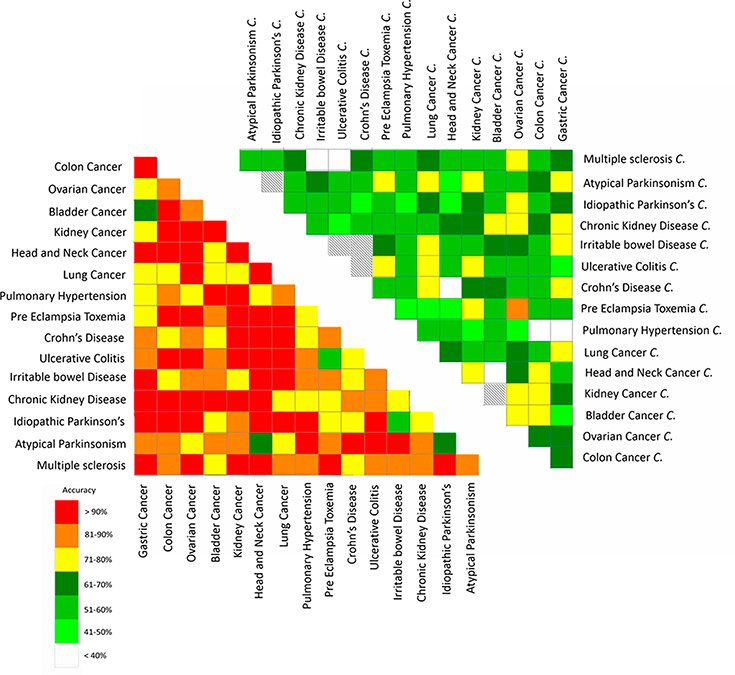
Technion professor Hossam Haick has developed a nanosystem that can identify the breath signatures of many diseases, including kidney failure, lung cancer, Crohn’s disease, MS, prostate and ovarian cancer.  Each compound’s relative abundance in a person’s breath is assessed, and disease signatures are compared against healthy individuals.

In a recent study, using mass spectrometry analysis, specific compound signatures for 17 different diseases were identified. The breath of 1,400 people was sampled, using a sensory array of carbon nanotubes and gold particles to register the compound mix they exhaled. Algorithms determined the presence or absence of each disease.

Haick’s goal is for the system to be used to screen widely for disease, even among those with no symptoms, to allow earlier interventions.

ApplySci’s 6th  Digital Health + NeuroTech Silicon Valley  –  February 7-8 2017 @ Stanford   |   Featuring:   Vinod Khosla – Tom Insel – Zhenan Bao – Phillip Alvelda – Nathan Intrator – John Rogers – Roozbeh Ghaffari –Tarun Wadhwa – Eythor Bender – Unity Stoakes – Mounir Zok – Sky Christopherson – Marcus Weldon – Krishna Shenoy – Karl Deisseroth – Shahin Farshchi – Casper de Clercq – Mary Lou Jepsen – Vivek Wadhwa – Dirk Schapeler – Miguel Nicolelis
Categories
Nanotubes

Implanted nanotube sensor diagnostics

MIT researchers are developing tiny devices made from polymer wrapped carbon nanotubes that detect insulin, nitric oxide and  fibrinogen —  simplifying and automating diagnostic tests.

Past efforts to develop implantable sensors have failed, due to the body’s inclination to protect itself and recycle biological material. Devices can become wrapped in scar tissue, or their components can be broken down.  The team believes that the nanotube sensors can be effective for the long term.

MIT’s Michael Strano builds sensors by coating carbon nanotubes with various polymers of different configurations. They are screened against libraries of molecules that the researchers want to detect. The method works because of the  nanotubes’ natural ability to fluoresce: when light hits a sensor, the nanotube dims or brightens depending on whether it is bound to a molecule of interest.

Categories
Eyes Nanotubes

Carbon nanotube artificial retina restores light sensitivity

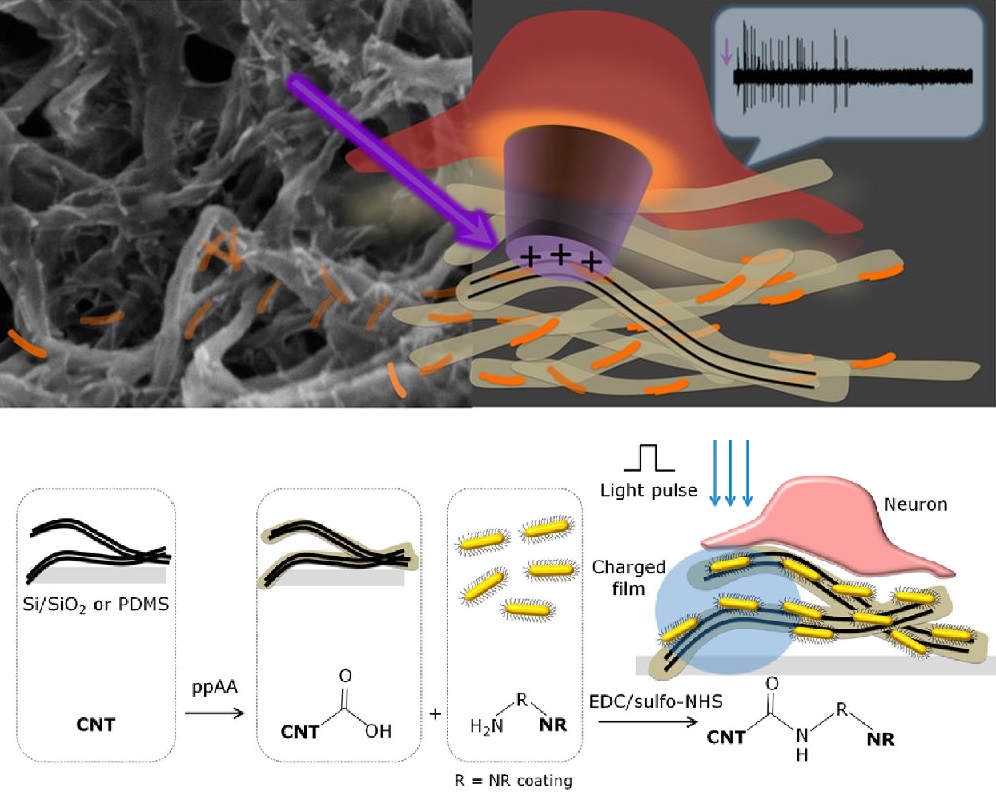
Tel Aviv University, The Hebrew University of Jerusalem and Newcastle University researchers are developing an artificial retina that sends sensory signals to the brain to address vision loss.  Several groups are attempting this, but have had issues with metallic parts, cumbersome wiring, or a low resolution outcome.

The TAU, HUJI and Newcastle team is working on a more efficient, higher resolution device. Semiconductor nanorods and carbon nanotubes were combined to create a wireless, light-sensitive, flexible film that could potentially act in the place of a damaged retina. When tested with a chick retina that normally doesn’t respond to light, the film absorbed light and sparked neuronal activity.

Categories
Diabetes Monitoring Nanotubes Sensors

Implanted nanotube sensor monitors health for up to one year

http://web.mit.edu/newsoffice/2013/new-implantable-sensor-1103.html

MIT scientists are developing injectable and embeddable carbon nanotube sensors that can monitor blood sugar levels, inflammation, and other health issues.  The continuous monitor can stay in a person’s body for up to a year.

Researcher Nicole Iverson wrapped carbon nanotubes in DNA sensitive to nitric oxide and made two types of sensors.  One is injectable for short-term monitoring of problems such as a reaction during surgery.  The other is implanted for long-term monitoring of cancer, diabetes or immune reactions to artificial joints.

The next step will be to link the nanotube sensor to a medical device, such as an insulin pump. The sensor would be implanted under a person’s skin, detecting blood glucose levels. The nanotubes would fluoresce when exposed to certain levels of glucose, and the light could signal the pump to start working and release insulin.