

Categories
Brain Eyes

Brain processes images viewed for 13 milliseconds

http://web.mit.edu/newsoffice/2014/in-the-blink-of-an-eye-0116.html

MIT professor Mary Potter has published a study showing that the human brain is capable of processing images viewed through the eyes for 13 milliseconds. This is significantly faster than the 100 milliseconds reported in earlier research.

The study offers evidence that “feedforward processing” — the flow of information in only one direction, from retina through visual processing centers in the brain — is enough for the brain to identify concepts without having to do any further feedback processing.  It also suggests that while the images are seen for only 13 milliseconds before the next image appears, part of the brain continues to process those images for longer than that.

The researchers are now investigating how long visual information presented so briefly can be held in the brain. They are also scanning subjects’ brains with a magnetoencephalography (MEG) scanner during the task to see what brain regions are active when a person successfully completes the identification task.

Categories
Eyes Sensors Wearables

Smart contact lens with potential to monitor intraocular pressure

http://www.nature.com/ncomms/2014/140107/ncomms3982/full/ncomms3982.html

Swiss Federal Institute of Technology scientists have developed a light, flexible, ultra-thin membrane with the potential to detect intraocular pressure in glaucoma.  Researchers claim that the technology “could offer significant advantages over existing solutions in terms of thickness, lightness, and transparency and, hence, comfort for the patient.”

The device consists of layered polymer films, one of which is a semiconductor. Gauge sensors monitor intraocular pressure in response to strain, which detects the high eye pressure typical of glaucoma.  In trials, the scientists transferred the material onto plastic contact lenses on an artificial eye.

The researchers must overcome technical obstacles before their solution is commercially viable. The method of attaching electronics to the contact lens must be optimized to include effects of the aqueous ocular environment.  Additionally, in the lab, the required energy is provided from an external source.  A different solution would be needed for a unit attached to a human eye.

Categories
Eyes

Inkjet printed eye cells

http://iopscience.iop.org/1758-5090/6/1/015001/article

Cambridge professors Keith Martin and Barbara Lorber have used inkjet printing technology to print cells taken from the eye. This could lead to the production of artificial tissue grafts made from the variety of cells found in the human retina and may aid in the search to cure blindness.

The researchers used a piezoelectric inkjet printer device that ejected the cells through a sub-millimetre diameter nozzle when a specific electrical pulse was applied. They also used high speed video technology to record the printing process with high resolution and optimised their procedures accordingly. Once printed, a number of tests were performed on each type of cell to see how many of the cells survived the process and how it affected their ability to survive and grow. The cells derived from the retina of the rats were retinal ganglion cells, which transmit information from the eye to certain parts of the brain, and glial cells, which provide support and protection for neurons.  The results are preliminary.

Categories
Assistive Technologies Eyes Heart Stroke Wearables

NIH funds robots for the vision impaired, stroke patients, doctors performing catheter ablation

http://www.nih.gov/news/health/oct2013/nibib-23.htm

Three projects have been awarded funding by the National Institutes of Health.  All involve robots that cooperate with people and adapt to changing environments to improve human capabilities and enhance medical procedures.

  • A co-robotic navigation device for the blind: Cang Ye at University of Arkansas is incorporating 3D imaging sensor technology into the white cane. This enables it to detect and relay to the user critical information about the environment, like when there’s a potential obstacle in the way.  In related research, Professor Amnon Shashua at The Hebrew University in Jerusalem, through his company OrCam, uses Artificial Vision to compensate for lost visual abilities, and Professor Amir Amedi at the Hebrew University of Jerusalem is also developing cutting edge technology to help the vision impaired. His projects include reading in the blind, sensory substitution devices, multisensory perception, topographic brain, and seeing with music and sound.
  • MRI-guided co-robotic catheter: During traditional catheter ablation for the treatment of atrial fibrillation, one of the most common arrhythmias, a catheter with an electrode on its tip is threaded through a vein in a patient’s groin up to the heart. Doctors destroy tissue at certain points on the heart in order to prevent the occurrence of irregular heart activity. The constant movement of the heart and blood can make that process difficult. Researchers at Case Western Reserve University are developing a catheter that uses robotic planning strategies to compensate for those movements to increase accuracy of procedures in conjunction with MRI.
  • Platform for exploration of robotic ankle exoskeleton control: Researchers at North Carolina State and Carnegie Mellon are developing a method to compare different wearable devices to assist people recovering from stroke.
Categories
Apps Assistive Technologies Eyes

Smartphones and tablets assist the visually impaired

http://bits.blogs.nytimes.com/2013/09/29/disruptions-guided-by-touch-screens-blind-turn-to-smartphones-for-sight/?partner=socialflow&smid=tw-nytimesbusiness&_r=0
The New York Times Bits blog reports that “advocates for the blind say that smartphones and tablets could be the biggest assistive aid to come along since Braille was invented in the 1820s.”  Writer Nick Bilton explores some of the many ways–from voice commands to gesture readers–that mobile devices are helping the visually impaired.

Categories
Eyes Wearables

Transparent artificial muscle plays music, demonstrating capabilities of ionic conductors

http://www.sciencemag.org/content/341/6149/984.full

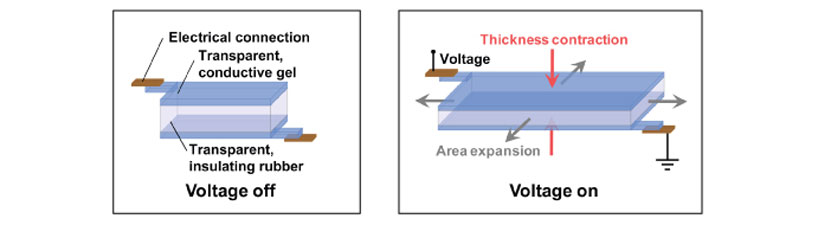
Harvard researchers have demonstrated that electrical charges carried by ions, rather than electrons, can be put to meaningful use in fast-moving, high-voltage devices.

These ionic conductors can be stretched to many times their normal area without an increase in resistivity—a problem common in stretchable electronic devices. They can be transparent, making them well suited for optical applications. The gels used as electrolytes are biocompatible, therefore easy to incorporate ionic devices—such as artificial muscles or skin—into biological systems.

Signals carried by charged ions are the electricity of the human body, allowing neurons to share knowledge and spurring the heart to beat. It is the goal of bioengineers to mesh artificial organs and limbs with that system.  Harvard is trying to commercialize the technology for use in tablets, smartphones, wearable electronics, consumer audio devices, and adaptive optics.

Categories
Data Eyes mHealth Monitoring Wearables

Contact lens continuously monitors intra-ocular pressure

http://www.sensimed.ch/en/products/sensimed-triggerfishr.html

The Sensimed Triggerfish combines a non-invasive wireless soft contact lens sensor with an automated system for recording IOP related patterns for up to 24 hours. The ambulatory patient wears the device during normal activity, including sleeping.  At the end of the session, the data is transferred from the recorder to an ophthalmologist’s computer for analysis of the circadian IOP-related pattern.

Categories
Assistive Technologies Computer Vision Eyes

Tiny wearable computer uses audio feedback to assist the vision impaired

http://www.orcam.com

OrCam, led by Hebrew University Professor Amnon Shashua, one the most exciting computer vision entrepreneurs in Israel, has developed a device that uses audio feedback to relay visual information to visually impaired people.   The tiny wearable computer works with a 5-mega pixel camera attached to glasses.   A computer vision algorithm enables it to read text, and it can be taught to recognize faces and objects with the help of the user.

Categories
Brain Eyes

Device uses sounds to build mental images

http://www.frontiersin.org/Cognitive_Science/10.3389/fpsyg.2013.00330/full
University of Bath scientists have developed the vOICe sensory substitution device to help blind people use sounds to build a mental image of things around them.

Blindfolded study participants captured an accurate mental image of an object in front of them when a wearable camera and the vOICe device converted its visual image into a cluster of natural sounds delivered to the participant via headphones.  The experiment suggested that even without eyesight, humans may still able to experience a visual sensation.

Categories
Eyes

LCD display, embedded in contact lenses — Google Glass functionality with out headgear?

http://www.ugent.be/en/news/bulletin/augmented-reality-contact-lens

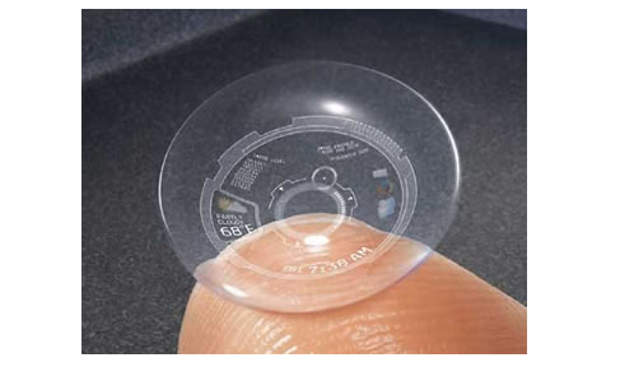
Professor Jelle De Smet of Ghent University has developed a spherical, curved LCD display which can be embedded in contact lenses and handle projected images using wireless technology.  This is the first step towards “fully pixelated contact lens displays” with the same detail as a television screen.  The technology could lead to a superimposed image projected onto the user’s normal view, similar to Google Glass but without the headgear.  The lenses could also be used for medical purposes, including controlling light transmission toward the eye’s retina when an iris is damaged, or to display directions or texts from a smartphone.

Categories
Apps Eyes mHealth

Smartphone diagnostic and cloud platform make eye care accessible

http://eyenetra.com/netra-g.html

Vinod Khosla and others have invested in MIT Media Lab’s EyeNetra, a smartphone attachment that claims to diagnose nearsightedness, farsightedness and astigmatism.  The device is positioned as a less bulky alternative to the Shack-Hartmann Wavefront sensor.  A $2 eyepiece is clipped onto a phone.  The user then clicks to align the displayed patterns.  The number of clicks required to bring the patterns into alignment indicates the refractive error.  Patients connect to corrective lens providers through a cloud based system.  The technology provides access to eye exams in the developing world.

Categories
Autism Brain Eyes Machine Learning Parkinson's

Eye tracking data helps diagnose autism, ADHD, Parkinson’s

http://www.scientificamerican.com/article.cfm?id=eye-tracking-software-may-reveal-autism-and-other-brain-disorders

USC’s Laurent Itti and researchers from Queen’s University in Ontario have created a data heavy, low cost method of identifying brain disorders through eye tracking.  Subjects watch a video for 15 minutes while their eye movements are recorded. An enormous amount of data is generated as the average person makes three to five saccadic eye movements per second.  Itti’s team uses advanced machine learning algorithms to enable a computer to recognize patterns without explicit human instruction.

The proof of concept study found that the algorithm could classify mental disorders through eye movement patterns.  Parkinson’s patients were identified with nearly 90 percent accuracy.  Children with ADHD or fetal alcohol spectrum disorder were identified with 77 percent accuracy.  “This is very different from what people have done before. We’re trying to have completely automated interpretation of the eye movement data,” said Itti.