Categories
3-D Printing Covid-19 Sensors

Sensors 3D printed directly on lungs, heart could be used with surgical robots to diagnose, monitor disease

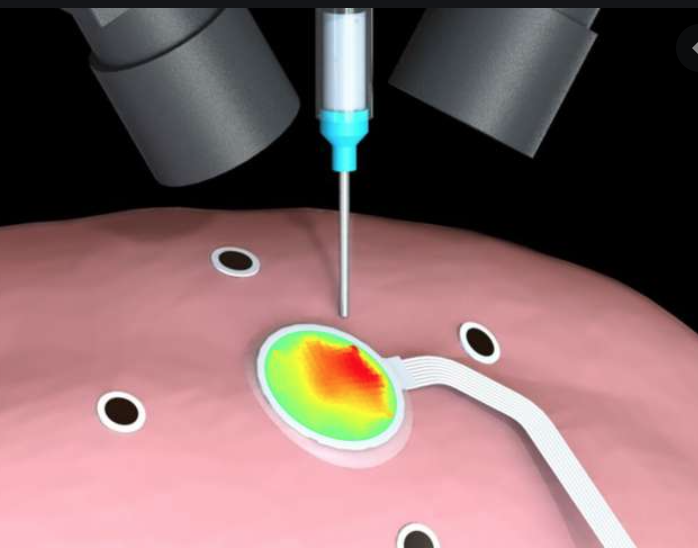
Michael McAlpine and University of Minnesota colleagues used 3D printing and motion capture technology to print electronic sensors directly on organs that are expanding and contracting, such as the heart and lungs. This could be used to diagnose and monitor the lungs of patients with COVID-19.

This builds on the team’s technique which enabled the printing of electronics directly on the skin of a hand that moved left to right or rotated.

They used a balloon-like surface and a specialized 3D printer, with motion capture tracking markers to help the 3D printer adapt its printing path to the expansion and contraction movements on the surface. An animal lung in the lab was artificially inflated and a soft hydrogel-based sensor was printed directly on the surface.

According to McAlpine, “the broader idea behind this research, is that this is a big step forward to the goal of combining 3D printing technology with surgical robots. In the future, 3D printing will not be just about printing but instead be part of a larger autonomous robotic system. This could be important for diseases like COVID-19 where health care providers are at risk when treating patients.”
Categories
3-D Printing Respiratory

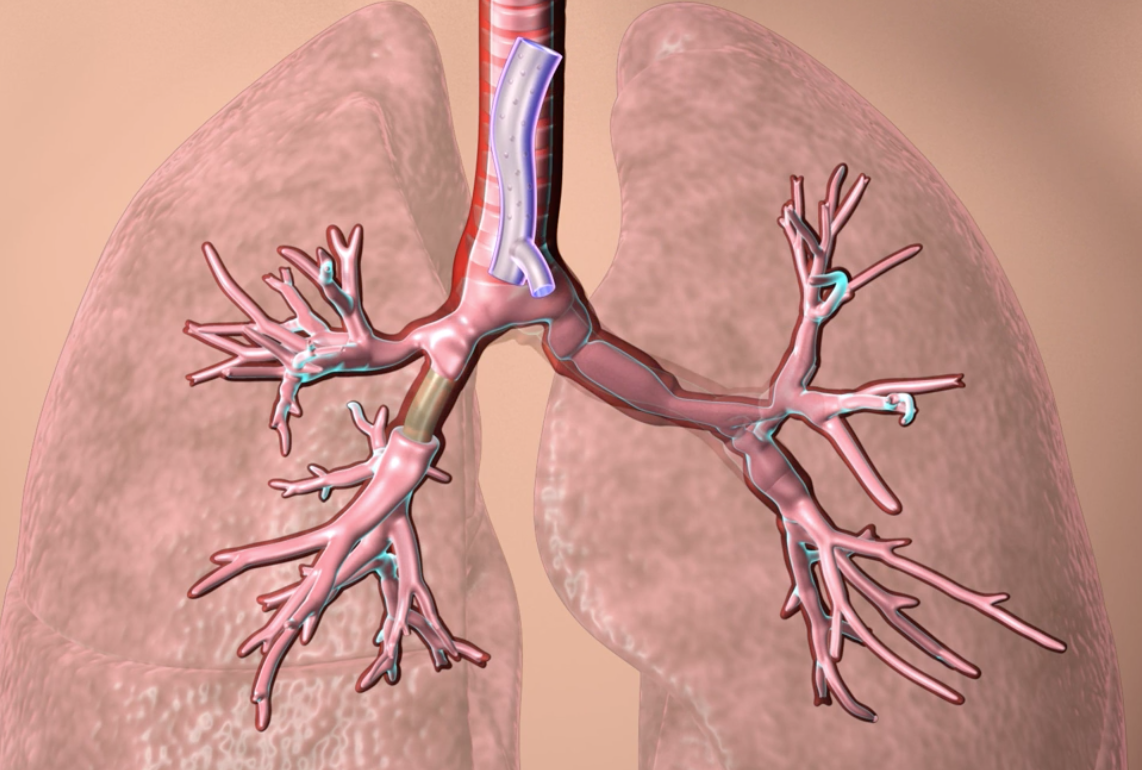
3D printed, custom fitted airway stents

Cleveland Clinic physician Tom Gildea used CT scans and visualization software to develop 3D printed silicone stents used to open the airways of patients with tumors, inflammation, trauma or other masses. The technology has now been approved by the FDA.

Standard airway stents come in a limited number of sizes and shapes and are generally designed for larger airways. As every patient’s anatomy is different, it difficult to get a perfect fit, especially for those with complex conditions. Poorly fitted stents can become distorted, and cause the growth of new tissue, mucus impaction and tissue death.

In studies, the 3D printed stents lasted about a year before needing to be changed, versus 90 days for stock stents. Procedure times were shorter and patient-reported symptoms improved, leading to a reduction in changes and modifications.

It’s estimated that 30,000 airway stents will be implanted in the U.S. in 2020

Join ApplySci at the 13th Wearable Tech + Digital Health + Neurotech Silicon Valley conference on February 11-12, 2020 at Quadrus Sand Hill Road.  Speakers include:  Zhenan Bao, Stanford – Vinod Khosla, Khosla Ventures – Mark Chevillet, Facebook – Shahin Farshchi, Lux Capital – Carla Pugh, Stanford – Nathan Intrator, Tel Aviv University | Neurosteer – Wei Gao, Caltech – Sergiu Pasca, Stanford – Walter Greenleaf, Stanford – Sheng Xu, UC San Diego – Dror Ben-Zeev, University of Washington – Mikael Eliasson, Roche  – Unity Stoakes, StartUp Health – Garth Smith, Ontario Brain Institute – Erika Ross, Abbott Neuromodulation

Categories
3-D Printing

3D printed bioreactor-grown bone for craniofacial surgery

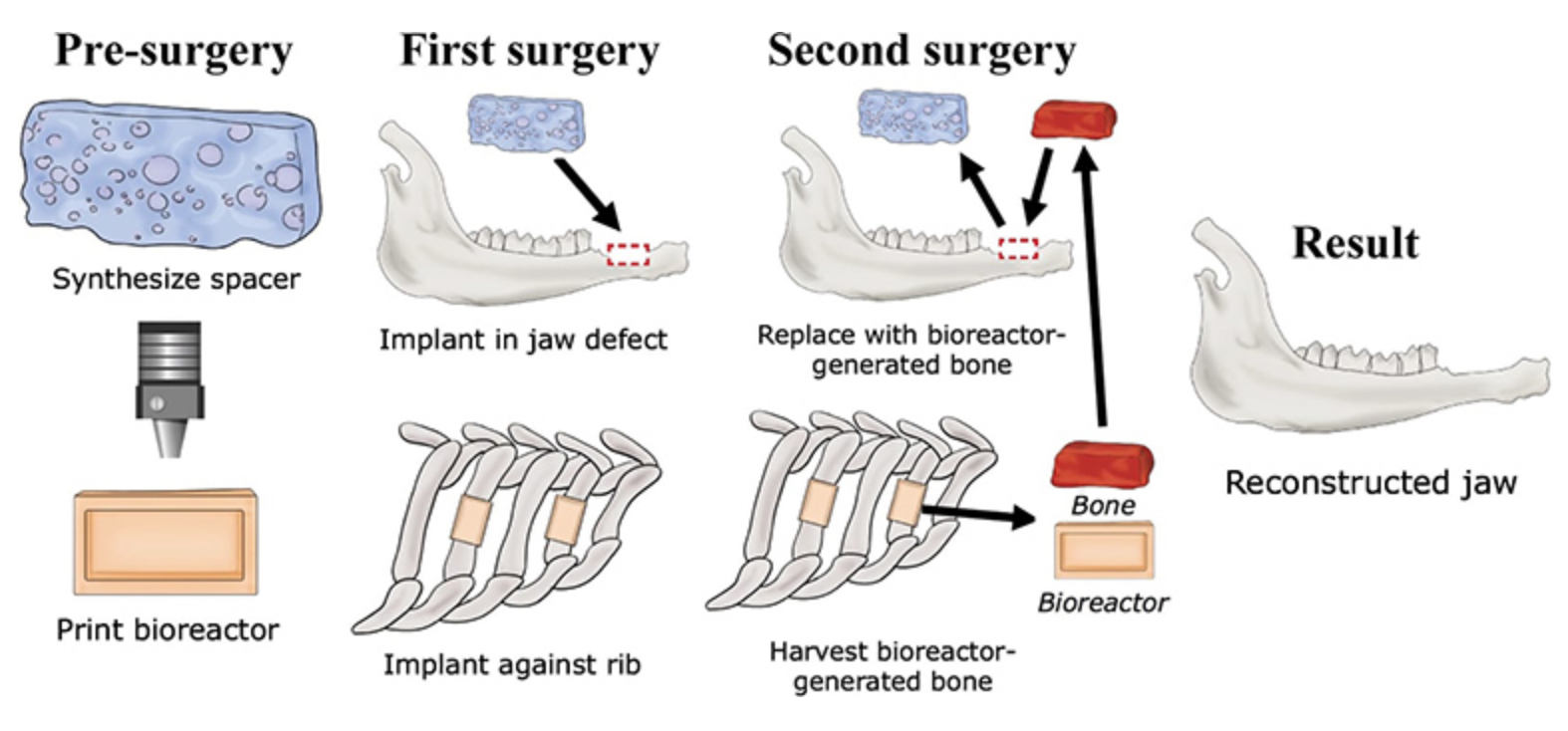
Antonios MikosAlexander Tatara, and Rice colleagues are using a 3D printed mold, attached to a rib, to grow live bones to repair craniofacial injuries. Stem cells and blood vessels from the rib infiltrate scaffold material and replace it with natural, custom-fit bone.

Current reconstruction methods use a patient’s own bone graft tissues, harvested from the lower leg, hip and shoulder.

According to Mikos: “We chose to use ribs because they’re easily accessed and a rich source of stem cells and vessels, which infiltrate the scaffold and grow into new bone tissue that matches the patient.”  New bone can potentially be grown on multiple ribs, simultaneously.

The technology has only been tested on animals, but shows promise, with custom geometry and a reduced risk of rejection.

Categories
Sensors

Miniature, lab-engineered “organs” create “body on a chip”

http://www.bbc.co.uk/news/technology-24125678

The US Department of Defense and Wake Forest University are developing miniature human organs with 3D printers to enable better drug testing.

The 2-inch “body on a chip” would be a testing ground for understanding how the human body might react to dangerous diseases, chemical warfare agents and new drugs intended to defend against biological or chemical attacks. This could speed drug development by replacing less ideal animal testing or testing done on human cells in petri dishes — and save time and money on drug candidates that fail in human clinical trials.

Tony Atala, director of the Wake Forest Institute for Regenerative Medicine, has pioneered 3D printing methods that aim to build human organs with layer upon layer of cells. Their bioprinting methods lay down the cell layers along with artificial scaffolding to keep an organ’s structure intact as it takes shape — a technique that has allowed the group to make tiny, less complex versions of full-size human organs.

The tiny organs intended for the “body on a chip” project don’t represent fully functional hearts, livers and kidneys. Instead, they represent small chunks of human tissue from such organs connected together by a system of fluid channels that circulate blood substitute to keep the cells alive — all placed on a 2-inch chip with sensors to monitor everything.

Having an artificial circulatory system means researchers can introduce biological or chemical agents into the “blood” to see how it affects the different organs. The system’s sensors would measure the temperature, oxygen levels, pH and other factors affecting the “body on a chip.”

Categories
Assistive Technologies

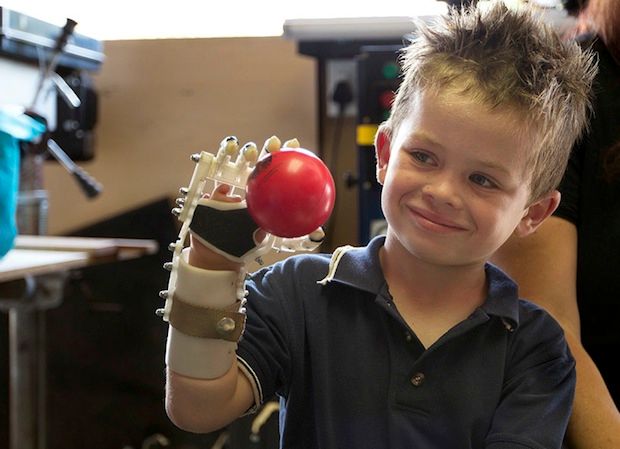
Crowdfunded, 3D printed “Robohands” provide dexterity to children with out fingers

http://www.npr.org/blogs/health/2013/06/18/191279201/3-d-printer-brings-dexterity-to-children-with-no-fingers

A Robohand is a customized, fitted set of mechanical fingers that open and close to grasp things based on the motion of the wrist.  When the wrist folds and contracts, the cables attaching the fingers to the base structure cause the fingers to curl.  Nearly all the parts of a Robohand are 3D printed on MakerBot Replicator 2 Desktop 3D printers.