Categories
Sensors

Joe Wang on next-generation biosensors

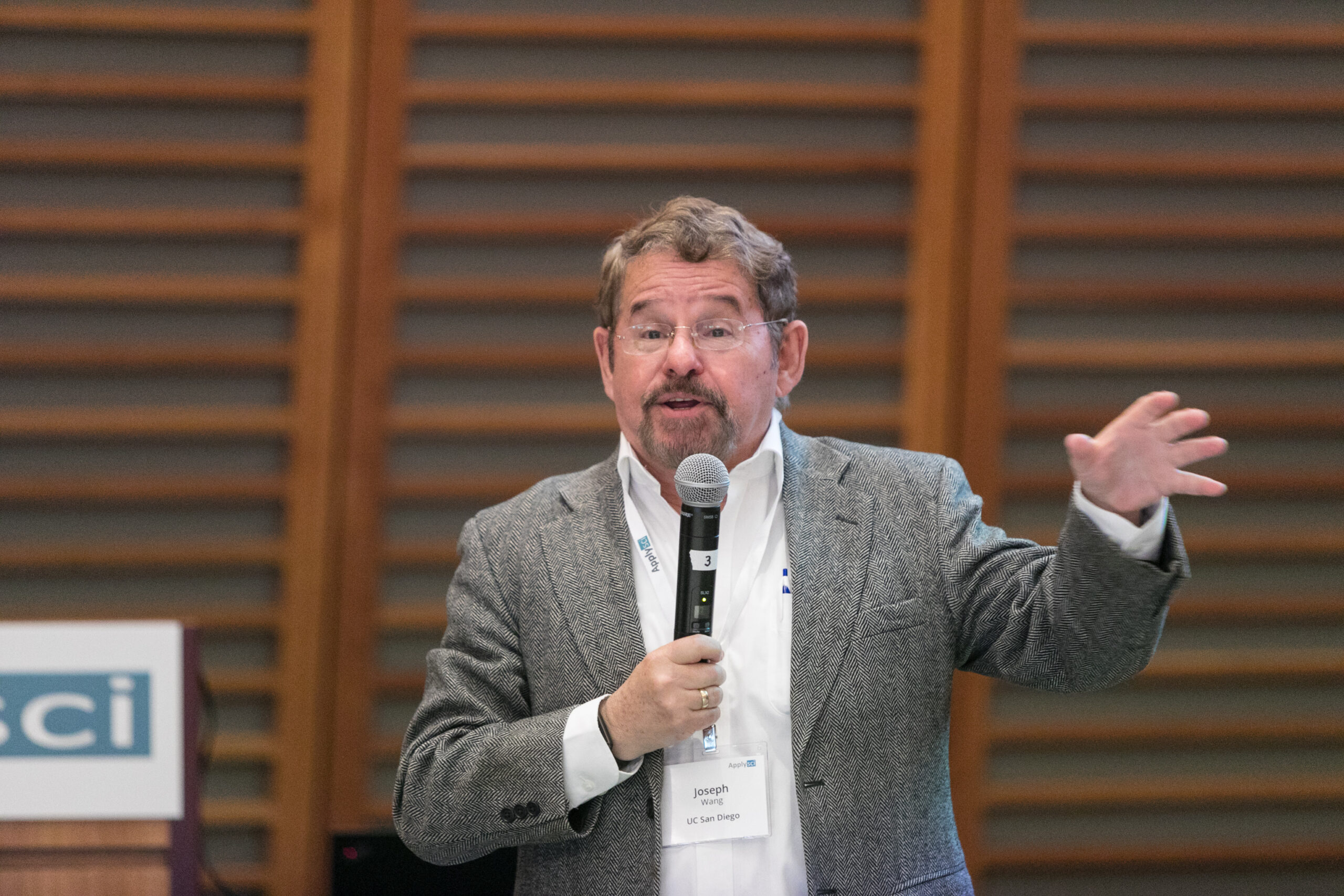
Joseph Wang is the SAIC Endowed Chair professor, Chairman of the NanoEngineering Department and Director of the Center for Wearable Sensors at University of California, San Diego, and Editor-in-chief of the journal Electroanalysis.

A prolific researcher with more than 1,200 papers and 100,000 citations, he recently developed an ultrasound patch to monitor blood pressure; self-propelled and targeted drug delivery; and continuous Levadopa monitoring for Parkinson’s management; amongst other full body, unobtrusive, advanced organic sensors for the next generation of healthcare.

Professor Wang described some of his groundbreaking work at the ApplySci conference at Harvard Medical School on November 14, 2019.

Click to view a video of his talk.


Join ApplySci at the 13th Wearable Tech + Digital Health + Neurotech Silicon Valley conference on February 11-12, 2020 at Quadrus Sand Hill Road.  Speakers include:  Zhenan Bao, Stanford – Vinod Khosla, Khosla Ventures – Mark Chevillet, Facebook – Shahin Farshchi, Lux Capital – Carla Pugh, Stanford – Nathan Intrator, Tel Aviv University | Neurosteer – Wei Gao, Caltech – Sergiu Pasca, Stanford – Walter Greenleaf, Stanford – Sheng Xu, UC San Diego – Dror Ben-Zeev, University of Washington – Mikael Eliasson, Roche  – Unity Stoakes, StartUp Health – Garth Smith and a delegation of startups from the Ontario Brain Institute
Categories
AI Cancer

AI for (much) earlier breast cancer detection – Constance Lehman

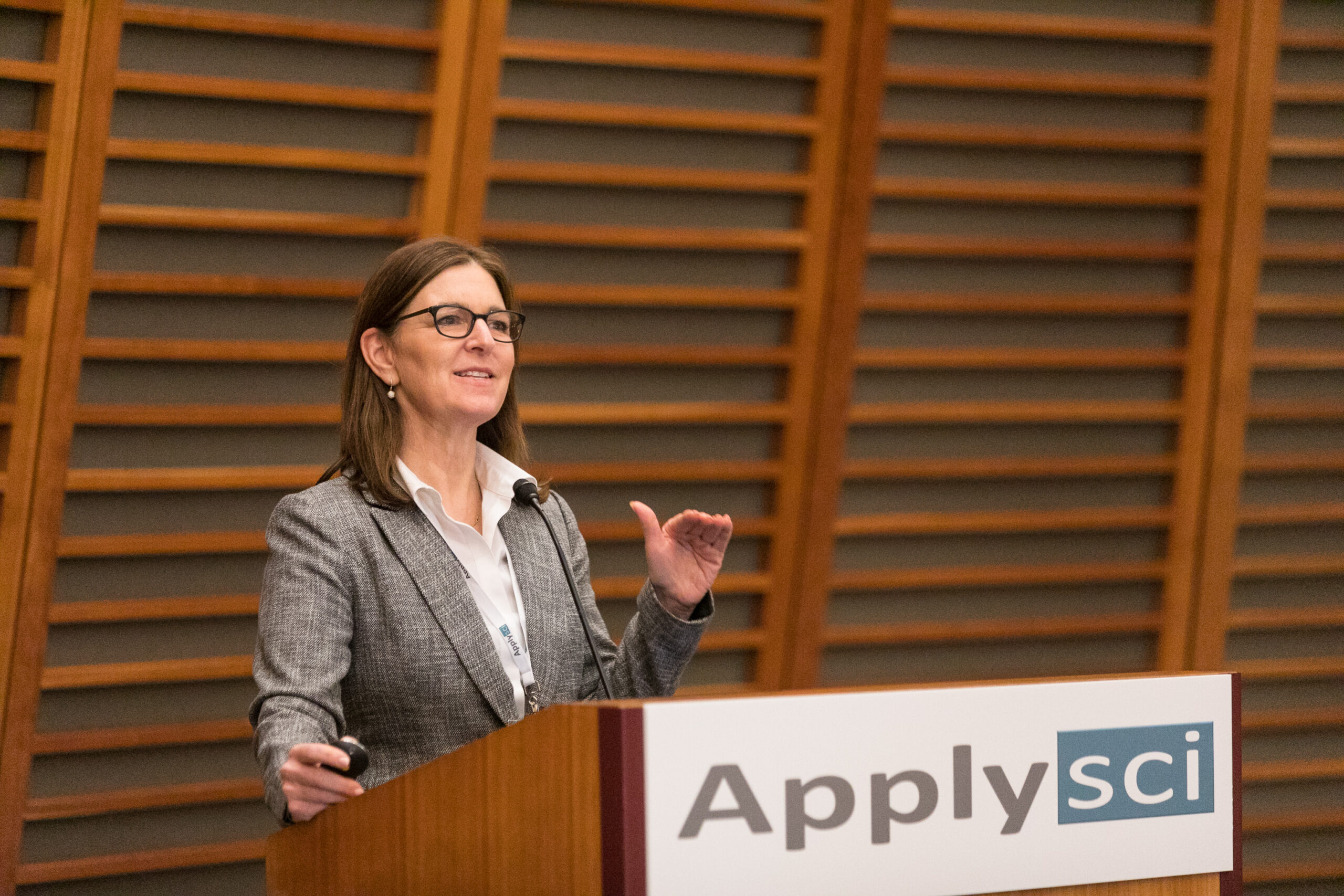
Connie Lehman — Professor, Radiology, Harvard Medical School; Chief of Breast Imaging, radiology, Massachusetts General Hospital; Co-director of AVON Breast Center, Radiology, Massachusetts General Hospital; and Director, Breast Imaging Research Center, Radiology, Massachusetts General Hospital spoke at ApplySci’s recent conference at Harvard Medical School.

Click to listen to her talk on using AI to discover breast cancer 5 years earlier than currently possible.


Join ApplySci at the 13th Wearable Tech + Digital Health + Neurotech Silicon Valley conference on February 11-12, 2020 at Quadrus Sand Hill Road.  Speakers include:  Zhenan Bao, Stanford – Vinod Khosla, Khosla Ventures – Mark Chevillet, Facebook – Shahin Farshchi, Lux Capital – Carla Pugh, Stanford – Nathan Intrator, Tel Aviv University | Neurosteer – Wei Gao, Caltech – Sergiu Pasca, Stanford – Walter Greenleaf, Stanford – Sheng Xu, UC San Diego – Dror Ben-Zeev, University of Washington – Mikael Eliasson, Roche  – Unity Stoakes, StartUp Health

Categories
3-D Printing Featured Sensors

3D-printed, remote-controlled lab on chip for quicker, more accurate monitoring

Imperial College’s Martyn  Boutelle has developed a 3D printed, remote-controlled Lab on a Chip for real-time monitoring with improved personal care.

Previous ‘Lab on a Chip’ devices have required large external support systems. Sensor deterioration over time inhibited their clinical effectiveness.

The device can monitor chemical fluctuations, giving quicker and more accurate results, and potentially gather data that was previously not possible.

Boutelle said that the “research has shown that these sensors are capable of successfully monitoring patients who are in incredibly unstable conditions and provide their healthcare team with reliable information as soon as they need it, as well as a means of alerting them when critical clinical changes occur.”

The brain requires a continuous supply of glucose to function, but too much of it can be detrimental. Declining pyruvate levels could indicate a lack of oxygen  to the brain.  Providing earlier access to this data can save lives, and has not been possible before.


Join ApplySci at the 13th Wearable Tech + Digital Health + Neurotech Silicon Valley conference on February 11-12, 2020 at Quadrus Sand Hill Road.  Speakers include:  Zhenan Bao, Stanford – Vinod Khosla, Khosla Ventures – Mark Chevillet, Facebook – Shahin Farshchi, Lux Capital – Carla Pugh, Stanford – Nathan Intrator, Tel Aviv University | Neurosteer – Wei Gao, Caltech – Sergiu Pasca, Stanford – Walter Greenleaf, Stanford – Sheng Xu, UC San Diego – Dror Ben-Zeev, University of Washington – Mikael Eliasson, Roche  – Unity Stoakes, StartUp Health

Categories
Featured Sensors

Stretchable, degradable semiconductors for health monitoring

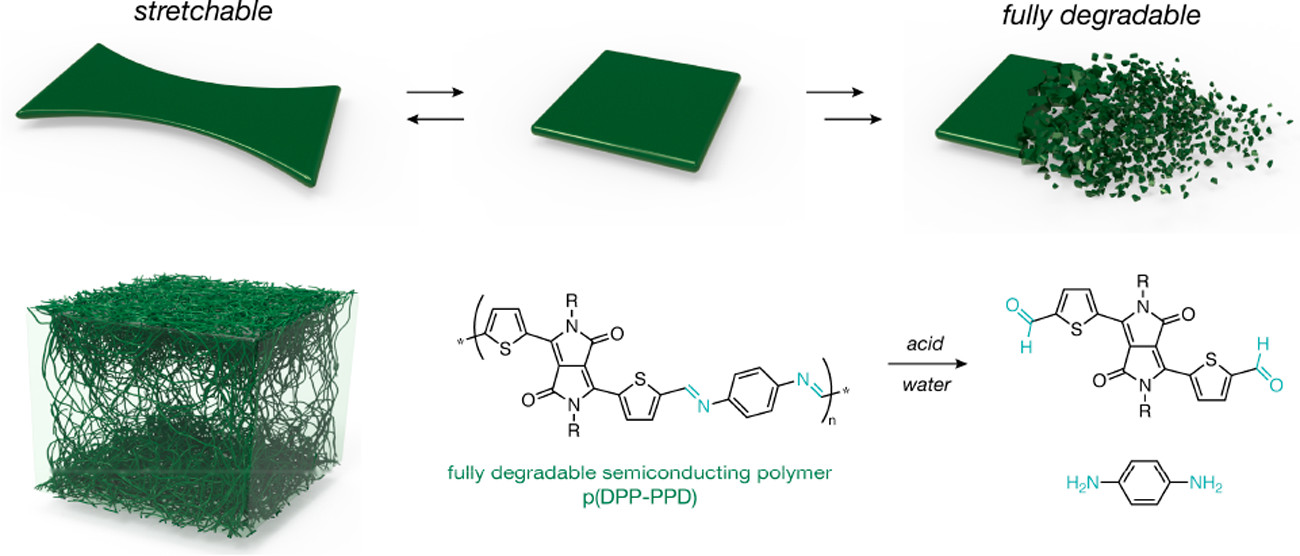
Zhenan Bao has developed stretchable, degradable semiconductors, with the ability to conform to internal organ surfaces, and dissolve and disappear when no longer needed.

This is the first example of a material that simultaneously possesses the three qualities of semiconductivity, intrinsic stretchability and full degradability. Other attempts resulted in semiconductors that either did not break down completely, or had reduced electrical performance when stretched.

Zhenan Bao has solved this problem – by combining a rubbery organic polymer with a semiconducting one.

Her team synthesized and mixed the two degradable polymers, which self-assembled into semiconducting nanofibers embedded in an elastic matrix. Thin films made of these fibers could be stretched to twice their normal length without cracking or compromising electrical performance. When placed in a weak acid, the new material degraded completely within 10 days.   (Bao said that it would take much longer in the human body.) The semiconductor was  non-toxic to human cells growing on the material in a petri dish.


Zhenan Bao will discuss this technology, and more of her latest work, at Wearable Tech + Digital Health + Neurotech Silicon Valley on Feb 11-12
Categories
Babies Diabetes Sensors

Pacifier sensor detects glucose levels in babies

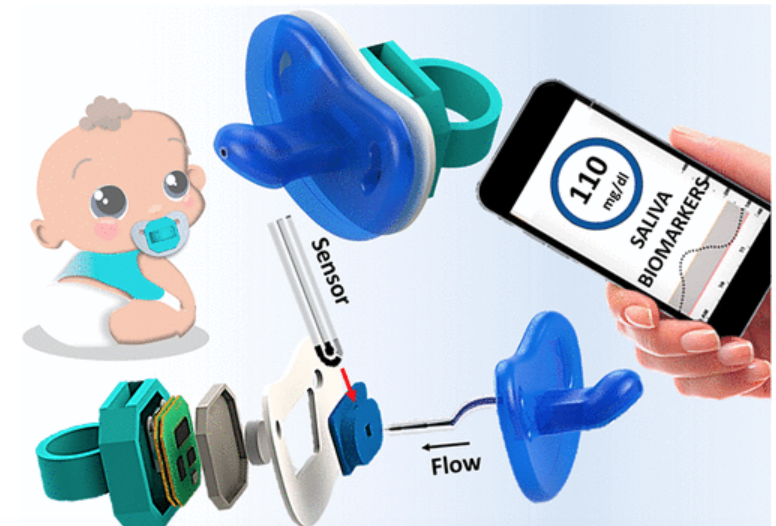
UCSD’s Joe Wang has developed a soft, flexible, pacifier-based biosensor that continuously monitors glucose levels in saliva to detect diabetes in babies. Until now,  continuous glucose monitoring in newborns,  available only in major hospitals, requires piercing the infant’s skin to reach interstitial fluid.

The team created a proof of concept pacifier where small amounts of saliva were transferred through a narrow channel to a detection chamber.  An enzyme attached to an electrode strip converted glucose in the fluid to a weak electrical signal, which could be detected wirelessly by an app. The strength of the current correlated with the amount of glucose in saliva samples.

The preliminary analysis was conducted on adults with type 1 diabetes.  The pacifier detected changes in glucose concentrations in  saliva before and after a meal.

The device could also be configured to monitor other disease biomarkers.


Joe Wang will be a keynote speaker at ApplySci’s 12th Wearable Tech + Digital Health + Neurotech Boston conference on November 14, 2019 at Harvard Medical School.  

Other speakers include:  Brad Ringeisen, DARPA  – Carlos Pena, FDA  – George Church, Harvard – Diane Chan, MIT – Giovanni Traverso, Harvard | Brigham & Womens – Anupam Goel, UnitedHealthcare  – Nathan Intrator, Tel Aviv University | Neurosteer – Arto Nurmikko, Brown – Constance Lehman, Harvard | MGH – Mikael Eliasson, Roche – Nicola Neretti, Brown – R. Jacob  Vogelstein, Camden Partners – Yael Mandelblat-Cerf, Biogen


Categories
Conference

Wearable Tech + Digital Health + Neurotech Boston

Join ApplySci at the 12th Wearable Tech + Digital Health + Neurotech Boston conference on November 14, 2019 at Harvard Medical School featuring talks by Brad Ringeisen, DARPA – Joe Wang, UCSD – Carlos Pena, FDA  – George Church, Harvard – Diane Chan, MIT – Giovanni Traverso, Harvard | Brigham & Womens – Anupam Goel, UnitedHealthcare  – Nathan Intrator, Tel Aviv University | Neurosteer – Arto Nurmikko, Brown – Constance Lehman, Harvard | MGH – Mikael Eliasson, Roche – Nicola Neretti, Brown – R. Jacob  Vogelstein, Camden Partners – Yael Mandelblat-Cerf, Biogen