
Categories
Assistive Technologies BCI Brain Conference Seniors Wearables

Data glasses controlled by eye movement — an alternative to brain machine interface

http://www.domain-b.com/technology/20130912_movements.html

Researchers at the Fraunhofer Institute have developed bidirectional OLED microdisplay eye-controlled data glasses.  Users can view the real world while browsing a large amount of virtual information and turn pages with their eyes.

Integrated camera sensors register the direction of the wearer’s eye movements and an image processing program calculates the exact position of their pupils in real time.  An infrared light source in the glass frame produces accurate positioning results even in low light.

The glasses can enable elderly and disabled people to attract attention in emergencies using nothing but their eyes – or simply provide a way to change the TV channel using specific eye movements.
Categories
Brain Seniors

Video game improves cognition in seniors

http://www.ucsf.edu/news/2013/09/108616/training-older-brain-3-d-video-game-enhances-cognitive-control

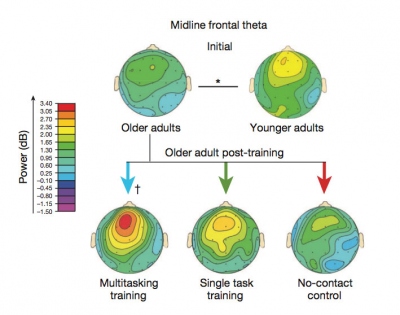
UCSF researchers found that older adults improved cognitive controls, including multitasking and the ability to sustain attention, by playing a specially designed videogame — and that the effects can be long lasting.

In the game, participants race a car around a winding track while a variety of road signs pop up. Drivers are instructed to keep an eye out for a specific type of sign, while ignoring all the rest, and to press a button whenever that particular sign appears.  The need to switch rapidly from driving to responding to the signs – i.e. multitasking – generates interference in the brain that undermines performance. The researchers found that this interference increases dramatically across the adult lifespan.

The study found that after training, the older adults were able to perform at a higher level than untrained 20-year-olds and that the positive effects lasted for at least six months.

Scientists continue to explore the connection between videogames and the brain’s information-processing functions, such as memory, attention, decision-making and creativity.

Categories
AI Apps Assistive Technologies Brain mHealth Monitoring Seniors Sensors

Personalized robot companion for seniors

http://cordis.europa.eu/fetch?CALLER=OFFR_TM_EN&ACTION=D&RCN=11525

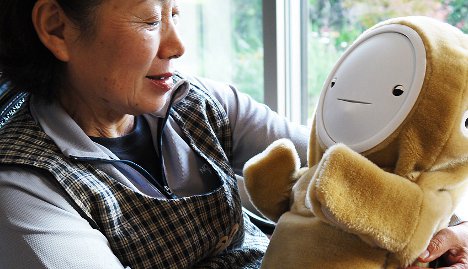
A European consortium of research institutes, universities and technology companies has developed a highly customizable robot companion to help seniors to maintain their quality of life, stay healthy and avoid social exclusion.

The robot, a mobile wheeled semi-humanoid figure equipped with cameras, sensors, audio, and a touch screen interface, can remind users to take their medicine, suggest they have their favorite drink, or prompt them to go for a walk or visit friends if they haven’t been out for a while. As part of a larger smart-home environment that can include smart clothing to monitor vital signs, the system can monitor user’s health and safety, and alert emergency services if necessary.

Categories
Monitoring Seniors Sensors

Sensor based fall detector for seniors

http://www.theengineer.co.uk/medical-and-healthcare/news/fall-sensor-for-elderly-receives-2m-to-improve-technology/1016542.article

Vigi’Fall detects falls using multidimensional contextual analysis.  It is a miniature accelerometric box attached to the chest with an adhesive patch.  Motion sensors are placed in several rooms of the home and doubt-removal software is placed in a home box.  The system is linked to a remote call center which contacts rescue teams in the event of a fall.  The next phase of the product will incorporate heartbeat monitoring.

Categories
Brain Seniors Stroke

Hyperbaric oxygen treatment for brain injuries

http://www.assafh.org/sites/en/Pages/brain-injuries.aspx
Tel Aviv University and Assaf Harofeh Medical Center researchers are treating stroke patients with hyperbaric oxygen therapy (HBOT), high-pressure chambers where oxygen-rich air increases oxygen levels in the body by a factor of ten.  Their goal is to reinvigorate dormant neurons and improve patients’ motor function, memory and other abilities that current therapies do not address.

The researchers are studying the potential benefits of HBOT for traumatic brain injury, and as an anti-aging therapy, applicable to Alzheimer’s and vascular dementia patients.

Categories
Assistive Technologies BCI Seniors Sensors

Eldercare robots perform essential tasks

http://bits.blogs.nytimes.com/2013/05/19/disruptions-helper-robots-are-steered-tentatively-to-elder-care/
Already popular in Japan, today’s New York Times reports on the developing trend of robotic companions for the elderly.

A typical Japanese example is the Tsukuba University created Hybrid Assistive Limb. The battery-powered suit senses and amplifies the wearer’s muscle action when carrying or lifting heavy objects.  Caregivers can also use the suit to aid them while lifting patients from a bed, and patients can wear it to support their movements.  Other Japanese devices include a small, battery-powered trolley to aid independent walking; a portable, self-cleaning bedside toilet; and a monitoring robot which tracks and reports the location of dementia patients.

The Times describes several interesting US developed robots:   Cody, a Georgia Tech created robotic nurse cable of bathing patients;  HERB, a Carnegie Mellon developed butler which retrieves objects and cleans; Hector, a University of Reading robot which provides medication reminders, locates lost objects, and can assist in a fall; and Paro, a baby seal looking robot which calms dementia patients.

Categories
Monitoring Seniors Sensors

Smart bottles measure medication, send reminders

http://www.fastcoexist.com/1681935/a-cell-phone-in-a-pill-bottle-to-text-you-to-remember-your-meds

AdhereTech bottles measure the exact amount of pills or liquid they contain in real-time. The data is sent wirelessly into the cloud, and patients are reminded to take their medication via an automated call or text message.

Categories
Apps mHealth Monitoring Pharmaceuticals Seniors Sensors

Ingestible sensors alert doctors and caregivers when a pill is taken

http://www.forbes.com/sites/nextavenue/2013/04/16/the-newest-high-tech-pill-will-text-when-swallowed/

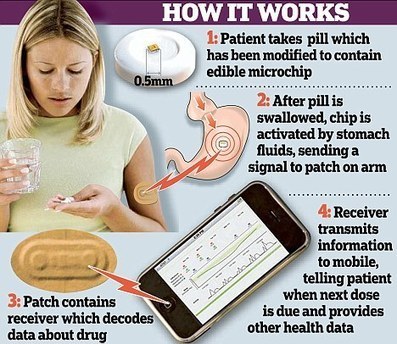
Proteus Digital Health is creating a new category of products, services and data systems that have the potential to significantly improve the effectiveness of existing pharmaceutical treatments.  Called Digital Medicines, these new pharmaceuticals will contain a tiny sensor that can communicate, via a digital health feedback system, vital information about an individual’s medication-taking behavior and how their body is responding.

Categories
Apps Monitoring Seniors

Google Glass for frail seniors

http://www.zdnet.com/old-age-is-the-killer-app-for-google-glass-7000014602/

Google Glass applications can benefit the aging population in many ways:

– Sensors can track a person’s gait, and identify mobility problems that signal a potential fall and broken bones. Early warning signs can trigger preventative treatments and healthcare providers could try stop a fall before it happens.

– Reminders for taking medication can be scheduled and double dosing prevented.

– For those suffering from dementia, the device could recognize family members and offer simple messages such as, “This is your son, his name is John. Say, “Hello John, how are my beautiful grandchildren?”

– Google Glass-type devices could enable family members to patch into what seniors are doing, even what they are seeing. If there were a problem, emergency aid would be on the way in seconds.

Categories
Crowdfunding Monitoring Seniors Sensors

Eldercare monitoring system based on social connections

http://mobihealthnews.com/21650/lively-a-new-eldercare-monitoring-system-focused-on-social-connections-heads-to-kickstarter/

Lively is an in-home sensor network for connecting elderly loved ones to their families.  The system combines a series of wireless sensors, a data-collection hub and biweekly printed mailers that serve as kind of an analog social network. The basic setup measures medication compliance, food and drink intake and general activity outside the home.

Lively is crowdfunding on Kickstarter, with a goal of $100,000.