Categories
Apps Heart mHealth Monitoring Sensors

Study charts heart risk in 1M adults in real time

http://online.wsj.com/article/SB10001424127887324323904578368572640617966.html

The Health eHeart Study will use smartphone apps, sensors and other devices to gather data on a wide variety of measures associated with cardiovascular health—including blood pressure, physical activity, diet and sleep habits—in real time.

Categories
Apps Heart mHealth Monitoring Sensors

Fujitsu facial imaging technology measures pulse

http://www.sys-con.com/node/2582171

A Fujitsu research lab has developed software that can accurately measure a subject’s pulse using the small digital cameras attached to smartphones and tablets.

The technology is based on the fact that the brightness of an individual’s face changes slightly as their heart beats, due to their blood flow. Hemoglobin, which carries oxygen around the body, absorbs green light, so analyzing the change in color of parts of the face reveals their heart rate.

As most image sensors capture pixel information in red, blue and green, they have the ability to detect hemoglobin built in. Fujitsu’s technology keeps track of specific regions of the face over time to take pulse measurements.

Categories
Apps Diabetes Heart mHealth Monitoring Sensors Sleep

A move toward aggregating health data from various devices and apps

http://gigaom.com/2013/03/15/tictrac-emerges-to-help-make-health-tracking-more-mainstream/
It seems that every day a new app or device promising the ultimate in health or fitness monitoring enters the market.  A startup has created a personal analytics dashboard which gives people a big picture view of their own aggregated data and underlying patterns, helping them make sense of the numbers.

Categories
Apps mHealth Sensors

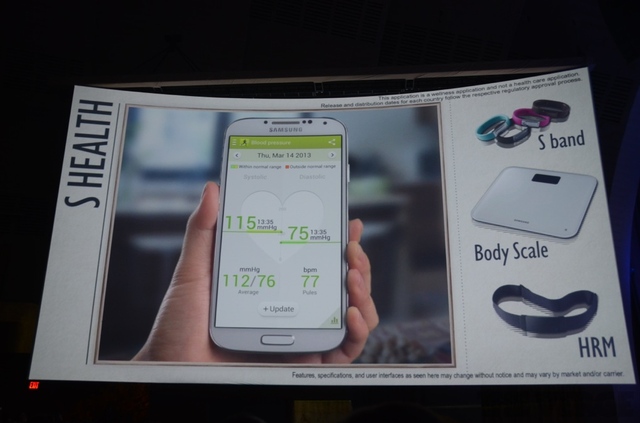
Samsung Galaxy S4 introduces health tracking features

http://www.techradar.com/news/phone-and-communications/mobile-phones/samsung-galaxy-s4-health-tracking-features-rival-fitbit-fuelband-1137737

Sensor technology will enable smartphone users to keep track of sleep patterns, heart rate, exercise, and weight.

Categories
mHealth Monitoring Sensors

Ultra thin sensors printed on skin to monitor health

http://www.biometricupdate.com/201303/super-thin-wearable-sensor-monitors-health-transmits-data/

Eliminating the elastomer backing makes the device one-thirtieth as thick, and thus “more conformal to the kind of roughness that’s present naturally on the surface of the skin,” says John Rogers at the University of Illinois. It can be worn for up to two weeks and can measure temperature, strain, and the hydration state of the skin, and also be used to monitor wound healing.

Categories
Brain fMRI Sensors

Researchers explain the goals of a new brain-mapping project

http://www.technologyreview.com/news/512141/the-brain-activity-map/

A proposed effort to map brain activity on a large scale, expected to be announced by the White House later this month, could help neuroscientists understand the origins of cognition, perception, and other phenomena. These brain activities haven’t been well understood to date, in part because they arise from the interaction of large sets of neurons whose coordinated efforts scientists cannot currently track.

An article published Thursday in Science online expands the project’s already ambitious goals beyond just recording the activity of all individual neurons in a brain circuit simultaneously. Researchers should also  find ways to manipulate the neurons within those circuits and understand circuit function through new methods of data analysis and modeling.

Categories
Brain Sensors

Computer modeling may help soldiers, athletes, avoid concussions

http://hub.jhu.edu/2013/03/07/concussion-research-impact

Johns Hopkins engineers have developed a powerful new computer-based process that helps identify the dangerous conditions that lead to concussion-related brain injuries.

Professor K.T. Ramesh led a team that used a technique called diffusion tensor imaging, together with a computer model of the head, to identify injured axons, which are tiny but important fibers that carry information from one brain cell to another. These axons are concentrated in a kind of brain tissue known as “white matter,” and they appear to be injured during the so-called mild traumatic brain injury associated with concussions. Ramesh’s team has shown that the axons are injured most easily by strong rotations of the head, and the researchers’ process can calculate which parts of the brain are most likely to be injured during a specific event.

Categories
Apps Heart mHealth Sensors

Doctors use smartphones to save lives

http://appleinsider.com/articles/13/01/25/doctors-see-apples-iphone-as-life-saver-in-the-future-of-medicine

A doctor recently used his iPhone, in combination with AliveCor, a mounted sensor capable of delivering clinically accurate electrocardiograms, while in flight, to measure the vital signs of a passenger experiencing severe chest pains at 30,000 feet.

The results indicated that the passenger was having a heart attack.  The doctor recommended an urgent landing, and the passenger survived after being rushed to the hospitall

Categories
Heart Sensors

NASA technology benefits cardio-pulmonary patients

http://www.azosensors.com/news.aspx?newsID=5350

PUMA measures six components to evaluate metabolic function: oxygen and carbon dioxide partial pressure, volume flow rate, heart rate, and gas pressure and temperature. From those measurements, PUMA can compute the oxygen uptake, carbon dioxide output and minute ventilation (average expired gas flow rate). A small, embedded computer takes readings of each sensor and relays the data wirelessly to a remote computer via Bluetooth.

Categories
mHealth Sensors

Data science meets healthcare science

http://newsroom.cisco.com/feature-content?type=webcontent&articleId=1123755

Devices that collect personal medical information are growing both prolific and inexpensive.  The biggest challenges lie not in collecting and transmitting the data, but in building the backend systems that can interpret it.

Categories
Sensors

Oregon State engineers develop microchip for cheap EEG and ECG

http://www.physbiztech.com/blog/health-sensors-size-postage-stamp

OSU researchers attempt to reduce the cost of wireless EEG and ECG monitoring to less than a dollar.  Applications include self-tracking and enabling doctors to monitor at-risk patients in real time.  Multiple chips around the body can continuously track specific metrics.

Categories
mHealth Sensors

Sensor technology protects seniors

http://www.seniorjournal.com/NEWS/Eldercare/2013/20130114-High_Tech_Surveillance.htm

In addition to the remote monitoring of chronic conditions, sensors, computerized pattern recognition and links to human responders can detect and head off health threats to the elderly living alone.