
Categories
Brain Computer Vision mHealth Monitoring Sensors

Computer vision algorithms used to diagnose depression

http://medvr.ict.usc.edu/projects/dcaps/

SimSensei software, developed by Stefan Scherer and colleagues at the University of Southern California, combines computer vision algorithms and the psychological model of depression. An on-screen psychologist asks you a series of questions and watches how you physically respond. Using Kinect, the computer vision algorithms build up a very detailed model of your face and body, including your “smile level,” horizontal gaze and vertical gaze, how wide open your eyes are, and whether you are leaning toward or away from the camera. From these markers, SimSensei can determine whether you’re exhibiting signs that indicate depression — gaze aversion, smiling less, and fidgeting.

Categories
Monitoring Seniors Sensors

Smart bottles measure medication, send reminders

http://www.fastcoexist.com/1681935/a-cell-phone-in-a-pill-bottle-to-text-you-to-remember-your-meds

AdhereTech bottles measure the exact amount of pills or liquid they contain in real-time. The data is sent wirelessly into the cloud, and patients are reminded to take their medication via an automated call or text message.

Categories
Apps mHealth Monitoring Pharmaceuticals Seniors Sensors

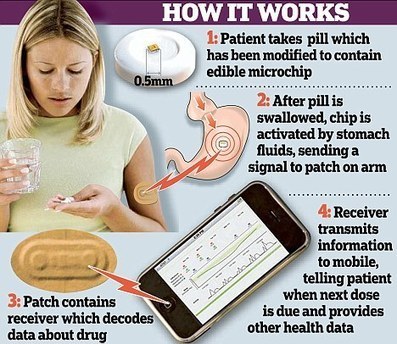
Ingestible sensors alert doctors and caregivers when a pill is taken

http://www.forbes.com/sites/nextavenue/2013/04/16/the-newest-high-tech-pill-will-text-when-swallowed/

Proteus Digital Health is creating a new category of products, services and data systems that have the potential to significantly improve the effectiveness of existing pharmaceutical treatments.  Called Digital Medicines, these new pharmaceuticals will contain a tiny sensor that can communicate, via a digital health feedback system, vital information about an individual’s medication-taking behavior and how their body is responding.

Categories
mHealth Monitoring Sensors

Multi-use, wireless, wearable sensors

http://www.kth.se/en/aktuellt/nyheter/hudnara-elektronisk-doktor-ar-framtiden-1.382668

The Bio-patch, developed by researchers at KTH Royal Institute of Technology, measures bioelectrical signals through the skin, gathering data on different parts of the body depending on where it is placed.

“On the chest it provides electrocardiography (ECG), on the skull it measures brainwaves (EEG), and on the forearm it can measure muscle response to stimulation from the nervous system (EMG),” says KTH researcher Geng Yang.  It also has a built-in sensor that constantly monitors body temperature.

Categories
Crowdfunding Monitoring Seniors Sensors

Eldercare monitoring system based on social connections

http://mobihealthnews.com/21650/lively-a-new-eldercare-monitoring-system-focused-on-social-connections-heads-to-kickstarter/

Lively is an in-home sensor network for connecting elderly loved ones to their families.  The system combines a series of wireless sensors, a data-collection hub and biweekly printed mailers that serve as kind of an analog social network. The basic setup measures medication compliance, food and drink intake and general activity outside the home.

Lively is crowdfunding on Kickstarter, with a goal of $100,000.

Categories
Apps mHealth Monitoring Pregnancy Sensors

Mobile monitors for expectant mothers

http://www.fiercemobilehealthcare.com/special-reports/mobile-monitors-expectant-mothers

AirStrip OB is a mobile patient monitoring solution for women in labor. The system, developed by San-Antonio-based AirStrip Technologies, captures vital patient waveform data, including fetal heart tracing and maternal contraction patterns, in “virtual real time” and sends it to a physician’s mobile device.

Categories
Monitoring Sensors

Cord-free hospital medical monitors

http://ajw.asahi.com/article/economy/technology/AJ201304120065

Hospital patients may no longer need to be hooked up to a tangle of wires, thanks to new technology developed by Fujitsu Ltd. The device enables cord-free monitoring through radio-wave transmission of electrocardiograms, blood pressure and other data from sensors attached to patients’ bodies.

A transmitter mounted on each sensor sends readings to a receiver adjacent to the bed, which will be connected to a dedicated monitor or personal computer. The data transmission utilizes the “medical body area network” (mBAN), a telecommunications standard for medical equipment. The radio waves only have a transmission range of 5 meters and do not interfere with pacemakers or other medical equipment, Fujitsu officials said.

Categories
Asthma mHealth Monitoring Sensors

Sensors and mobile technology for asthma management

http://techcrunch.com/2013/04/05/asthmapolis-wants-to-hack-the-inhaler-and-help-26-million-americans-better-track-and-manage-their-asthma/

Asthmapolis uses a novel combination of smartphone applications and snap-on inhaler sensors that track when and how often patients use their inhaled medications. The geomedicine platform, available in both English and Spanish, is designed to help individuals with their daily preventive medications, reveal insights about their use of rescue medications and provide personalized feedback to improve their ability to successfully manage the disease.

Categories
Diabetes mHealth Monitoring Sensors

Sensors detect diabetic foot ulcers early

Two new sensor-based early detection tools for diabetic foot ulcers are being developed.

http://www.express.co.uk/life-style/health/383644/The-alarm-that-can-save-limbs

Orpyx Medical Technologies has developed a wristwatch and shoe insert.  An insole is designed to support the foot, with three separate foam layers. Eight tiny electronic sensors are packed in the top of the insole so that they rest against thesurface of the foot once the shoe has been put on. These sensors are programmed to detect when pressure exceeds predetermined levels at certain points of the foot that are most susceptible to ulcers. Once they do, they wirelessly transmit a warning to the watch, which immediately sounds an alert.

http://www.podimetrics.com

Cambridge based Podimetrics is developing a home-monitoring bath mat with sensors that record changes in blood flow patterns when a diabetic patient steps on the mat. The sensors scan the foot to collect data about blood flow and send the data to the cloud to be stored and analyzed. The company’s algorithms look at that data in two ways: longitudinally over time and comparatively between the left and right foot to detect patterns that may indicate the presence of a developing ulcer. When the algorithms detect a pre-ulcer, an alert is sent to the patient and his doctor prompting an intervention early on.

Categories
Sensors Stroke

Sensor detects swallowing problems in stroke patients

http://www.futurity.org/health-medicine/stick-on-sensor-detects-trouble-swallowing/
 A small, external sensor developed at the University of Pittsburgh records how a person swallows and could result in more efficient and less invasive testing for stroke patients.

Dysphagia can have dire consequences like malnutrition, dehydration, pneumonia, and even death. Current evaluation and monitoring methods are often cumbersome and not as effective as they need to be.

Categories
Apps fitness Heart mHealth Monitoring Sensors

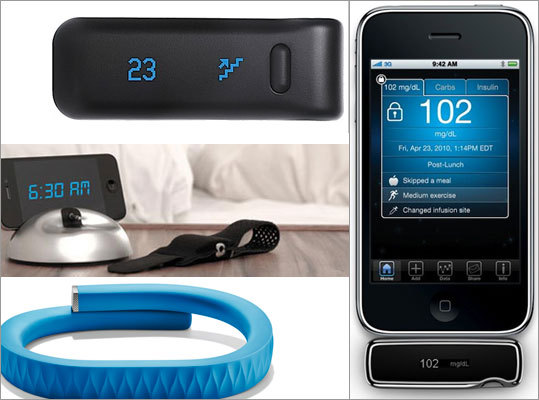
8 new sensor based health tracking devices

http://www.boston.com/lifestyle/health/gallery/wearable_trackers/

An overview of 8 new sensor based health tracking devices.  Some predict that 400 million such products will enter the market by 2014.

Categories
mHealth Monitoring Sensors

Implantable chip analyzes blood and sends data to doctors

http://www.wired.co.uk/news/archive/2013-03/20/implantable-chip-doctor

A multidisciplinary Swiss team has developed a tiny, implantable device that instantly analyses the blood before wirelessly sending the data to a doctor.

The device can be used for monitoring general health, but the team also sees immediate applications in monitoring the efficacy of treatments such as chemotherapy in order to tailor drug delivery to a patient’s unique needs.