
 http://elfi-tech.com
Elfi-Tech of Israel, led by Dr. Ilya Fine, has disrupted digital healthcare. They are the only Israeli finalist in the Nokia XCHALLENGE competition, which “envisions a future of access to affordable, personalized healthcare through sophisticated sensing technologies”. The company has developed a sensor that is more suitable as a continuous monitor with minimal discomfort. This is due to lower power consumption of the laser technology and less of a need to be very tightly secured to skin. Perhaps its most exciting feature is the non invasive measurement of many blood flow parameters, providing a more complete cardiac perspective at home.
Category: Apps
 http://teddytheguardian.com/fp-sections/about/
Health tracking technology is becoming increasingly accessible and aesthetically pleasing. Examples include Teddy the Guardian, a cute teddy bear used to monitor children’s health. It measures a child’s heart rate, blood pressure, oxygen saturation, and body temperature, and sends the data using wireless technologies to a paqrent’s smartphone. Miniature and advanced sensors will continue to enable product designers to discreetly incorporate vital sign sensing technology into commonly used objects. We look forward to more developments in this fast-growing segment of the continuous monitoring industry.
 http://www.angelsensor.com/index.html
The Angel Health Monitor is an open platform and SDK that senses motion and acceleration, skin temperature, blood oxygen saturation, and heart rate. It was created by Eugene Jorov in Israel and will launch a crowdfunding campaign soon. Developers will be able to use Angel to create apps for iPhone, Android, and other devices that support Bluetooth 4.0. Their SDK, drivers and app templates will be released as open source.
 http://www.bostonglobe.com/lifestyle/health-wellness/2013/07/28/century-house-call/tdupWvOQI6b3dKdKcEgdGM/story.html
Boston’s Partners HealthCare has launched a system that allows patients to upload information from their medical devices directly to their electronic records in doctors’ offices. Patients can regularly use glucometers, blood pressure cuffs, bathroom scales, and pulse oximeters at home, and send the data to their doctors. Doctors are also becoming increasingly interested in eating habit, movement, and sleep data collected by patients using consumer health-tracking devices.
A recent study by the company showed a significant decrease in diastolic blood pressure among participants who both took their readings and uploaded them to a web interface where they could track and monitor their progress.
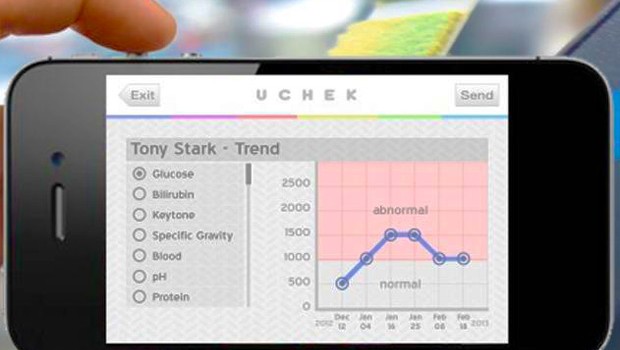 http://uchek.in
Biosense’s uChek is crowdfunding its urine analysis system. It is a free app for iPhone users that can interpret color changes on urine analysis test strips with a smartphone camera. uChek can be used for semi-quantitative and qualitative detection of leukocytes, ketone, nitrite, urobilinogen, bilirubin, protein, specific gravity and pH. Test results may provide information regarding the status of carbohydrate metabolism, kidney and liver function, acidbase balance and bacteriuria.
 http://rijuven.com/cardiosleeve.html
CardioSleeve, when attached to a stethoscope, records, displays and analyzes electrical and acoustical footprints of the heart in real time via any wirelessly connected portable device. The data can be stored in the cloud or uploaded into an EHR.
Categories
Smart diapers detect disease
 http://pixiescientific.com
Crowdfunded digital diaper by Pixie Scientific detects urinary tract infections, kidney dysfunction, and dehydration, and analyzes health patterns after months of tracking. It has an accompanying smartphone app that transmits the data to a central location that can be viewed by a doctor.
 http://research.microsoft.com/apps/pubs/default.aspx?id=194498
Microsoft’s MoodScope is a “sensor” that measures a smartphone user’s mental state. It analyzes an enormous array of interactions including app usage, phone calls, emails, text messages, browsing history, and geographic location — thousands of data points each day. 32 study participants used the system for two months, and completed mood self-assessments to gauge the accuracy of the software. The app was able to guess someone’s mood with 66% accuracy. When the software was “calibrated” for an individual user, accuracy increased to 93%.
 http://eyenetra.com/netra-g.html
Vinod Khosla and others have invested in MIT Media Lab’s EyeNetra, a smartphone attachment that claims to diagnose nearsightedness, farsightedness and astigmatism. The device is positioned as a less bulky alternative to the Shack-Hartmann Wavefront sensor. A $2 eyepiece is clipped onto a phone. The user then clicks to align the displayed patterns. The number of clicks required to bring the patterns into alignment indicates the refractive error. Patients connect to corrective lens providers through a cloud based system. The technology provides access to eye exams in the developing world.
Categories
mHealth timeline, 2009 – 2013
 http://mobihealthnews.com/22674/timeline-smartphone-enabled-health-devices/
Sensors are becoming smaller, smarter, and more ubiquitous, and have transformed the way we monitor our health. Attached is a timeline of health and fitness apps from 2009 through today, providing an interesting look at the development of the mHealth market.
 http://www.economist.com/news/technology-quarterly/21578518-sensor-technology-microphones-are-designed-capture-sound-they-turn-out
The Economist’s Technology Quarterly describes how mobile phone microphones are being used as versatile sensors with myriad health applications. Examples follow:
1. Professor Tanzeem Choudhury of Cornell has created StressSense to capture and analyze voice characteristics such as amplitude and frequency. Her team concluded that “it is feasible to implement a computationally demanding stress-classification system on off-the-shelf smartphones”.
2. BeWell’s sleep-tracking feature, also by Professor Choudhury, determines whether the phone’s user is awake or not by analyzing usage, light and sound levels, and charging habits. Physical activity is monitored using built-in accelerometers for motion-detection. Social activity is measured by sounds that indicate that the user is talking to someone, either in person or over the phone.
3. Professor John Stankovic of the University of Virginia uses microphones to capture heartbeats. Researchers in his group use earphones modified with accelerometers and additional microphones that detect the pulse in arteries in the wearer’s ear. This makes it possible to collect physical state information, including heart rate and activity level, which is transmitted to the smartphone via the audio jack.
4. Shwetak Patel of the University of Washington uses a smartphone to measure lung function when users blow on its microphone. His team has developed the SpiroSmart app, which simulates a digital spirometer, to measure the volume of air a person can expel from his or her lungs. Spirometers help doctors better understand the health status of patients with conditions like asthma, chronic obstructive pulmonary disease and cystic fibrosis.
 https://www.glowing.com
Several recently launched companies are trying to assist couples conceive by using wearable sensors and big data analytics to pinpoint a woman’s most fertile days.