Categories
fitness Heart mHealth Monitoring Sleep

Update: Samsung increases health applications with Gear 2 watch, Gear Fit, Galaxy S5

Samsung has updated its devices as it tries to establish dominance in the health and fitness tracking market.

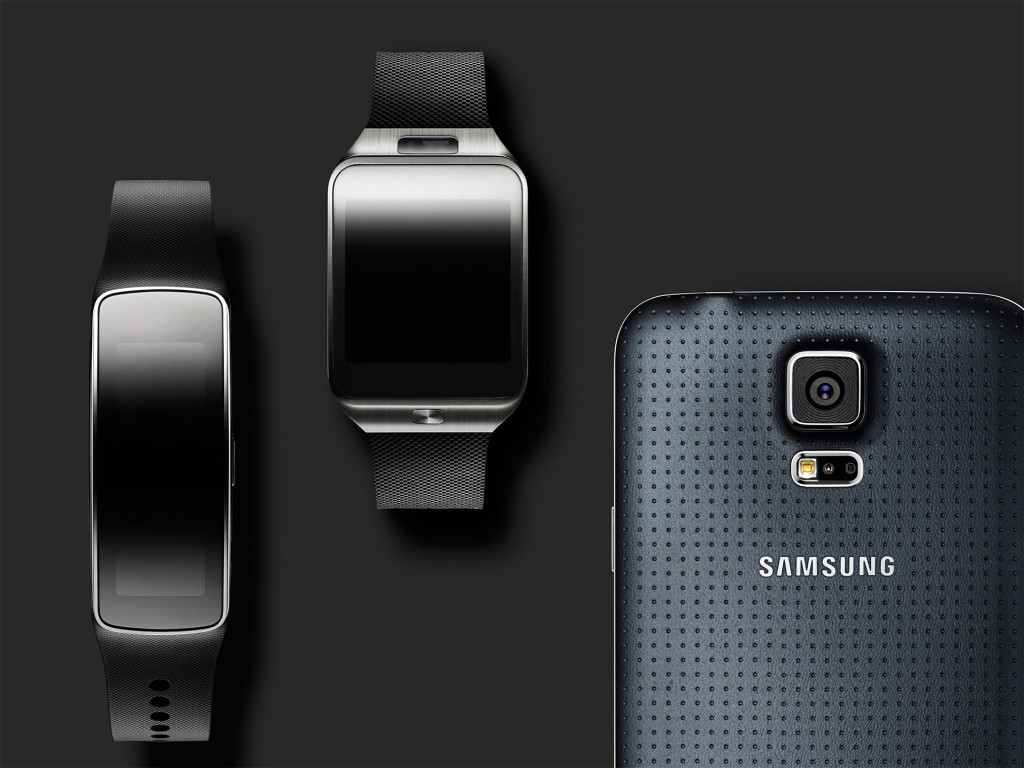
Its Gear 2 watch is now based on Samsung’s Tizen operating system rather than Android. It includes an accelerometer and gyroscope – capable of acting as a pedometer and an optical heart rate monitor. This allows the watch to integrate with Samsung’s health and fitness tracking applications, replacing the need for additional tracking gadgets.  Its various tools will measure exercise, sleep and stress levels.

Apple is expected to release a smartwatch in the near future with a strong focus on fitness and health tracking, as well as a “Healthbook” application for its next iteration of its iOS iPhone and iPad software.

The Gear Fit band tracks movement, heart rate and sleep patterns. It is water-resistant and includes phone notifications, a timer, stopwatch and a curved OLED screen.

The Galaxy S5 smartphone features an enhanced S Health 3.0 app, a comprehensive personal fitness tracker, a pedometer, diet and exercise records, and a built-in heart rate monitor. It will pair seamlessly with the next generation Gear products for real-time fitness coaching.
Categories
mHealth Monitoring Sensors

Apple patents health monitoring earbuds

United States Patent 8655004

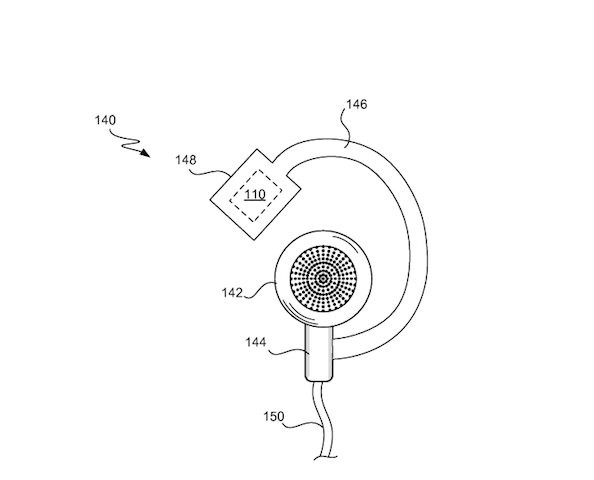
As the sensor based health monitoring market continues to expand, the USPTO on has granted Apple a patent for a biometric headphone system.

By positioning the headset in or near the ear, an embedded activity sensor can measure temperature, perspiration and heart rate data, among other metrics.  In addition to skin-based readings, an accelerometer may also be incorporated into the earbud chassis to facilitate the collection of accurate movement data.

Categories
Cancer mHealth Monitoring Sensors

Sensors detect radiation complications early, at home

http://www.ncbi.nlm.nih.gov/pubmed/24395986

Susan Peterson and colleagues at MD Anderson have completed a feasibility study showing that equipping head and neck cancer patients with home-based sensors can identify dehydration during radiation treatment.

Physicians reviewed patients’ information daily using CYCORE (CYberinfrastructure for COmparative Effectiveness REsearch), a software-based platform to collect and manage data from multiple systems through a suite of home-based and mobile sensors. They followed 48 patients during two five-day periods. Sensors were used to monitor daily weight and blood pressure fluctuations.  Patients also reported daily food and drink consumption, degree of pain with swallowing, and other side effects, using a smartphone.  60 percent of patients had at least one event that would suggest risk for dehydration and would warrant clinical intervention, and 35 percent had two or more events.

Categories
Diabetes mHealth Monitoring Sensors

Smart contact lens prototype to monitor glucose

http://googleblog.blogspot.com/2014/01/introducing-our-smart-contact-lens.html

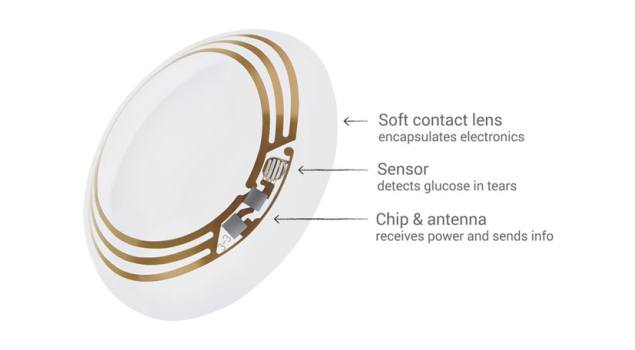
Google is testing a smart contact lens that’s built to measure glucose levels in tears.  It uses a tiny wireless chip and miniaturized glucose sensor embedded between two layers of soft contact lens material. The prototype can generate a reading once per second. They are investigating the potential of integrating tiny LED lights that could light up to indicate that glucose levels have crossed above or below thresholds.  Google says it is working with the FDA to turn the prototypes into products.

Categories
mHealth Monitoring Sensors Wearables

Sony’s “SmartWig” can monitor and transmit health data

US Patent Office

Sony has submitted a patent application for a health monitoring “SmartWig.”  It can include a GPS and camera placed near the forehead. Users can receive vibrating feedback on specific parts of their head.  A laser pointer and remote can be controlled by the head’s movement. An ultrasound transducer could transmit or receive ultrasound waves to detect surrounding objects, warning users if there are obstacles behind or above their heads.  A circuit board in the hair can talk to a second device wirelessly — such as a phone or pair of smartglasses.

Categories
fitness mHealth Monitoring Sensors Wearables

Printable, multi-touch sensors consumers can cut with scissors

http://embodied.mpi-inf.mpg.de/files/2012/11/ACuttableMultiTouchSensor.pdf

Max Planck Institute researchers and the MIT Media Lab have developed printable, multi-touch sensors that are printed with e-ink and can be cut with scissors.  A new circuit layout makes it robust against cuts, damage, and removed areas.  By customizing and pasting such a sensor, one can make every surface interactive, including the wristband of a watch, a fabric or an object.  This implies many digital health and fitness applications.

The scientists use “printed electronics” – electrical components and devices which are printed. The approach is similar to that of inkjet printers. Instead of printing with normal ink, electrically-functional electronic ink is printed on flexible, thin films called substrates.

In the circuit layout, the wires run horizontally, vertically, and parallel to each other. At the intersection of one parallel and one horizontal layer are the touch-sensitive electrodes. Via the wires they are connected to a controller. This type of layout requires only a minimal number of wires, but is not robust. Since each wire addresses several electrodes, a small cut has a huge effect: many electrodes become unusable and possibly large sensor areas do not work anymore. “It was not easy to find an alternative layout, robust enough for our approach” said lead developer Simon Olberding. They took their inspiration from nature, looking at the human nerve system and fungal root networks, and thus came up with two basic layouts. The “star topology” has the controller in the center. It is connected to every electrode separately. The “tree topology” also has the controller in its center connected to each electrode separately. But the wires are bundled similarly to a tree structure. They all run through a vertical line in the middle and then branch off to reach their electrodes.

The scientists found out that the star topology supports  basic forms like triangles, rectangles, or ovals best. It is suited for shapes commonly used for crafts, like stars, clouds, or hearts. In contrast, with the tree topology it is possible to cut out whole areas. The researchers were also able to combine both layouts in a space-saving way, so that the sensor supports all basic forms.
Categories
mHealth Monitoring Seniors Sensors

Ambient Assisted Living system monitors senior health at home

http://www.theengineer.co.uk/medical-and-healthcare/news/wireless-system-provides-ambient-health-monitoring-of-elderly/1017120.article

One outcome of the EU’s support of Ambiant Assistant Living is the following multi-bio-marker home monitoring device which continuously monitors glucose, cholesterol and blood oxygen levels.  It is expected that several similar monitors will be introduced in the near future, enabling seniors to better manage various diseases at home.

Fraunhofer FIT has developed an AAL system using miniature sensors integrated into one platform.  A nano potentiostat measures biochemical information in a patient’s assay, including glucose, lactate and cholesterol levels. A fluorescence sensor is used to detect color-marked biomarkers. An SpO2 sensor monitors heart rate and arterial oxygen saturation. A smartphone app processes the data from the three sensors and transfers them to a server. For secure data communication, a Bluetooth connection with a specifically developed protocol is used.

Categories
fitness Heart mHealth Monitoring Wearables

Mayo Clinic studies step tracking data as a post-surgery monitoring tool

http://www.annalsthoracicsurgery.org/article/S0003-4975(13)01253-8/fulltext
Mayo Clinic has published a study using step recording from a  Fitbit activity tracker to monitor recovery in cardiac surgery patients and help hospitals determine the appropriate length of stay.  Those who had the shortest hospital stay walked the most on all days in the study, by a statistically significant margin. Likewise, patients bound for home walked more than those headed for a nursing facility.

Categories
EEG mHealth Monitoring

Non-invasive EEG ear device to detect seizures

http://www.technologyreview.com/news/518356/device-could-spot-seizures-by-reading-brainwaves-through-the-ear/

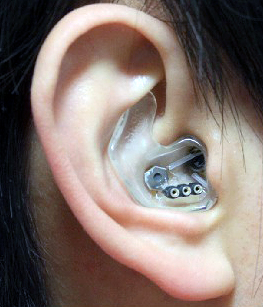
Danilo Mandic at Imperial College in London has developed an EEG device that can be worn inside the ear, like a hearing aid.  It will enable scientists to record EEGs for several days at a time,  allowing doctors to monitor patients who have recurring problems such as seizures or microsleep.

By nestling the EEG inside the ear, a lot of signal noise usually introduced by body movement is avoided. The engineers can also ensure that the electrodes are always placed in exactly the same spot to make repeated readings more reliable.

Categories
Apps mHealth Monitoring Sensors

Crowdfunded breast exam sensor and software

http://eclipsebreasthealth.com

Eclipse Breast Health Technologies has launched a crowdfunding campaign to test and eventually bring to market a wireless sensor meant to aid in the early detection of breast cancer and the tracking of patients being treated for the disease.  The campaign is meant to support the company as it goes through the FDA approval process.  With the simplicity of the home self-check, and  the potential vast amount of data that the company can gather on its servers, this is a potentially disruptive clinical tool.  Clearly those cases where the device did not detect cancer when it should have will make or break this product.

The system consists of a handheld imaging device paired with imaging software that tracks changes in breast density over time, and also incorporates an element of social networking. Eclipse says the device, which uses what the company calls “transphotonic” technology – combining low-energy photons and light sensors, without the need for radiation – is as much as five times as sensitive as the human hand.

The imaging device links wirelessly or by USB to a PC, smartphone or tablet, where a Web application creates a visual representation of the self-exam and helps quantify observations. Data is uploaded to patient accounts on a platform that calls Pink Cloud. From there, women can compare readings over time, share the information with their physicians or connect with others on Pink Cloud, which incorporates a social network of Eclipse users.

Categories
AI Apps Assistive Technologies Brain mHealth Monitoring Seniors Sensors

Personalized robot companion for seniors

http://cordis.europa.eu/fetch?CALLER=OFFR_TM_EN&ACTION=D&RCN=11525

A European consortium of research institutes, universities and technology companies has developed a highly customizable robot companion to help seniors to maintain their quality of life, stay healthy and avoid social exclusion.

The robot, a mobile wheeled semi-humanoid figure equipped with cameras, sensors, audio, and a touch screen interface, can remind users to take their medicine, suggest they have their favorite drink, or prompt them to go for a walk or visit friends if they haven’t been out for a while. As part of a larger smart-home environment that can include smart clothing to monitor vital signs, the system can monitor user’s health and safety, and alert emergency services if necessary.

Categories
Apps Data Heart mHealth Monitoring Sensors

Elfi-Tech – non-invasive sensor captures more meaningful health data

http://elfi-tech.com

Elfi-Tech of Israel, led by Dr. Ilya Fine,  has disrupted digital healthcare.  They are the only Israeli finalist in the Nokia XCHALLENGE competition, which “envisions a future of access to affordable, personalized healthcare through sophisticated sensing technologies”.  The company has developed a sensor that is more suitable as a continuous monitor with minimal discomfort. This is due to lower power consumption of the laser technology and less of a need to be very tightly secured to skin. Perhaps its most exciting feature is the non invasive measurement of many blood flow parameters, providing a more complete cardiac perspective at home.