
 http://www.nature.com/nphoton/journal/vaop/ncurrent/full/nphoton.2013.191.html
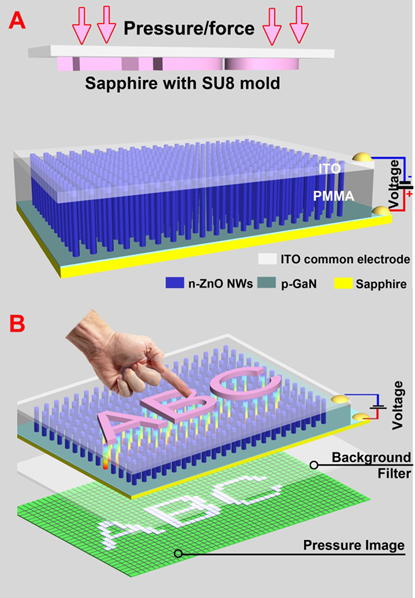
In a related development to Berkeley’s touch responsive e skin, Georgia Tech Professor Zhong Lin Wang has proposed a new “piezo-phototronic” approach to the human-machine interface. Zinc-oxide nanowires serve as tiny LEDs which have an emission intensity dependent on the local strain put on them. The nanowire array could act as artificial skin for robots to give them human-like touch sensitivity. Additional uses include inkless fingerprint scanners, biological imaging, or performance enhancement of micro-electro-mechanical systems. ApplySci hopes that this technology will find its way into body tactile sensors in the near future.
10 replies on “Piezo-Phototronic LEDs may help robots feel”
I just couldn’t go away your website before suggesting that
I really loved the usual info a person provide for your visitors?
Is gonna be back incessantly to inspect new posts
Thanks very interesting blog!
Great post.
Thanks for sharing such a fastidious idea, article is
nice, thats why i have read it entirely
Touche. Solid arguments. Keep up the good spirit.
When I initially commented I seem to have clicked on the
-Notify me when new comments are added- checkbox and from now on every time a comment
is added I recieve 4 emails with the exact same comment.
There has to be an easy method you can remove me from that service?
Many thanks!
Hi, yup this article is truly nice and I have learned lot
of things from it regarding blogging. thanks.
I always used to study post in news papers but now as I am a
user of internet so from now I am using net for articles,
thanks to web.
Keep this going please, great job!
You actually make it seem so easy with your presentation but
I find this topic to be really something that I think I would never understand.
It seems too complex and very broad for me. I’m looking forward for your
next post, I’ll try to get the hang of it!