
Categories
Assistive Technologies BCI Seniors Sensors

Eldercare robots perform essential tasks

http://bits.blogs.nytimes.com/2013/05/19/disruptions-helper-robots-are-steered-tentatively-to-elder-care/

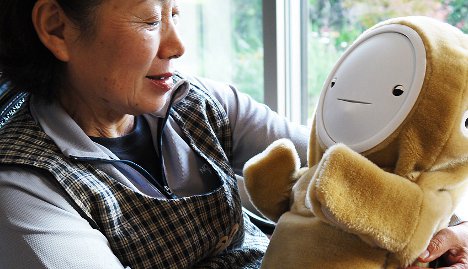
Already popular in Japan, today’s New York Times reports on the developing trend of robotic companions for the elderly.

A typical Japanese example is the Tsukuba University created Hybrid Assistive Limb. The battery-powered suit senses and amplifies the wearer’s muscle action when carrying or lifting heavy objects.  Caregivers can also use the suit to aid them while lifting patients from a bed, and patients can wear it to support their movements.  Other Japanese devices include a small, battery-powered trolley to aid independent walking; a portable, self-cleaning bedside toilet; and a monitoring robot which tracks and reports the location of dementia patients.

The Times describes several interesting US developed robots:   Cody, a Georgia Tech created robotic nurse cable of bathing patients;  HERB, a Carnegie Mellon developed butler which retrieves objects and cleans; Hector, a University of Reading robot which provides medication reminders, locates lost objects, and can assist in a fall; and Paro, a baby seal looking robot which calms dementia patients.
Categories
Assistive Technologies

Eye gaze controlled email, Skype for stroke and ALS patients

http://www.tobii.com/en/assistive-technology/north-america/products/hardware/ceye-eye-control-module/

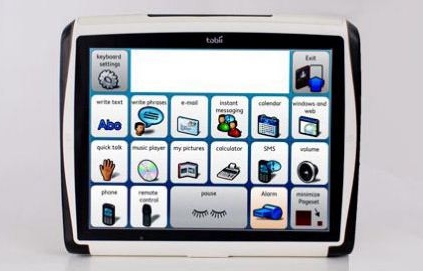
Tobii ATI has unveiled a new tablet-like product line, the i-Series, designed to let users with ALS, stroke, and cerebral palsy use email and Skype through eye-gaze tracking. A mouse is no longer needed.

Categories
Assistive Technologies BCI

Brain-machine interface allows control of limbs through thoughts

http://www.fastcoexist.com/1681674/a-prosthetic-arm-controlled-by-your-thoughts

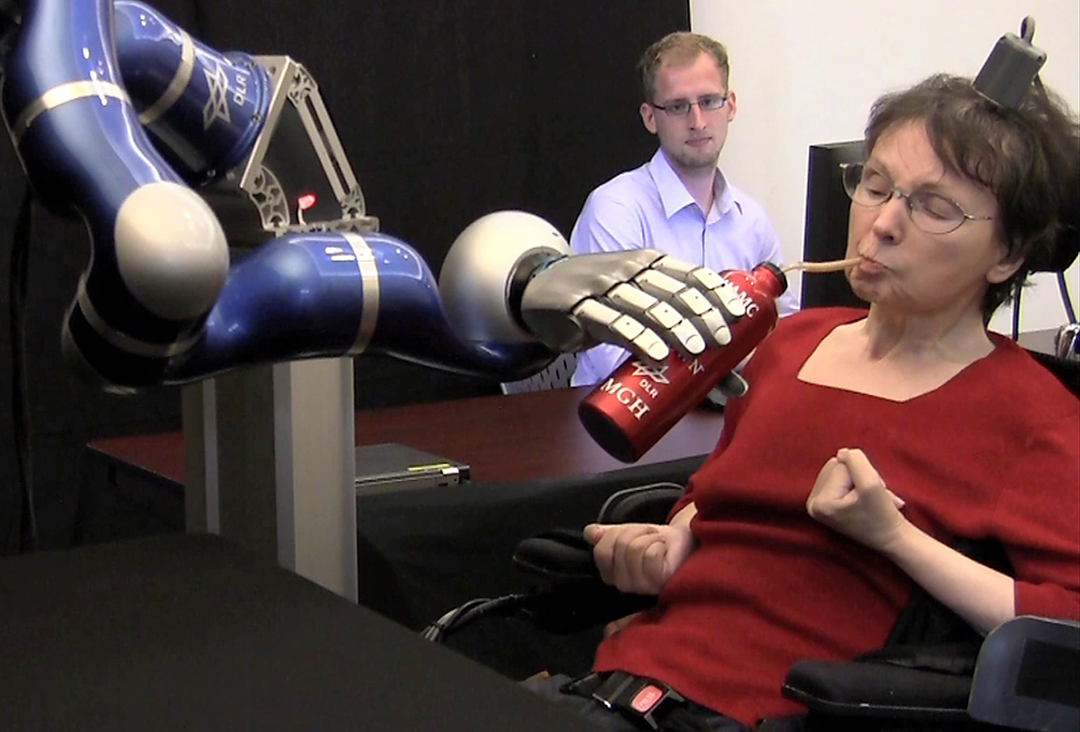
By placing a small sensor in the brain’s motor cortex, interfaces can pick up on electrical activity, and translate it into commands that control a robotic arm. Now scientists have gone a step further. Instead of a wired brain-arm link, they have now developed a wireless connection powerful enough to work at a distance of three feet.

“Clinical applications may include thought-controlled prostheses for severely neurologically impaired patients, wireless access to motorized wheelchairs or other assistive technologies, and diagnostic monitoring such as in epilepsy, where patients currently are tethered to the bedside during assessment,” says David Borton, at Brown University.

Categories
Assistive Technologies

Bronx VA doctor helps paraplegics walk with Israeli exoskeleton device

http://www.nydailynews.com/life-style/health/doctor-helps-parapalegics-walk-exoskeletons-article-1.1315915

ReWalk is a commercial bionic walking assistance system, utilising powered leg attachments to enable paraplegics to stand upright, walk, and climb stairs. The system is powered by a backpack battery, and is controlled by a simple wrist-mounted remote which detects and enhances the user’s movements.

Categories
Assistive Technologies EEG

EPSRC funds 15 creative healthcare engineering projects

http://www.epsrc.ac.uk/newsevents/news/2013/Pages/enghealthcare.aspx

The EPSRC is funding technologies in three health areas:

1. Medical Imaging.  Projects include technology which could:

-lead to better diagnosis and treatment for epilepsy, multiple sclerosis, depression, dementia as well as breast cancers and osteoporosis

-reduce risks during brain surgery by creating ultrasound devices in needles

-improve therapies for brain injured patients and help severely disabled people interact with the world around them

2. Acute Treatment Technology.  Projects include:

-a multiphoton scanner and a multiphoton endoscope to collect images of tissue at depth and sub-cellular level, allowing immediate diagnosis during surgery

-ultrasonic bone-penetrating needles to deliver drugs and obtain biopsies in bone

-laser spectroscopy to quickly analyze tissue in cancer patient

-a pulsed laser system to restore tooth enamel

3. Assistive Technology and Rehabilitation.  Projects aim to:

-improve prosthetics, hearing aids, and develop a wearable material to support healing muscles or create an exoskeleton.