
Categories
Brain

MRI identified brain neuromarkers predict response to antipsychotic medications

http://archpsyc.jamanetwork.com/article.aspx?articleid=1727437

Dr. Paola Dazzan and researchers at King’s College London have identified neuroimaging markers in the brain which could help predict whether people with psychosis respond to antipsychotic medicatins or not.

The team used MRI to scan the brains of 126 people – 80 who had experienced a first episode of psychosis and 46 healthy controls.  The scans were done shortly after the psychotic episodes, and the participants were assessed again 12 weeks later to see whether symptoms had improved after initial treatment with antipsychotic medications.
The researchers looked at a feature of the brain called “cortical gyrification” – the extent of folding or wrinkling of the cerebral cortex, the outermost sheet of brain tissue that plays a key role in memory, language and consciousness.  They found that people who did not respond to treatment had less gyrification in many brain regions – particularly in areas considered important in psychosis such as the temporal and frontal lobes.

Categories
Brain Sensors

Non-invasive intracranial pressure monitor receives NSF funding

http://www.3-e-d.com

The National Science Foundation is supporting Third Eye Diagnostics of Philadelphia as it develops a non-invasive, handheld intracranial pressure monitor to rapidly diagnose brain injury.

Cerepress simultaneously records images of the CRV and measures intraocular pressure while pressure in the eye is increased. A medical technician aligns the system by centering the field of view to patient’s pupil. The system then contacts the patient’s cornea and simultaneously collects images of the cornea and the retinal fundus. The contact force increases the IOP and momentarily compresses the CRV. When CRV compression is complete, the Cerepress records the eye pressure, which is equivalent to CRV pressure. CRV pressure is a known to be a good correlate to ICP.  Data shows that the combination of CRVP and the pulsatility index produces a correlation with better accuracy than using CRV pressure alone. To determine the pulsatility index, a medical technician uses an optimized Doppler ultrasound probe to obtain blood velocities in the ophthalmic artery.


Categories
Brain Cancer

Real-time MRI guided gene therapy for brain cancer

http://health.ucsd.edu/news/releases/Pages/2013-08-06-MRI-guided-gene-therapy-for-brain-cancer.aspx

Neurosurgeons at the University of California San Diego School and Moores Cancer Center utilize MRI navigational technology to guide the delivery of investigational gene therapy Toca 511, or vocimagene amiretrorepvec, precisely into a brain malignancy in an attempt to make it more susceptible to chemotherapy.

Categories
BCI Brain Wearables

Transcranial direct current stimulation headset receives FCC approval

http://www.extremetech.com/extreme/162581-foc-us-the-first-commercial-tdcs-headset-that-lets-you-safely-overclock-your-brain
The Foc.us headset is an early player in the wave of non-invasive devices that will enable improved brain function.  It passes direct current between the cathode and anode, which are placed over the prefrontal cortex, making neurons more excitable.  This helps them to fire more quickly, improving reaction time. When the currents are removed, neurons have additional plasticity.

Early studies have shown that tDCS, which can be used to stimulate regions of the brain other than the prefrontal cortex, such as the motor cortex, can provide therapeutic effects to Parkinson’s and stroke patients.  DARPA has used tDCS to improve the training of snipers, and it has also been used to improve gamer performance.

Categories
Brain

Motion sensor – potential for autism diagnosis and treatment?

http://www.frontiersin.org/Integrative_Neuroscience/researchtopics/Attism_The_Movement_Perspectiv/801

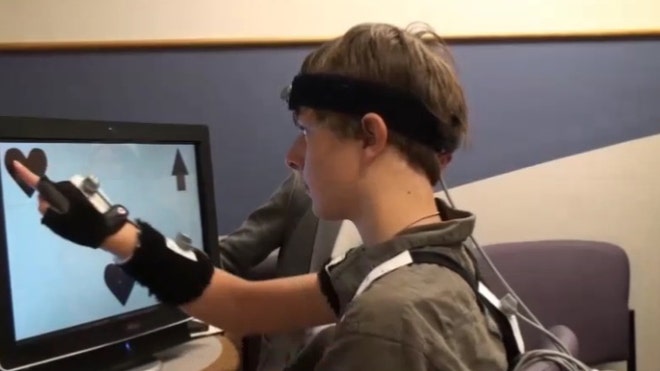
Rutgers and Indiana University researchers have developed a motion sensor that they claim can help diagnose and treat autism.

A movement tracker is attached to the individual, which senses “systemic signatures,” measuring each person’s movement as they respond to various screen images from a computer program showing 240 images a second.  This analyzes the importance of changes in movement and movement sensing, enabling the identification of stable capabilities in each individual, and highlights the impairments of a person’s movement system.  The screening tool can measure tiny fluctuations, determining exactly how an individual’s movement differs to that of a more typically developing child or adult.

The researchers claim that their work could potentially be used as an early therapeutic tool, helping autistic children learn and communicate more effectively.

Categories
AI BCI Brain

Neuromorphic chip mimics human brain in real time

http://www.mediadesk.uzh.ch/articles/2013/chips-die-das-gehirn-imitieren_en.html

University of Zurich and ETH Zurich scientists have created a two by two millimeter microchip with 11,011 electrodes that mimics the brain’s processing power.   The brain-like microchips are not sentient beings, but can carry out complex sensorimoter tasks in real time.  Previous brain-like computer systems have been slower and larger.  This system, developed by Professor Giacomo Indiveri, is comparable to an actual brain in both speed and size.

Categories
Brain EEG Monitoring

FDA approves EEG-based device to diagnose ADHD

http://www.fda.gov/NewsEvents/Newsroom/PressAnnouncements/ucm360811.htm

US regulators have approved a device that analyzes brain activity to help confirm a diagnosis of attention deficit hyperactivity disorder in children ages 6-17.  It records different kinds of electrical impulses given off by neurons in the brain and the frequency the impulses are given off each second.

The EEG based, Neuropsychiatric EEG-Based Assessment Aid test is noninvasive, takes 20 minutes, and is designed to measure theta and beta brain waves via sensors attached to the child’s head.  Both brain frequencies are at higher levels in children and teens with ADHD

Categories
BCI Brain

Computer model of the brain simulates daydreams

http://www.jneurosci.org/content/33/27/11239.abstract?sid=f2eef2ee-cad7-4d63-b90a-ac6566847078

Washington University researchers have created a computer model to help scientists learn how the brain’s anatomical structure contributes to the creation and maintenance of resting state networks.   They hope that the model will help them understand why certain portions of the brain work together when a person daydreams or is mentally idle, helping doctors better diagnose and treat brain injuries.

“We can give our model lesions like those we see in stroke or brain cancer, disabling groups of virtual cells to see how brain function is affected,” said Professor Maurizio Corbetta.  “We can also test ways to push the patterns of activity back to normal.”

Based on data from brain scans, researchers assembled 66 cognitive units in each hemisphere, and interconnected them in anatomical patterns similar to the connections present in the brain.  Individual units went through the signaling process at random low frequencies that had previously been observed in brain cells in culture and in recordings of resting brain activity.  The researchers let the model run, slowly changing the coupling, or the strength of the connections between units.   At a specific coupling value, the interconnections between units sending impulses soon began to create coordinated patterns of activity.

“Even though we started the cognitive units with random low activity levels, the connections allowed the units to synchronize,” said Professor Gustavo Deco of Universitat Pompeu Fabra. “The spatial pattern of synchronization that we eventually observed approximates very well—about 70 percent—to the patterns we see in scans of resting human brains.”

Categories
Brain Eyes

Device uses sounds to build mental images

http://www.frontiersin.org/Cognitive_Science/10.3389/fpsyg.2013.00330/full

University of Bath scientists have developed the vOICe sensory substitution device to help blind people use sounds to build a mental image of things around them.

Blindfolded study participants captured an accurate mental image of an object in front of them when a wearable camera and the vOICe device converted its visual image into a cluster of natural sounds delivered to the participant via headphones.  The experiment suggested that even without eyesight, humans may still able to experience a visual sensation.

Categories
BCI Brain Machine Learning Signal Processing

Brain Computer Interface – a timeline

http://www.livescience.com/37944-how-the-human-computer-interface-works-infographics.html

From the Babbage Analytical Engine of 1822 through thought control – a brief history of the intersection of mind and machine.

Categories
Brain

Avatar therapy addresses voices in schizophrenia

http://www.uclb.com/news-and-events/news-post/avatar-therapy-helps-silence-voices-in-schizophrenia
Researchers at University College London and the Wellcome Trust have developed an avatar based system to enable those suffering from schizophrenia to control the voice of hallucinations.

The patient creates a computer-based avatar, choosing the face and voice of the entity they believe is talking to them. The system then synchronizes the avatar’s lips with its speech, enabling a therapist to speak to the patient through the avatar in real time. The therapist encourages the patient to oppose the voice and attempts to help them take control of their hallucinations.

Professor Julian Leff developed the therapy and is leading the project. He said: “Even though patients interact with the avatar as though it was a real person, because they have created it, they know that it cannot harm them, as opposed to the voices, which often threaten to kill or harm them and their family. As a result the therapy helps patients gain the confidence and courage to confront the avatar, and their persecutor.  We record every therapy session on MP3 so that the patient essentially has a therapist in their pocket which they can listen to at any time when harassed by the voices. We’ve found that this helps them to recognize that the voices originate within their own mind and reinforces their control over the hallucinations.”

Categories
Brain

High resolution mapping uncovers brain circuit architecture

http://www.salk.edu/news/pressrelease_details.php?press_id=623

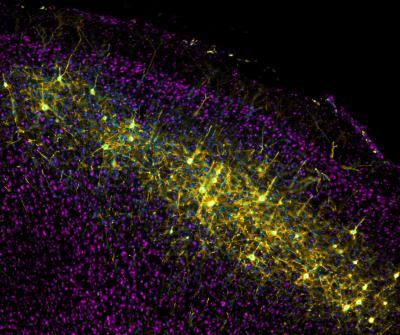
Salk and Gladstone Institute scientists have found a way to untangle neural networks by enhancing a brain mapping technique that they first developed in 2007.

“These initial results should be treated as a resource not only for decoding how this network guides the vast array of very distinct brain functions, but also how dysfunctions in different parts of this network can lead to different neurological conditions,” said Salk professor Edward Callaway.

The researchers combined mouse models with a tracing technique known as the monosynaptic rabies virus system to assemble maps of neurons that connect with the basal ganglia, a region of the brain that is involved in movement and decision making.

“The monosynaptic rabies virus approach is ingenious in the exquisite precision that it offers compared with previous methods, which were messier with a much lower resolution,” explained Gladstone investigator Professor Anatol Kreitzer.  “In this paper, we took the approach one step further by activating the tracer genetically, which ensures that it is only turned on in specific neurons in the basal ganglia. This is a huge leap forward technologically, as we can be sure that we’re following only the networks that connect to particular kinds of cells in the basal ganglia from other parts of the brain.”