
 http://mimobaby.com/
Sensor based baby monitoring is receiving a lot of exposure at CES. One such monitor, by Mimo baby, includes three parts: the Kimono, the Turtle and the Lilypad station. The Kimono is a cotton onesie, with machine washable sensors, worn by a baby when sleeping. It houses the Turtle, which tracks a baby’s respiration, skin temperature, body position and activity levels. The Turtle conveys the information via Bluetooth to the base station, called Lilypad, in the baby’s sleep room. The Lilypad is connected to the home Wi-Fi network. It processes the information and transmits it to a smartphone app.
Author: lisaweiner

Wearable tech. Digital health. Quantified self. mHealth. Connected home. Internet of things. However described, the phenomenon of using sensor technology to monitor, adapt, diagnose, gamify, and improve our health is in full swing at the Consumer Electronics Show. As sensors become better and cheaper, signal processing becomes more sophisticated, and mobile technology becomes ubiquitous, the revolution in health and fitness will continue. With this revolution comes the need for knowledge. The knowledge to understand which technology can save one’s life; which gadgets are fun to have; and what is purely hype. In the next days we will hear a lot about what’s happening in Las Vegas. About brainwave headbands , heartbeat detecting watches, sleep monitoring gadgets, measuring babies’ vital signs, helping seniors age in place, and even ways to correct our posture, mood, and eating habits, through technology. This intersection of science + technology + digital health is ApplySci’s raison d’etre. Our scientific committee leads our focus on the brain and neuro-technology, assistive technologies, and advances in monitoring the lungs, heart, diabetes, sleep, seniors, babies, and, of course, fitness – the key to wellness. It is our pleasure, through our blog, conferences, and our soon to emerge from beta crowdfunding platform, to curate this movement. To apply science to change our world.
Lisa Weiner Intrator, January 2014.
 http://www.nytimes.com/2014/01/07/science/the-brain-in-exquisite-detail.html?smid=tw-nytimes
Computers and mathematical tools for analyzing vast amounts of data are making the goal of mapping the brain possible, as reported in today’s New York Times.
Professor Deanna Barch leads Washington University’s project, which requires 1,200 healthy people, ages 22 to 35, to spend four hours over two days in a customized MRI machine. The subjects spend another six hours taking tests designed to measure intelligence, basic physical fitness, tasting ability and their emotional state. “In an ideal world, we would have enough tasks to activate every part of the brain. We got pretty close. We’re not perfect, but pretty close,” said Barch.
The data is processed and incorporated into a three-dimensional, interactive map of the healthy human brain, showing structure and function, with detail to one and a half cubic millimeters. The researchers then spend another 10 hours analyzing and storing each person’s data to build a neuroscience first: a baseline database for structure and activity in a healthy brain that can be cross-referenced with personality traits, cognitive skills and genetics. It will be online, in an interactive map available to all.
.jpg) http://www.utsandiego.com/news/2013/Dec/01/vaccine-nanoparticles-ucsd-efficient/
http://www.utsandiego.com/news/2013/Dec/01/vaccine-nanoparticles-ucsd-efficient/
UCSD professor Liangfang Zhang has developed a “nanosponge vaccine” which has enabled the immune systems of mice to block the adverse effects of the alpha-haemolysin toxin from MRSA—both within the bloodstream and on the skin.
The nanosponges in the “toxoid vaccine” platform are bio-compatible particles made of a polymer core wrapped in a red-blood-cell membrane. Each nanosponge’s red-blood-cell membrane seizes and detains the Staphylococcus aureus toxin alpha-haemolysin without compromising the toxin’s structural integrity through heating or chemical processing. These toxin-studded nanosponges served as vaccines capable of triggering neutralizing antibodies and fighting off otherwise lethal doses of the toxin in mice.
The nanosponge vaccine approach could be used to create vaccines that protect against a wide range of toxins, including those produced by E. coli and H. pylori.
 http://www.cs.tau.ac.il/~ruppin/mta_aging.pdf
Tel Aviv University Professor Eytan Ruppin‘s lab has developed an algorithm to predict which genes can be “turned off” to create the same anti-aging effect as calorie restriction.
“Most algorithms try to find drug targets that kill cells to treat cancer or bacterial infections,” said Keren Yizhak, lead researcher. “Our algorithm is the first in our field to look for drug targets not to kill cells, but to transform them from a diseased state into a healthy one.”
Professor Ruppin is a leader in genomic scale metabolic monitoring, which describes the metabolism of living cells. Yizhak’s “metabolic transformation algorithm” can take information about any two metabolic states and predict environmental or genetic changes required to go from one to the other.
 http://www.copa2014.gov.br/en/noticia/brazilian-neuroscientist-miguel-nicolelis-unveil-walk-again-project-fifa-world-cup-brazil
Duke Professor Miguel Nicolelis‘s brain controlled exoskeleton technology may enable a paraplegic teen to kick off the 2014 World Cup in Brazil. The plan is for the teenager to walk onto the field, cock back a foot, and swing at a soccer ball, using a mechanical exoskeleton controlled by his/her brain.
Motorized metal braces tested on monkeys will support and bend the kicker’s legs. The braces will be stabilized by gyroscopes and powered by a battery carried by the kicker in a backpack. Sensors will relay a feeling of pressure when each foot touches the ground. Months of training on a virtual-reality simulator will have prepared the teenager to do this using a device that translates thoughts into actions.
 http://www.pnas.org/content/early/2013/12/26/1316253111.abstract
Rice University researchers have developed noninvasive technology that accurately detects malaria through the skin in seconds with a laser scanner. The “vapor nanobubble” requires no dyes or diagnostic chemicals, and there is no need to draw blood. In a recent study, the technology detected even a single malaria-infected cell among a million normal cells with zero false-positive readings.
The new diagnostic uses a low-powered laser that creates tiny vapor “nanobubbles” inside malaria-infected cells. The bursting bubbles have a unique acoustic signature that allows for an extremely sensitive diagnosis.
 http://hub.jhu.edu/2013/01/02/prosthetic-arm-60-minutes
The number of researchers developing advanced prosthetics, particularly thought controlled limbs, is increasing rapidly. This can significantly impact the lives of many. In Johns Hopkins Universty’s Applied Physics Lab, a motorized arm with a five fingered hand that operates much like human hand is nearing completion.
Professor Michael McLoughlin and trauma surgeon Albert Chi have developed a technique known as targeted innervations—in which nerves can be rerouted through spare muscle, allowing amputees to operate motorized prosthetics using motor commands. In a recent surgery, Dr. Chi successfully combined this technique with the aforementioned prosthetic.
“The body is amazing in terms of its will to return to normal function,” Chi says. “When you have a missing limb, all the information is there, but the body has no way to get it out. So we rerouted the pathway for that information so that it can be expressed.”
Categories
Inkjet printed eye cells
 http://iopscience.iop.org/1758-5090/6/1/015001/article
Cambridge professors Keith Martin and Barbara Lorber have used inkjet printing technology to print cells taken from the eye. This could lead to the production of artificial tissue grafts made from the variety of cells found in the human retina and may aid in the search to cure blindness.
The researchers used a piezoelectric inkjet printer device that ejected the cells through a sub-millimetre diameter nozzle when a specific electrical pulse was applied. They also used high speed video technology to record the printing process with high resolution and optimised their procedures accordingly. Once printed, a number of tests were performed on each type of cell to see how many of the cells survived the process and how it affected their ability to survive and grow. The cells derived from the retina of the rats were retinal ganglion cells, which transmit information from the eye to certain parts of the brain, and glial cells, which provide support and protection for neurons. The results are preliminary.

http://arxiv.org/abs/1307.2196
Current Brain-computer interfaces offer finite resolution, are hard to apply to many brain regions, and can only stay directly connected to the brain for a short period of time due to their invasiveness. Berkeley researchers have proposed an ultra-small, ultrasound-based neural recording system called “neural dust”. It consists of thousands of sensors that are 10-100 micrometers in size containing CMOS circuits and sensors to detect and report local extracellular electrophysiological data. The neural dust is powered by ultrasonic waves via a transducer that is implanted just below the dura. The sub-dural unit interrogates the neural dust and sends information to another receiver outside the body.
This could provide a much higher resolution look inside the brain, as it will be able to record from thousands of sites, in contrast to the hundreds of channels allowed by current technology.
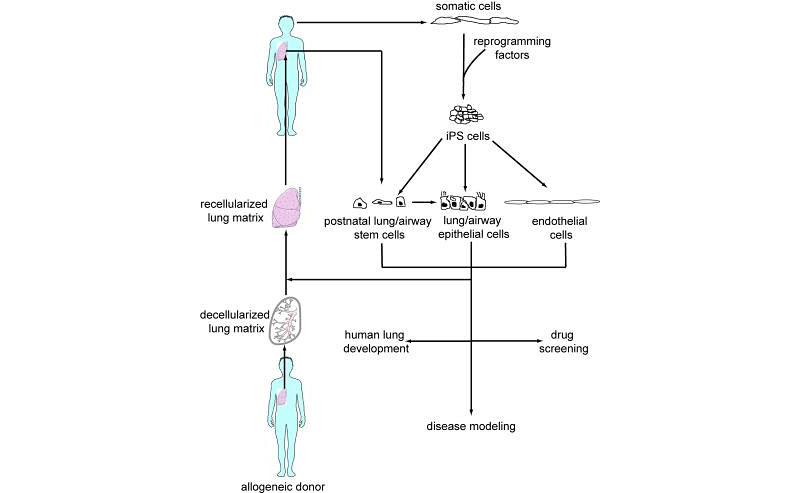
http://www.nature.com/nbt/journal/vaop/ncurrent/full/nbt.2754.html
Columbia professor Hans-Willem Snoeck and colleagues have transformed human stem cells into functional lung and airway cells. This has significant potential for modeling lung disease, screening drugs, studying human lung development, and, ultimately, generating lung tissue for transplantation.
The research builds on Dr. Snoeck’s 2011 discovery of a set of chemical factors that can turn human embryonic stem cells or human induced pluripotent stem cells into anterior foregut endoderm—precursors of lung and airway cells. Human iPS cells closely resemble human ES cells but are generated from skin cells, by coaxing them into taking a developmental step backwards. Human iPS cells can then be stimulated to differentiate into specialized cells—offering researchers an alternative to human ES cells.
The team have found new factors that can complete the transformation of human ES or iPS cells into functional lung epithelial cells. The resultant cells were found to express markers of at least six types of lung and airway epithelial cells, particularly markers of type 2 alveolar epithelial cells. Type 2 cells are important because they produce surfactant, a substance critical to maintain the lung alveoli, where gas exchange takes place; they also participate in repair of the lung after injury and damage.
The findings have implications for the study of several lung diseases, including idiopathic pulmonary fibrosis, in which type 2 alveolar epithelial cells are thought to play a central role.

Sun Yat-sen University researchers claim that Kinect based virtual reality training could promote the recovery of upper limb motor function in subacute stroke patients, and brain reorganization by Kinect based training may be linked to the contralateral sensorimotor cortex. They have completed a study in which they located the target brain region for Kinect based intervention and preliminarily explored the mechanism of the system for physical rehabilitation of upper limb dysfunction.