Categories
Cancer Ultrasound

Ultrasound combined with contrasting agent for radiation-free tumor detection

http://www.plosone.org/article/info%3Adoi%2F10.1371%2Fjournal.pone.0086642

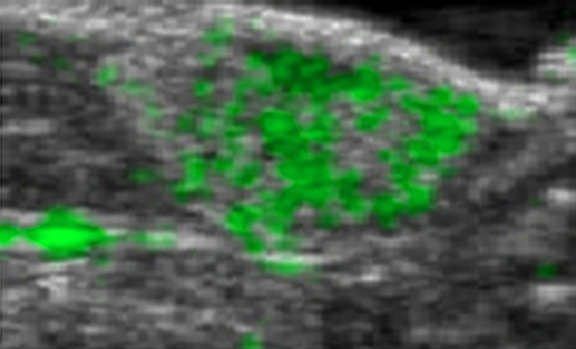
University of North Carolina Professor Nancy Klauber-Demore has improved the resolution and tumor-detecting ability of ultrasound scans.

Combining ultrasound with a contrast agent composed of tiny bubbles that pair with an antibody that many cancer cells produce at higher levels than do normal cells, Klauber-Demore was able to visualize lesions created by angiosarcoma.  By binding to the protein SFRP2, the contrast agent may help distinguish malignant from benign masses found on imaging.  Since SFRP2 is expressed in many cancers – including breast, colon, pancreas, ovarian, and kidney tumors – the technique could potentially be useful for a broad range of cancer types.  As the level of SFRP2 in tumors increases as tumors develop, the team will also investigate whether the technique can be used to track tumor growth.

Categories
Cancer mHealth Monitoring Sensors

Sensors detect radiation complications early, at home

http://www.ncbi.nlm.nih.gov/pubmed/24395986

Susan Peterson and colleagues at MD Anderson have completed a feasibility study showing that equipping head and neck cancer patients with home-based sensors can identify dehydration during radiation treatment.

Physicians reviewed patients’ information daily using CYCORE (CYberinfrastructure for COmparative Effectiveness REsearch), a software-based platform to collect and manage data from multiple systems through a suite of home-based and mobile sensors. They followed 48 patients during two five-day periods. Sensors were used to monitor daily weight and blood pressure fluctuations.  Patients also reported daily food and drink consumption, degree of pain with swallowing, and other side effects, using a smartphone.  60 percent of patients had at least one event that would suggest risk for dehydration and would warrant clinical intervention, and 35 percent had two or more events.

Categories
Cancer Sensors

Capsule endoscopy modification detects stomach cancer via “diagnostic pill”

http://www.inderscience.com/info/inarticle.php?artid=57925

Researchers at Chongqing University in China have developed an ingestible capsule capable of detecting chemical precursors of a gastric tumor. The findings might allow oncologists to catch the disease at a very early stage.  It is based on a modification of existing capsule endoscopy to detect occult bleeding  — tiny quantities of blood associated with the earliest stages of stomach cancer.

The diagnostic pill is encased in a non-toxic and acid-safe polycarbonate shell and carries its own power supply, transmitter, and a sensor with a detection limit of six micrograms per liter of fluid.

Categories
Cancer Sensors

Breath sensor identifies lung cancer

Journal of Thoracic Oncology

Metabolic processes are different in those with and without lung cancer.   Cleveland Clinic researchers have developed a colorimetric sensor that analyzes breath to identify lung cancer and characterize cancer histology.  The sensor evaluates the activity of antioxidant pathways, the handling of energy stress, and the metabolism of specific volatile organic compounds.

The technology used included nanoporous matrix for chemically reactive colorants.  The study involved patients with biopsy-proven untreated lung cancer, patients with a high clinical suspicion for lung cancer, and control subjects.  Samples were obtained while subjects performed tidal breathing through a volatile organic compound filter. The end tidal carbon dioxide level triggered the collection of the alveolar portion of the breath. Data were log-transformed to provide color values. The entire dataset was then reduced using univariate logistic regression.  The sensor was optimized with samples from 288 subjects. Accuracy was then tested with samples from 236 patients.

Categories
Cancer Data Machine Learning

MD Anderson uses IBM’s Watson supercomputer to accelerate cancer fighting knowledge

http://www-03.ibm.com/press/us/en/pressrelease/42214.wss

Houston’s MD Anderson Cancer Center is feeding IBM’s Watson “cognitive computer” case histories on more than 1 million leukemia patients, along with information about the disease, research and treatment options. Hospital staff and doctors hope it will help guide care and reduce the death rate. They also hope the supercomputer will be able to spot trends missed by researchers, possibly leading to suggestions for new targets for cancer drugs.

The collaboration with IBM is part of MD Anderson’s Moon Shots Program designed to use innovative approaches to fight eight deadly cancers.

Categories
Cancer Conference

Eliminating sugar slows cancer growth

http://www.scotsman.com/news/health/cutting-off-sugar-could-stop-cancer-growth-1-3024411

Old but important news: Eliminating sugar can slow cancer growth.

Researchers were aware that all cancer cells are attracted to sugar, grabbing it from the blood before using it to fuel their growth.  In breast cancer the process involves binding proteins called CtBPs together to form pairs known as dimers. These in turn help the cells to multiply and proliferate.  Dr Jeremy Blaydes of the University of Southampton found that chemicals called cyclic peptide inhibitors can block CtBPs and prevent the dimers forming.  The most successful of CtBP blocker, known as CP61, is now being developed as a potential new breast cancer drug.

This concept was put forth in the lecture given by Otto Warburg at his Nobel ceremony in 1931.  The short story: cancerous cells rely more on sugar for their energy consumption than normal cells.

In related news, a new technique for detecting cancer by imaging the consumption of sugar with MRI  has been unveiled by University College London scientists.

Categories
Brain Cancer

Real-time MRI guided gene therapy for brain cancer

http://health.ucsd.edu/news/releases/Pages/2013-08-06-MRI-guided-gene-therapy-for-brain-cancer.aspx

Neurosurgeons at the University of California San Diego School and Moores Cancer Center utilize MRI navigational technology to guide the delivery of investigational gene therapy Toca 511, or vocimagene amiretrorepvec, precisely into a brain malignancy in an attempt to make it more susceptible to chemotherapy.

Categories
Cancer Ultrasound

Sound waves detect disease related changes in red blood cell shape

http://www.cell.com/biophysj/abstract/S0006-3495(13)00624-3

Ryerson University investigators used photoacoustics to create detailed images to detect changing shapes of red blood cells associated with diseases including maria, sickle cell anemia and certain types of cancer.

A drop of blood is placed under a microscope that picks up sounds produced by the cells. Researchers then focus a laser beam on the samples. As the blood cells absorb energy from the laser pulse, they release some of it in the form of sound waves, enabling scientists to understand details about the shape of the cell.

Categories
Cancer Monitoring

Nanotube sensor detects skin cancer

http://www.monell.org/news/news_releases/monell_led_research_identifies_scent_of_melanoma

A study from the Monell Center and the University of Pennsylvania suggests that non-invasive odor analysis may be a valuable technique in the detection and early diagnosis of human melanoma.  The researchers used sophisticated sampling and analytical techniques to identify VOCs from melanoma cells at three stages of the disease, as well as from normal melanocytes. All the cells were grown in culture.  They then examined VOCs from normal melanocytes and melanoma cells using a sensor constructed of nano-sized carbon tubes coated with strands of DNA and bioengineered to recognize a wide variety of targets, including specific odor molecules.

Categories
Cancer

DNA “nanotrain” for targeted cancer drug delivery

http://news.ufl.edu/2013/04/29/nanotrain/

The nanotrain cost-effectively delivers high doses of drugs to precisely targeted cancers and other medical maladies without leaving behind toxic nano-clutter.

“The beauty of the nanotrain is that by using different disease biomarkers you can hitch different types of DNA probes as the train’s ‘locomotive’ to recognize and target different types of cancers,” said Weihong Tan of the University of Florida. “We’ve precisely targeted leukemia, lung and liver cancer cells, and because the DNA probes are so precise in targeting only specific types of cancer cells we’ve seen dramatic reduction in drug toxicity in comparison to standard chemotherapies, which don’t discriminate well between cancerous and healthy cells.”

Categories
Cancer

Chip could individualize prostate cancer treatment

http://cedars-sinai.edu/About-Us/News/News-Releases-2013/New-diagnostic-technology-may-lead-to-individualized-treatments-for-prostate-cancer-.aspx

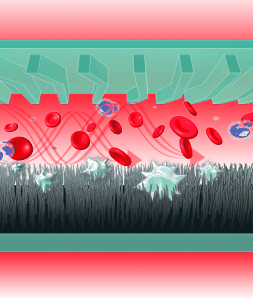
A research team jointly led by scientists from Cedars-Sinai Medical Center and the University of California, Los Angeles, have enhanced a device they developed to identify and “grab” circulating tumor cells, or CTCs, that break away from cancers and enter the blood, often leading to the spread of cancer to other parts of the body.

If more studies confirm the technology’s effectiveness, the NanoVelcro Chip device could enable doctors to access and identify cancerous cells in the bloodstream, which would provide the diagnostic information needed to create individually tailored treatments for patients with prostate cancer.

With the new system, a patient’s blood is pumped through the NanoVelcro Chip — the microvilli protruding from the cancer cells will stick to the nanofiber structures on the device’s surface, much like Velcro. This phenomenon facilitates the capture of rare CTCs in the blood stream. Next, laser capture microdissection technology allows the scientists to selectively cut out and pick up the CTCs from the NanoVelcro Chip, virtually eliminating any trace of any contamination from white blood cells, which can complicate analysis. Finally, the isolated and purified CTCs are subjected to single cell “next-generation” sequencing, which reveals mutations in the genetic material of the cells and may help doctors personalize therapies to a patient’s unique cancer.

“To date, CTC capture technologies have been able to do little more than count the number of CTCs, which is informative but not very useful from a treatment planning perspective. It is a scientific breakthrough to have the ability to isolate pure CTCs and maintain their integrity for sophisticated genomic and behavioral analyses,” said Hsian-Rong Tseng, PhD, associate professor of molecular and medical pharmacology at UCLA and the inventor of the NanoVelcro Chip concept and device.