Categories
BCI Brain fMRI

Neurofeedback enhances signal-to-noise ratio in thought

http://research.vtc.vt.edu/news/2013/sep/13/covert-operations-your-brain-digitally-remastered/.

Virgina Tech Carillon Professor Stephen Laconte developed technology to transfer non-invasive brain activity measurements into control signals that drive physical devices and computer displays in real time. The study suggests that the signal-to-noise ratio of the brain activity underlying our thoughts can be remastered. Researchers used whole-brain, classifier-based real-time fMRI to understand the neural underpinnings of brain-computer interface control.

24 subjects were asked to control a visual interface by silently counting numbers at fast and slow rates. For half the tasks, the subjects were told to use their thoughts to control the movement of the needle on the device they were observing; for the other tasks, they simply watched the needle.  Scientists discovered a feedback effect: the subjects who were in control of the needle achieved a better whole-brain signal-to-noise ratio than those who simply watched the needle move.  The act of controlling the computer-brain interface also led to an increased classification accuracy, which corresponded with improvements in the whole-brain signal-to-noise ratio.

This enhanced signal-to-noise ratio has implications for brain rehabilitation.

Categories
Sensors

Miniature, lab-engineered “organs” create “body on a chip”

http://www.bbc.co.uk/news/technology-24125678

The US Department of Defense and Wake Forest University are developing miniature human organs with 3D printers to enable better drug testing.

The 2-inch “body on a chip” would be a testing ground for understanding how the human body might react to dangerous diseases, chemical warfare agents and new drugs intended to defend against biological or chemical attacks. This could speed drug development by replacing less ideal animal testing or testing done on human cells in petri dishes — and save time and money on drug candidates that fail in human clinical trials.

Tony Atala, director of the Wake Forest Institute for Regenerative Medicine, has pioneered 3D printing methods that aim to build human organs with layer upon layer of cells. Their bioprinting methods lay down the cell layers along with artificial scaffolding to keep an organ’s structure intact as it takes shape — a technique that has allowed the group to make tiny, less complex versions of full-size human organs.

The tiny organs intended for the “body on a chip” project don’t represent fully functional hearts, livers and kidneys. Instead, they represent small chunks of human tissue from such organs connected together by a system of fluid channels that circulate blood substitute to keep the cells alive — all placed on a 2-inch chip with sensors to monitor everything.

Having an artificial circulatory system means researchers can introduce biological or chemical agents into the “blood” to see how it affects the different organs. The system’s sensors would measure the temperature, oxygen levels, pH and other factors affecting the “body on a chip.”

Categories
Conference

Real-time detector for intravenously delivered drugs

http://phys.org/news/2013-09-real-time-detector-iv-drugs-life-threatening.html

A University of Illinois developed optical device can identify fluid in an IV line in real-time, improving the safety of delivery.  Professor Brian T. Cunningham and his team used Surface-Enhanced Raman Scattering (SERS) technology, a powerful analytical tool prized for its extreme sensitivity in obtaining molecular signals that can be used to identify chemicals. To determine the identity of a particular IV medication, researchers shine laser light onto a nanostructured gold surface that contains millions of tiny “nano-domes” that are separated from each other by as little as 10 nanometers.  The nano-domes are incorporated into the inner surface of IV tubing, where they are exposed to drugs that are dispersed in liquid. They capture the light scattered from drug molecules that are in contact with the nano-domes and use SERS to determine the drug’s molecular signature. Finally, they match the signature to known signatures for the drug in order to confirm the presence of a specific medication in the IV line.

Categories
mHealth Monitoring Seniors Sensors

Ambient Assisted Living system monitors senior health at home

http://www.theengineer.co.uk/medical-and-healthcare/news/wireless-system-provides-ambient-health-monitoring-of-elderly/1017120.article

One outcome of the EU’s support of Ambiant Assistant Living is the following multi-bio-marker home monitoring device which continuously monitors glucose, cholesterol and blood oxygen levels.  It is expected that several similar monitors will be introduced in the near future, enabling seniors to better manage various diseases at home.

Fraunhofer FIT has developed an AAL system using miniature sensors integrated into one platform.  A nano potentiostat measures biochemical information in a patient’s assay, including glucose, lactate and cholesterol levels. A fluorescence sensor is used to detect color-marked biomarkers. An SpO2 sensor monitors heart rate and arterial oxygen saturation. A smartphone app processes the data from the three sensors and transfers them to a server. For secure data communication, a Bluetooth connection with a specifically developed protocol is used.

Categories
Conference

Collaborative robots work alongside humans

http://www.economist.com/news/technology-quarterly/21584455-robotics-new-breed-robots-being-designed-collaborate-humans

The Economist’s Technology Quarterly describes several examples of “collaborative robots” with qualities that allow them to team with people in factories, at home, or in the classroom.

Categories
Assistive Technologies BCI Brain Conference Seniors Wearables

Data glasses controlled by eye movement — an alternative to brain machine interface

http://www.domain-b.com/technology/20130912_movements.html

Researchers at the Fraunhofer Institute have developed bidirectional OLED microdisplay eye-controlled data glasses.  Users can view the real world while browsing a large amount of virtual information and turn pages with their eyes.

Integrated camera sensors register the direction of the wearer’s eye movements and an image processing program calculates the exact position of their pupils in real time.  An infrared light source in the glass frame produces accurate positioning results even in low light.

The glasses can enable elderly and disabled people to attract attention in emergencies using nothing but their eyes – or simply provide a way to change the TV channel using specific eye movements.

Categories
BCI Brain

Duke researchers link visual stimulus with tactile sensation

http://www.dukehealth.org/health_library/news/touch-and-movement-neurons-shape-the-brain-s-internal-image-of-the-body

Miguel Nicolelis is one of the main contributors to brain machine interface.  In a series of innovative experiments, he demonstrates the intricate connections in the brain, attempting to create a coherent model of multi-sensory input.  His recent experiment shows that monkeys can be tricked when the multi-sensory input is only partially coherent.

A related study from Stockholm’s Karolinska Institute describes humans distorted self perception due to incoherency between visual and tactile input.

In the Nicolelis study, untrained monkeys were implanted with up to 384 electrodes to analyze how stimulus was encoded by the monkey brain. The monkeys were then shown a virtual simulation of their arm being touched, while simultaneously having their own arm touched. After a few minutes of synchronized stimulation, the physical component was removed. The areas of the monkeys’ brains responsible for tactile sensations, however, continued to respond to the virtual simulation, indicating that they felt physical sensation simply through visual association. The monkeys’ neuronal responses to the virtual stimulation came later than the responses to the physical stimulation. This suggests that the sensation was mediated by a longer pathway involving the visual system.

Instead of previously imagined single neuronal pathways, seemingly unrelated cortices apparently use a highly dynamic, cross functional process to form more of a continuously interacting grid or network. They also appear to cooperate quite closely in shaping the body schema, or the brain’s internal representation of the body

Categories
Conference

“Artificial nose” speeds sepsis diagnosis

http://phys.org/news/2013-09-artificial-nose-device-diagnosis-sepsis.html
Researchers at the National University of Kaohsiung in Taiwan and the University of Illinois have developed an “artificial nose” capable of detecting the odor of germs that lead to blood poisoning.  Within 24 hours it determines whether a patient’s blood has bacteria that cause sepsis, a gain of up to two days over conventional methods.

The “nose” is a palm-sized plastic bottle filled with a liquid nutrient that helps bacteria to grow.  Attached to the inside of the bottle is a small array of chemical dots that change color in reaction to the odors released by the bacteria. The device can identify eight of the most common disease causing bacteria.

Other work in an “artificial nose” has yielded prototypes that can detect forms of cancer in a patient’s breath, and the presence of certain kinds of explosives.

Categories
Brain Seniors

Video game improves cognition in seniors

http://www.ucsf.edu/news/2013/09/108616/training-older-brain-3-d-video-game-enhances-cognitive-control

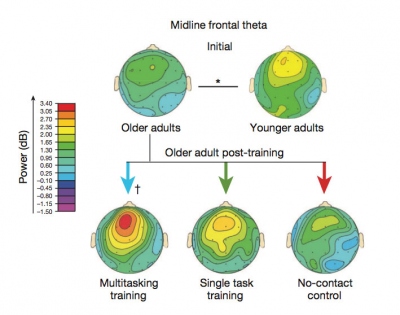
UCSF researchers found that older adults improved cognitive controls, including multitasking and the ability to sustain attention, by playing a specially designed videogame — and that the effects can be long lasting.

In the game, participants race a car around a winding track while a variety of road signs pop up. Drivers are instructed to keep an eye out for a specific type of sign, while ignoring all the rest, and to press a button whenever that particular sign appears.  The need to switch rapidly from driving to responding to the signs – i.e. multitasking – generates interference in the brain that undermines performance. The researchers found that this interference increases dramatically across the adult lifespan.

The study found that after training, the older adults were able to perform at a higher level than untrained 20-year-olds and that the positive effects lasted for at least six months.

Scientists continue to explore the connection between videogames and the brain’s information-processing functions, such as memory, attention, decision-making and creativity.

Categories
Brain

Imaging technology distinguishes between brain tissue and tumors at microscopic level

http://stm.sciencemag.org/content/5/201/201ra119

Harvard’s Xiaoliang Sunney Xie and Minbiao Ji used SRS microscopy (Stimulated Raman Scattering) to “see” the tiniest areas of tumor cells in brain tissue, and to distinguish tumor from healthy tissue in the brains of living mice.  They then showed that the same was possible in tissue removed from a patient with glioblastoma multiforme, one of the most deadly brain tumors.

Professor Xie described that “Biopsy has been the gold standard for detecting and removing these types of tumors.  But this technique, we believe, is better because it’s live. Surgeons can now skip all the steps of taking a biopsy, freezing, and staining the tissue. This technique allows them to do it all in vivo.”

SRS works by shining non-invasive lasers into tissue and detecting the weak signal that emerges. By analyzing the signal’s spectrum, researchers can build images of the cellular makeup of the tissue. By amplifying those signals, they transform a technique that once took hours or days into one that works in real time, and could offer a critical insight to surgeons in the operating room. Since brain tissue and tumors contain different chemical makeups, researchers can create images that precisely show where the tumor “margin” — the boundary area where tumor cells infiltrate among normal cells — is located, helping to guide surgeons in the operating room.

Categories
Heart Sensors Wearables

ECG wristband sensors use your heartbeat as your password

http://www.getnymi.com

The Nymi wristband confirms a user’s identity via electrocardiogram sensors that monitor the heartbeat and can authenticate a range of devices, from iPads to cars. Developers at Bionym, the Toronto-based company that makes the device, say the peeks and valleys of an individual’s heartbeat are harder to imitate than the external features of biometric systems, like fingerprints or facial recognition.  Bionym describes the process:

“When you clasp the Nymi around your wrist it powers on. By placing a finger on the topside sensor while your wrist is in contact with the bottom sensor, you complete an electrical circuit. After you feel a vibration and see the LEDs illuminate, your Nymi knows you are you and your devices will too. You will stay authenticated until your Nymi is taken off.”

Categories
fitness Heart mHealth Monitoring Wearables

Mayo Clinic studies step tracking data as a post-surgery monitoring tool

http://www.annalsthoracicsurgery.org/article/S0003-4975(13)01253-8/fulltext

Mayo Clinic has published a study using step recording from a  Fitbit activity tracker to monitor recovery in cardiac surgery patients and help hospitals determine the appropriate length of stay.  Those who had the shortest hospital stay walked the most on all days in the study, by a statistically significant margin. Likewise, patients bound for home walked more than those headed for a nursing facility.