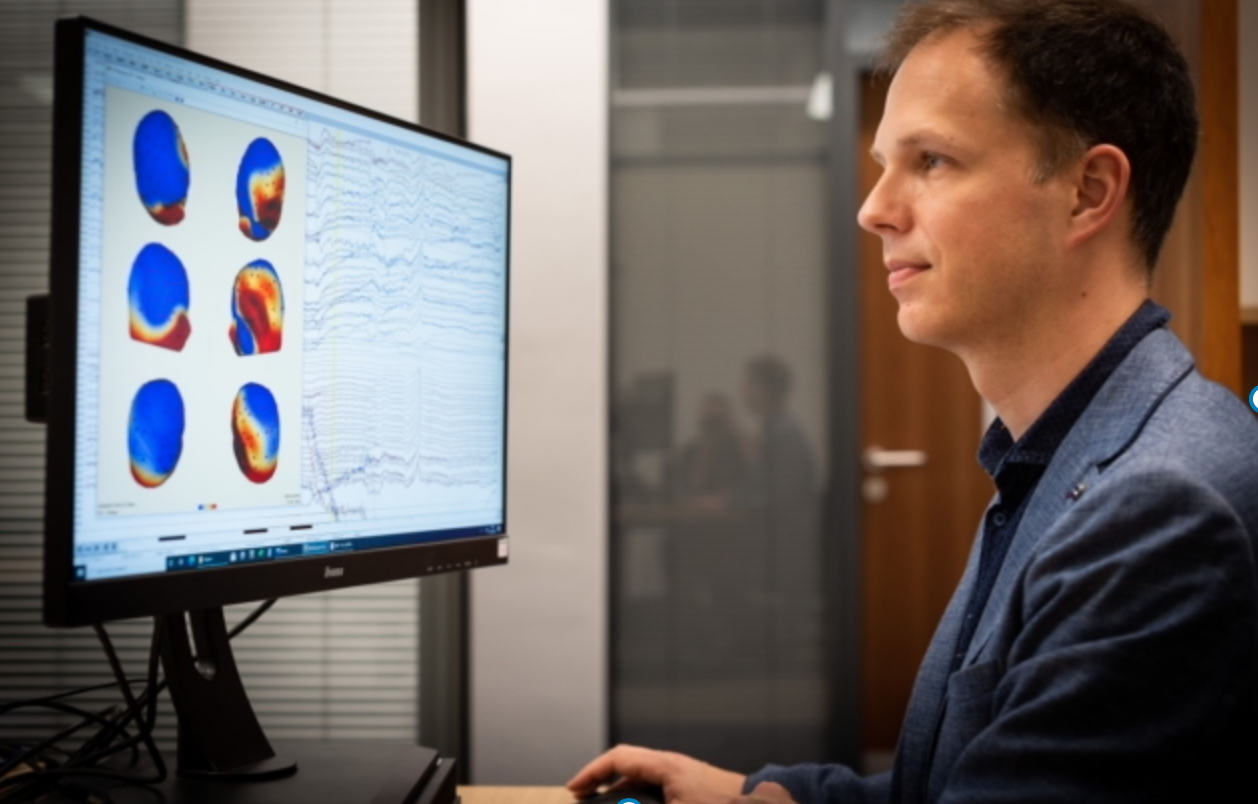
George Sothart and University of Bath colleagues have developed a new, EEG + game memory assessment technique which could enable the earlier diagnosis of Alzheimer’s disease, the underlying cause of around 60% of dementia cases..
The need for early diagnosis tools to help doctors to prescribe lifestyle interventions to slow the rate of cognitive decline is obvious. This tool could also help identify dementia patients for clinical trials.
“Fastball EEG” is passive. The person performing the test is not given priorinstructions prior to the task, as dementia patients may struggle to follow complex directions, and is not asked to reflect on, respond to or remember any items. She or he simply watches a screen of flashing images.
Two discrete frequency responses are captured, reflecting the participant’s periodic neural responses to the stimuli. The first reflects visual processing; the second mirrors the brain’s response to previously seen images and reflects recognition memory. Analyzing the EEG spectrum at the second, slower frequency can quantify the patient’ memory response.
Fastball EEG was studied in 20 patients with Alzheimer’s disease, 20 healthy older adults and 20 healthy younger adults. For both the recognition and repetition conditions, Fastball EEG detected significantly impaired recognition memory in Alzheimer’s disease patients compared with healthy older control subjects. There were no differences between the two groups under the control condition, where image recognition was not included. The Fastball test could also discriminate Alzheimer’s disease patients from healthy older adult controls, with an accuracy of 86%. No significant performance differences were seen between older and younger healthy controls.
After the Fastball task, participants completed a forced-choice task, in which they had to identify a previously seen image from two alternatives. Here, the researchers observed little difference between Alzheimer’s disease patients and controls, suggesting that Fastball was more sensitive to memory performance than this behavioral recognition test.
Join ApplySci at MIT on April 8, 2022 for Wearable Tech + Digital Health + Neurotech Boston