Categories
Brain

Glowing worm imaging system to study neural circuitry; can impact drug development

http://www.pnas.org/content/110/45/E4266

Worcester Polytechnic Institute and Rockefeller University researcher in have developed a system to image brain activity in multiple awake and unconstrained worms. The technology makes it possible to study the genetics and neural circuitry associated with animal behavior.  It can also be used as a high-throughput screening tool for drug development targeting autism, anxiety, depression, schizophrenia, and other brain disorders.

Numerous studies have been done by “worm labs” around the world exploring various neurological processes in C. elegans. These have typically been done using one worm at a time, with the animal’s body fixed in place on a slide. In his paper, Professor Dirk Albrecht’s team details how they imaged, recorded, and analyzed specific neurons in multiple animals as they wormed their way around a custom-designed microfluidic array, called an arena, where they were exposed to favorable or hostile sensory cues.

The team engineered a strain of worms with neurons near the head that would glow when they sensed food odors. In experiments involving up to 23 worms at a time, Albrecht’s team infused pulses of attractive or repulsive odors into the arena and watched how the worms reacted. In general, the worms moved towards the positive odors and away from the negative odors, but the behaviors did not always follow this pattern.

In addition to watching the head neurons light up as they picked up odor cues, the new system can trace signaling through “interneurons.” These are pathways that connect external sensors to the rest of the network (the “worm brain”) and send signals to muscle cells that adjust the worm’s movement based on the cues. Numerous brain disorders in people are believed to arise when neural networks malfunction. In some cases the malfunction is dramatic overreaction to a routine stimulus, while in others it is a lack of appropriate reactions to important cues. Since C. elegans and humans share many of the same genes, discovering genetic causes for differing neuronal responses in worms could be applicable to human physiology. Experimental compounds designed to modulate the action of nerve cells and neuronal networks could be tested first on worms using Albrecht’s new system. The compounds would be infused in the worm arena, along with other stimuli, and the reaction of the worms’ nervous systems could be imaged and analyzed.

Categories
Monitoring Seniors Sensors

NEC’s PaPeRo Petit robot uses third party apps to monitor seniors at home

http://jpn.nec.com/press/201311/20131111_01.html

NEC has introduced the PaPeRo Petit robot, which is about half the size of earlier PaPeRo senior companions, and a cloud computing system for services using the new robot.  PaPeRo Petit combines multiple sensors (cameras, ultrasonic range finders, temperature sensor, and microphones) to detect people and look in their direction even in complete darkness.  It can also link to online databases to better communicate with loved ones.  The robot can recognize faces and has between 80 to 90 percent success rate at speech recognition.

Categories
Brain

Signal enhances survival of new brain cells – can impact treatment of Alzheimers, Schizophrenia

http://www.nature.com/neuro/journal/vaop/ncurrent/full/nn.3572.html

Last year Johns Hopkins researchers reported that brain cells known as parvalbumin-expressing interneurons instruct nearby stem cells not to divide by releasing a chemical signal called GABA.

In a new study, Professors Hongiun Song and Guo-li Ming wanted to find out how GABA from surrounding neurons affects the newborn neurons that stem cells produce. Many of these newborn neurons naturally die soon after their “birth,” Song says; if they do survive, the new cells migrate to a permanent home in the brain and forge connections called synapses with other cells.

To learn whether GABA is a factor in the newborn neurons’ survival and behavior, the research team tagged newborn neurons from mouse brains with a fluorescent protein and then watched their response to GABA.

“We didn’t expect these immature neurons to form synapses, so we were surprised to see that they had built synapses from surrounding interneurons and that GABA was getting to them that way,” Song says. In the earlier study, the team had found that GABA was getting to the synapse-less stem cells by a less direct route, drifting across the spaces between cells.

The team engineered the interneurons to be either stimulated or suppressed by light. When stimulated, the cells would indeed activate nearby newborn neurons, the researchers found. They next tried the light-stimulation trick in live mice, and found that when the specialized interneurons were stimulated and gave off
more GABA, the mice’s newborn neurons survived in greater numbers than otherwise. This was in contrast to the response of the stem cells, which go dormant when they detect GABA.

“This appears to be a very efficient system for tuning the brain’s response to its environment,” says Song. “When you have a high level of brain activity, you need more newborn neurons, and when you don’t have high activity, you don’t need newborn neurons, but you need to prepare yourself by keeping the stem cells active. It’s all regulated by the same signal.”

Song notes that parvalbumin-expressing interneurons have been found by others to behave abnormally in neurodegenerative diseases such as Alzheimer’s and mental illnesses such as schizophrenia.

Categories
Brain Sensors

Smart foam measures football helmet impact

http://news.byu.edu/archive13-nov-helmetsmartfoam.aspx

Brigham Young University researchers have developed a “smart foam” helmet lining for immediate, real-time measurements of each hit that a football player endures. The measurements are communicated immediately to a hand-held device, telling coaches if a collision is capable of inducing a concussion, even if the player denies a problem.

“ExoNanoFoam” is a  nano-enabled foam that behaves as a piezoelectric in which pressure on the material produces an electrical voltage. A microcontroller sensor in the helmet reads the electrical voltage produced by the foam, and sends a signal to a tablet equipped with a program that interprets it and delivers real-time information on the seriousness of the hit sustained by the player.

As the foam is in contact with the player’s head, it provides a more accurate measurement of the forces on the player’s head than previously used accelerometers.  Accelemeters only measure the acceleration or deceleration of the player’s helmet.

Categories
Assistive Technologies BCI Brain

Monkeys in Nicolelis lab control both arms using brain activity

http://stm.sciencemag.org/content/5/210/210ra154.short?rss=1

Duke’s Miguel Nicolelis continues to advance brain machine interface, and in his latest experiment, monkeys have learned to control the movement of both arms on an avatar using their brain activity.

The findings  advance efforts to develop bilateral movement in brain-controlled prosthetic devices for severely paralyzed patients.  Until now brain-machine interfaces could
only control a single prosthetic limb.

Categories
Diabetes Monitoring Nanotubes Sensors

Implanted nanotube sensor monitors health for up to one year

http://web.mit.edu/newsoffice/2013/new-implantable-sensor-1103.html

MIT scientists are developing injectable and embeddable carbon nanotube sensors that can monitor blood sugar levels, inflammation, and other health issues.  The continuous monitor can stay in a person’s body for up to a year.

Researcher Nicole Iverson wrapped carbon nanotubes in DNA sensitive to nitric oxide and made two types of sensors.  One is injectable for short-term monitoring of problems such as a reaction during surgery.  The other is implanted for long-term monitoring of cancer, diabetes or immune reactions to artificial joints.

The next step will be to link the nanotube sensor to a medical device, such as an insulin pump. The sensor would be implanted under a person’s skin, detecting blood glucose levels. The nanotubes would fluoresce when exposed to certain levels of glucose, and the light could signal the pump to start working and release insulin.

Categories
Assistive Technologies BCI

“Bionic” arm exoskeleton concept for rehabilitation and strength augmentation

http://titanarm.com/about

Titan Arm is an untethered, powered, upper body exoskeleton concept for use in rehabilitation and therapeutic applications, which can also augment strength.  It is under development and not yet ready to be brought to market, but is being designed by students at The University of Pennsylvania.  It straps directly to a user’s right arm to help lift heavy objects. Its inventors believe that it will be useful in aiding physical rehabilitation, both for people who have suffered upper body injuries and for those with pre-existing muscular-skeletal disorders.  The bionic limb can lift approximately 40 pounds of weight, and is predominantly made of aluminum and steel components, and powered by a DC battery.

Categories
Cancer Sensors

Breath sensor identifies lung cancer

Journal of Thoracic Oncology

Metabolic processes are different in those with and without lung cancer.   Cleveland Clinic researchers have developed a colorimetric sensor that analyzes breath to identify lung cancer and characterize cancer histology.  The sensor evaluates the activity of antioxidant pathways, the handling of energy stress, and the metabolism of specific volatile organic compounds.

The technology used included nanoporous matrix for chemically reactive colorants.  The study involved patients with biopsy-proven untreated lung cancer, patients with a high clinical suspicion for lung cancer, and control subjects.  Samples were obtained while subjects performed tidal breathing through a volatile organic compound filter. The end tidal carbon dioxide level triggered the collection of the alveolar portion of the breath. Data were log-transformed to provide color values. The entire dataset was then reduced using univariate logistic regression.  The sensor was optimized with samples from 288 subjects. Accuracy was then tested with samples from 236 patients.

Categories
Sensors

Light guiding hydrogel for cell based sensing

http://hms.harvard.edu/news/talking-light-10-22-13http://www.nature.com/nphoton//journal/vaop/ncurrent/abs/nphoton.2013.278.html

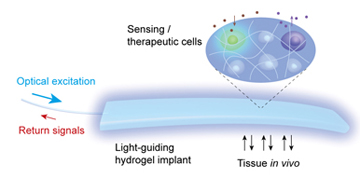
Harvard Medical School researchers have developed a way to deliver a light signal to specific tissues deep within the body.  Called a light-guiding hydrogel, the implant is constructed from a polymer-based scaffolding capable of supporting living cells. The hydrogel contains cells genetically engineered either to carry out a specific activity in response to light or to emit light in response to a particular metabolic signal. An optical fiber connects the implant to an external light source or light detector.

In one experiment, the scientists used programmed HeLa cells that were caused to emit a kind of protein when exposed to light. When that protein is produced in the body, the pancreas creates more insulin. A means of controlling diabetes was shown. In another experiment, the researchers filled the hydrogel with cells that light up when exposed to a certain toxin, then after implanting the hydrogel, injected mice with the toxin. Using the fiber cable in reverse, the researchers were able to see the cells in the hydrogel lighting up in response to the presence of the toxin

Categories
Assistive Technologies Eyes Heart Stroke Wearables

NIH funds robots for the vision impaired, stroke patients, doctors performing catheter ablation

http://www.nih.gov/news/health/oct2013/nibib-23.htm

Three projects have been awarded funding by the National Institutes of Health.  All involve robots that cooperate with people and adapt to changing environments to improve human capabilities and enhance medical procedures.

  • A co-robotic navigation device for the blind: Cang Ye at University of Arkansas is incorporating 3D imaging sensor technology into the white cane. This enables it to detect and relay to the user critical information about the environment, like when there’s a potential obstacle in the way.  In related research, Professor Amnon Shashua at The Hebrew University in Jerusalem, through his company OrCam, uses Artificial Vision to compensate for lost visual abilities, and Professor Amir Amedi at the Hebrew University of Jerusalem is also developing cutting edge technology to help the vision impaired. His projects include reading in the blind, sensory substitution devices, multisensory perception, topographic brain, and seeing with music and sound.
  • MRI-guided co-robotic catheter: During traditional catheter ablation for the treatment of atrial fibrillation, one of the most common arrhythmias, a catheter with an electrode on its tip is threaded through a vein in a patient’s groin up to the heart. Doctors destroy tissue at certain points on the heart in order to prevent the occurrence of irregular heart activity. The constant movement of the heart and blood can make that process difficult. Researchers at Case Western Reserve University are developing a catheter that uses robotic planning strategies to compensate for those movements to increase accuracy of procedures in conjunction with MRI.
  • Platform for exploration of robotic ankle exoskeleton control: Researchers at North Carolina State and Carnegie Mellon are developing a method to compare different wearable devices to assist people recovering from stroke.
Categories
AI Brain

IBM unveils prototype of “brain-inspired” computer

http://www.bbc.co.uk/news/science-environment-24571219

The human brain is 10,000 times more dense and efficient than any computer today.

IBM is using the brain as a design template, including using fluids to cool the machine and distribute electrical power. This could enable processing power that is densely packed into 3D volumes rather than spread out across flat 2D circuit boards with slow communication links.  The initiative is part of IBM’s “cognitive systems era” in which computers exhibit perception, make judgments, communicate with natural language, and learn from experience.

Categories
Parkinson's Sensors

Gait sensor for Parkinson’s patients could prevent falls

http://www.scientificamerican.com/article.cfm?id=could-a-simple-ankle-sensor-help-with-parkinsons-symptoms

University of Alabama professor Emil Jovanov is developing a sensory cue device to detect freezing of gait episodes that lead to falls and serious injuries.  It uses sensors embedded in a shoe or attached to the ankle. As soon as the system senses a gait freeze, it transmits an auditory cue (such as the word “walk”) to an earpiece, prompting the patient to keep moving.