
Categories
Brain

Pass-thoughts as the new passwords

http://phys.org/news/2013-04-password-future-passthoughts.html

Pass-thoughts are thoughts that a headset records through brainwaves. The computer learns what your individual brainwaves are like and then identifies you. Traditionally, these brainwaves, called electroencephalograms (EEGs), are collected through expensive and sometimes invasive devices, so the pass-thought growth has been severely stunted.

Berkeley’s John Chuang and his team conducted a series of experiments to determine whether a single, less expensive, non-invasive EEG channel provided high enough signal quality for accurate authentication. For authentication, the computer needs to be able to accurately and consistently distinguish your brainwave patterns from someone else’s.

By selecting customized tasks for each user and then customizing each user’s authentication thresholds, the team was able to reduce error rates to below 1%, comparable to the accuracy of more invasive multi-channel EEG signals.

Categories
Brain

A hard look at neuroscience research from The Economist

http://www.economist.com/blogs/babbage/2013/04/neuroscience
Sample sizes in neurological research are often too small to draw general conclusions.

Marcus Munafo, from the University of Bristol, and his colleagues analyzed hundreds of neuroscience studies to determine their “statistical power”.  If the researchers’ figures are accurate—and if the 12-month period they looked at is representative of neuroscience research in general—then the implications are alarming. Bluntly, much of the published neuroscientific research is likely to be reporting effects, correlations and “facts” that are simply not real. At the same time, real phenomena are going unnoticed.

Understanding the brain is the most important opportunity of our lifetime.  It’s afflictions and treatments can no longer be based on hypothesis, trial and error.  Let’s not miss it.

Categories
Assistive Technologies BCI

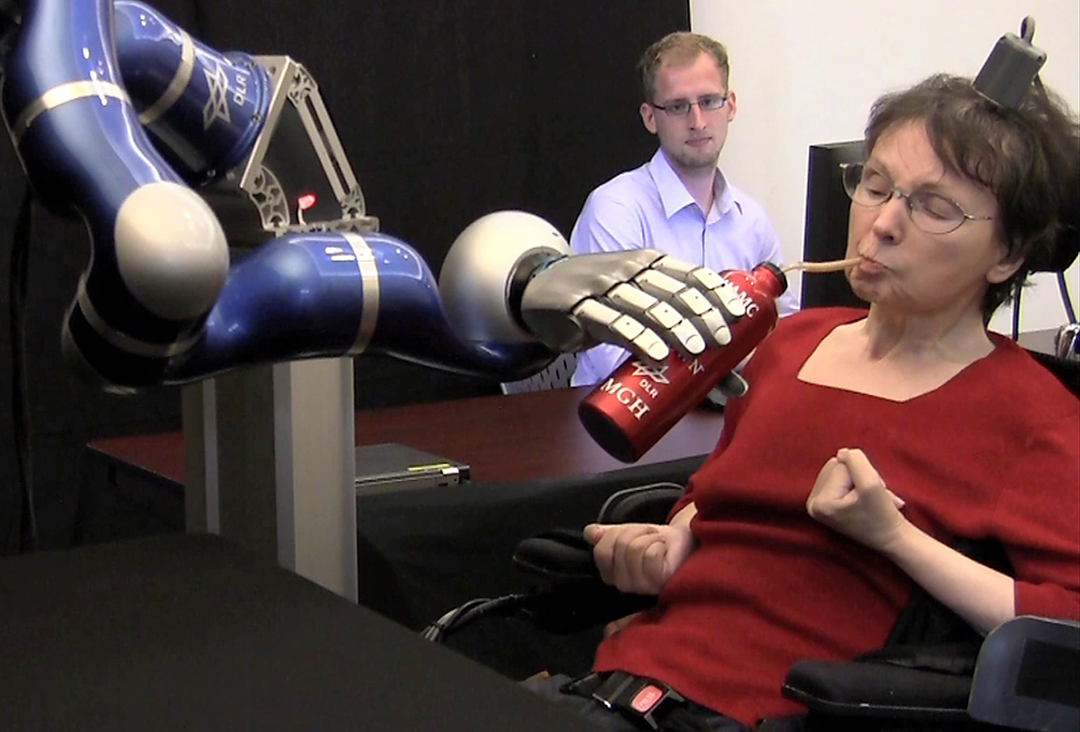
Brain-machine interface allows control of limbs through thoughts

http://www.fastcoexist.com/1681674/a-prosthetic-arm-controlled-by-your-thoughts

By placing a small sensor in the brain’s motor cortex, interfaces can pick up on electrical activity, and translate it into commands that control a robotic arm. Now scientists have gone a step further. Instead of a wired brain-arm link, they have now developed a wireless connection powerful enough to work at a distance of three feet.

“Clinical applications may include thought-controlled prostheses for severely neurologically impaired patients, wireless access to motorized wheelchairs or other assistive technologies, and diagnostic monitoring such as in epilepsy, where patients currently are tethered to the bedside during assessment,” says David Borton, at Brown University.

Categories
Crowdfunding Monitoring Seniors Sensors

Eldercare monitoring system based on social connections

http://mobihealthnews.com/21650/lively-a-new-eldercare-monitoring-system-focused-on-social-connections-heads-to-kickstarter/

Lively is an in-home sensor network for connecting elderly loved ones to their families.  The system combines a series of wireless sensors, a data-collection hub and biweekly printed mailers that serve as kind of an analog social network. The basic setup measures medication compliance, food and drink intake and general activity outside the home.

Lively is crowdfunding on Kickstarter, with a goal of $100,000.

Categories
Data Longevity

Protective genes vs lifestyle for longevity

http://ngm.nationalgeographic.com/2013/05/longevity/hall-text

Scientists studying longevity have begun using powerful genomic technologies, basic molecular research, and, most important, data on small, genetically isolated communities of people to gain increased insight into the maladies of old age and how they might be avoided.

Categories
Apps mHealth Monitoring Pregnancy Sensors

Mobile monitors for expectant mothers

http://www.fiercemobilehealthcare.com/special-reports/mobile-monitors-expectant-mothers

AirStrip OB is a mobile patient monitoring solution for women in labor. The system, developed by San-Antonio-based AirStrip Technologies, captures vital patient waveform data, including fetal heart tracing and maternal contraction patterns, in “virtual real time” and sends it to a physician’s mobile device.

Categories
Assistive Technologies

Bronx VA doctor helps paraplegics walk with Israeli exoskeleton device

http://www.nydailynews.com/life-style/health/doctor-helps-parapalegics-walk-exoskeletons-article-1.1315915

ReWalk is a commercial bionic walking assistance system, utilising powered leg attachments to enable paraplegics to stand upright, walk, and climb stairs. The system is powered by a backpack battery, and is controlled by a simple wrist-mounted remote which detects and enhances the user’s movements.

Categories
Apps Eyes Monitoring

Monitoring app for deteriorating eye, retinal conditions

http://www.healthtechzone.com/topics/healthcare/articles/2013/04/12/334081-new-fda-approved-myvisiontrack-medical-device-provides-hope.htm

Using a proprietary patented shape discrimination hyperacuity (SDH) test, myVisionTrack enables patients to regularly assess their vision function. myVisionTrack stores test results, tracks disease progression and can automatically alert a healthcare provider if it suspects significant deterioration of visual function in the patient. Clinical studies demonstrate that myVisionTrack’s shape discrimination hyperacuity test has comparable or higher sensitivity and specificity compared to clinically available standard visual function tests for detecting advanced maculopathy from high-risk moderate maculopathy.

Categories
Monitoring Sensors

Cord-free hospital medical monitors

http://ajw.asahi.com/article/economy/technology/AJ201304120065

Hospital patients may no longer need to be hooked up to a tangle of wires, thanks to new technology developed by Fujitsu Ltd. The device enables cord-free monitoring through radio-wave transmission of electrocardiograms, blood pressure and other data from sensors attached to patients’ bodies.

A transmitter mounted on each sensor sends readings to a receiver adjacent to the bed, which will be connected to a dedicated monitor or personal computer. The data transmission utilizes the “medical body area network” (mBAN), a telecommunications standard for medical equipment. The radio waves only have a transmission range of 5 meters and do not interfere with pacemakers or other medical equipment, Fujitsu officials said.

Categories
Brain fMRI

fMRI differentiates physical from emotional pain

http://www.latimes.com/health/boostershots/la-sci-pain-measure-fmri-20130409,0,5200467.story

A group of scientists at the University of Michigan have succeeded in using functional magnetic resonance imaging to tease apart the brain’s consistent response to physical pain from its very similar response to emotional pain. The result is a moving picture of physical pain that allowed the researchers to predict with remarkable accuracy whether the individual whose brain they were watching was experiencing intense physical pain, the sensation of a warm spot on his arm, or the sting of social rejection.

Categories
Brain

Babies’ brains to be mapped in the womb and after birth

http://www.bbc.co.uk/news/health-21880017

The study – known as the Developing Human Connectome Project – hopes to look at more than 1,500 babies, studying many aspects of their neurological development.

By examining the brains of babies while they are still growing in the womb, as well as those born prematurely and at full term, the scientists will try to define baselines of normal development and investigate how these may be affected by problems around birth.

Central to this project are advanced MRI scanning techniques, which the scientists say are able to pick up on details of the growing brain that have been difficult to capture until now.
Categories
Apps mHealth Monitoring

Obamacare positions mHealth as a remedy for chronic hospital readmissions

http://www.scientificamerican.com/article.cfm?id=affordable-care-act-technology

The Obama administration introduced the ACA in 2010 to move health care away from a fee-for-service model to one that promotes preventative care and overall wellness. Beginning this October the ACA will reinforce this approach by penalizing hospitals with chronic readmission problems by cutting Medicare reimbursement payments to those facilities. This policy initially targets patients suffering from three health conditions—heart failure, pneumonia and heart attack—but penalties will apply to additional conditions beginning in 2015.

Remote health monitoring systems have patients wear sensors that wirelessly collect, store, analyze and transmit health-related data. One of several approaches is the Wearable Wellness System from Italy’s Smartex, essentially an undershirt with embedded sensors and a processor that can monitor heart and respiration rates. Although not as fashionable, the Metria wearable sensor, from Vancive Medical Technologies, a medical division of Avery Dennison, can be adhesively bound to the body to measure heart rate, respiration, sleep duration and activity levels.