Categories
Conference

Neural codes of diseases studied to discover potential “electroceutical” treatments

http://www.reuters.com/article/2013/04/10/us-glaxosmithkline-electroceuticals-idUSBRE9390VM20130410

The Feinstein Institute for Medical Research, the University of Pennsylvania, MIT and GlaxoSmithKline are collaborating on research which aims to discover medicines that use electrical impulses to regulate the body’s organs and functions.

Nearly all organs and functions in the body are regulated through circuits of neurons that communicate through electrical impulses. There already exist devices that use electrical impulses to treat disease (i.e., pacemakers, defibrillators, deep-brain stimulation), but these devices do not target specific cells in the body. Researchers now believe it is possible to create devices that control action potentials in individual neurons, a critical step in developing technologies to use neural circuits to control specific cells. It may be possible to intervene in a broad spectrum of diseases, like inflammatory and autoimmune diseases, because these conditions can be controlled by neurons.

Categories
Autism

Research links autism to environmental factors

https://imfar.confex.com/imfar/2013/webprogram/Paper14885.html

New studies lend strength to the notion that environmental influences before birth play a role in the risk for the autism.

At the recent International Society for Autism Research annual conference, Marc Weisskopf of the Harvard School of Public Health presented results from a large national study, known as the Nurses’ Health Study II.  The research suggested that a mother’s exposure to high levels of certain types of air pollutants, such as metals and diesel particles, increased the risk of autism by an average of 30% to 50%, compared with women who were exposed to the lowest levels.

Categories
Machine Learning Parkinson's

Machine learning algorithms analyze mobile phone data for Parkinson’s research

http://mobihealthnews.com/22076/michael-j-fox-foundation-takes-first-step-toward-crowdsourced-research/
The Michael J. Fox Foundation is exploring how data sourced from mobile phones and analyzed with machine learning algorithms can improve Parkinson’s research.  The research was crowdsourced via a public competition.

The initial study included 16 individuals — nine patients, seven control.  For 8 weeks, 4-5 hours per day, each carried a smartphone with seven sensors collecting data. Inputs of a built-in accelerometer, data about the user’s tone of voice, how much the phone was turned on and used, data from the built-in compass and GPS, and an ambient light sensor were analyzed. A machine learning algorithm was developed to use the data to identify the Parkinson’s patients from the control group and identify what stage of the disease users were in.

Categories
Cancer

DNA “nanotrain” for targeted cancer drug delivery

http://news.ufl.edu/2013/04/29/nanotrain/

The nanotrain cost-effectively delivers high doses of drugs to precisely targeted cancers and other medical maladies without leaving behind toxic nano-clutter.

“The beauty of the nanotrain is that by using different disease biomarkers you can hitch different types of DNA probes as the train’s ‘locomotive’ to recognize and target different types of cancers,” said Weihong Tan of the University of Florida. “We’ve precisely targeted leukemia, lung and liver cancer cells, and because the DNA probes are so precise in targeting only specific types of cancer cells we’ve seen dramatic reduction in drug toxicity in comparison to standard chemotherapies, which don’t discriminate well between cancerous and healthy cells.”

Categories
Apps mHealth Monitoring Pharmaceuticals Seniors Sensors

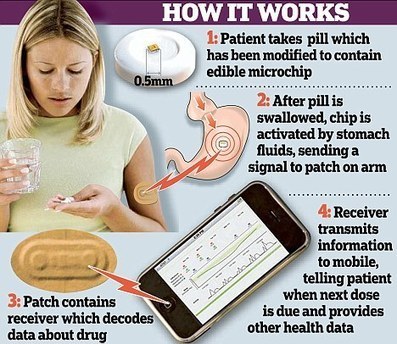
Ingestible sensors alert doctors and caregivers when a pill is taken

http://www.forbes.com/sites/nextavenue/2013/04/16/the-newest-high-tech-pill-will-text-when-swallowed/

Proteus Digital Health is creating a new category of products, services and data systems that have the potential to significantly improve the effectiveness of existing pharmaceutical treatments.  Called Digital Medicines, these new pharmaceuticals will contain a tiny sensor that can communicate, via a digital health feedback system, vital information about an individual’s medication-taking behavior and how their body is responding.

Categories
Brain Machine Learning

Brain scans link math learning abilities to brain structure

http://scopeblog.stanford.edu/2013/04/29/peering-into-the-brain-to-predict-kids-response-to-math-tutoring/

Researchers from the Stanford University School of Medicine used brain scans to look for a link between math-learning abilities and brain structure or function, and compared neural and cognitive predictors of childrens’ responses to tutoring.

The analysis of the children’s structural brain scans showed that larger gray matter volume in three brain structures predicted greater ability to benefit from math tutoring. The predictions were generated with a machine learning algorithm.

The researchers’ next steps will include comparing brain structure and wiring in children with and without math learning disabilities, analyzing how the wiring of the brain changes in response to tutoring, and examining whether lower-performing children’s brains can be exercised to help them learn math.

Categories
Brain

Babies’ consciousness, development studied

http://news.sciencemag.org/sciencenow/2013/04/when-does-your-baby-become-consc.html

Finding the point at which babies’ reactions change from being purely reflexive to reflecting more intention is leading researches to focus on the first glimmers of conscious thought in infants as young as 5 months old.

Ideally, the infant studies would enable scientists to trace a trajectory of how consciousness generates. “You can start to use this method very early to basically try to check whether there is normal or abnormal development,” says Sid Kouider, a researcher at the École Normale Supérieure in Paris.  “We know that autistic children can have trouble being aware of faces, and you could imagine this kind of method to diagnose early on whether someone is reacting in a normal way to objects or faces.”

Categories
AI Brain

Kurzweil envisions emotionally intelligent Google search

http://www.wired.com/business/2013/04/kurzweil-google-ai/

Kurzweil predicts that computers will be able to have a deep understanding of human emotion by 2029.  He wants to see search evolve to understand even more complex language that will involve “emotional intelligence, being funny, getting the joke, being sexy, being loving, understanding human emotion.”

Categories
Apps Monitoring Seniors

Google Glass for frail seniors

http://www.zdnet.com/old-age-is-the-killer-app-for-google-glass-7000014602/

Google Glass applications can benefit the aging population in many ways:

– Sensors can track a person’s gait, and identify mobility problems that signal a potential fall and broken bones. Early warning signs can trigger preventative treatments and healthcare providers could try stop a fall before it happens.

– Reminders for taking medication can be scheduled and double dosing prevented.

– For those suffering from dementia, the device could recognize family members and offer simple messages such as, “This is your son, his name is John. Say, “Hello John, how are my beautiful grandchildren?”

– Google Glass-type devices could enable family members to patch into what seniors are doing, even what they are seeing. If there were a problem, emergency aid would be on the way in seconds.

Categories
Diabetes Monitoring

A “bionic pancreas” for diabetes management

http://www.huffingtonpost.com/riva-greenberg/diabetes-clinical-trial_b_3110140.html

The bionic pancreas consists of three pieces of hardware. There’s an iPhone with an app that contains the system’s control software and algorithm and a continuous glucose monitor (CGM).

The CGM’s sensor/transmitter, worn under the skin, streams glucose (blood sugar) data to two connected infusion pumps. One delivers insulin to lower blood sugar and one delivers glucagon to raise it. Based on glucose levels transmitted every five minutes from the CGM, the app determines and dispatches how much insulin or glucagon should be delivered to maintain ideal blood sugar levels.

Categories
Monitoring

70% of doctors have self-tracking patients; better outcomes reported

http://www.fiercehealthit.com/story/physicians-report-self-tracking-popular-positive/2013-04-16

7 in 10 doctors report at least one patient sharing some form of health measurement data with them, according to Manhattan Research’s annual “Taking the Pulse” survey of 2,950 physicians.  Nearly three-quarters agreed that self-tracking leads to better outcomes.

Self-tracking patient impacts include:

  • 40% lead them to ask their doctors new questions
  • 46% changed their overall approach to their health
  • 34% affected decisions about how to best treat their conditions
Categories
mHealth Monitoring Sensors

Multi-use, wireless, wearable sensors

http://www.kth.se/en/aktuellt/nyheter/hudnara-elektronisk-doktor-ar-framtiden-1.382668

The Bio-patch, developed by researchers at KTH Royal Institute of Technology, measures bioelectrical signals through the skin, gathering data on different parts of the body depending on where it is placed.

“On the chest it provides electrocardiography (ECG), on the skull it measures brainwaves (EEG), and on the forearm it can measure muscle response to stimulation from the nervous system (EMG),” says KTH researcher Geng Yang.  It also has a built-in sensor that constantly monitors body temperature.