Categories
Diabetes Heart Sensors

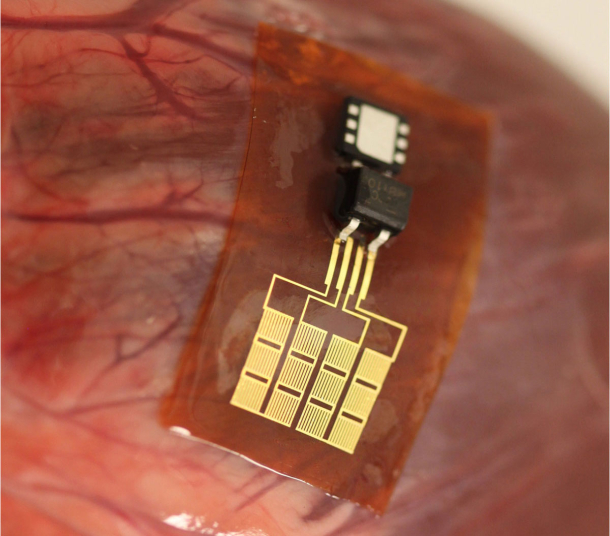
Piezoelectric nanoribbons power pacemakers

http://news.cnet.com/8301-11386_3-57617483-76/nanoribbons-let-beating-hearts-power-their-own-pacemakers/

Scientists are studying various steady energy source alternatives for small biomedical sensors, including piezoelectric power.

University of Illinois researchers have attached small, flexible strips (piezoelectric nanoribbons) to internal organs of animals, and harvested energy from their movement  to power pacemakers and other medical devices.  Current practice depends on hard-to-change batteries.

This is a minimally invasive power source, which in the future can be activated by muscle activity other than the heart muscle, with potential implications for glucose pumps and other devices.  The researchers claim that their system is a  “complete, flexible, and integrated system that is capable of harvesting and storing energy from the natural contractile and relaxation motions of the heart, lung, and diaphragm at levels that meet requirements for practical applications.”

Categories
Cancer mHealth Monitoring Sensors

Sensors detect radiation complications early, at home

http://www.ncbi.nlm.nih.gov/pubmed/24395986

Susan Peterson and colleagues at MD Anderson have completed a feasibility study showing that equipping head and neck cancer patients with home-based sensors can identify dehydration during radiation treatment.

Physicians reviewed patients’ information daily using CYCORE (CYberinfrastructure for COmparative Effectiveness REsearch), a software-based platform to collect and manage data from multiple systems through a suite of home-based and mobile sensors. They followed 48 patients during two five-day periods. Sensors were used to monitor daily weight and blood pressure fluctuations.  Patients also reported daily food and drink consumption, degree of pain with swallowing, and other side effects, using a smartphone.  60 percent of patients had at least one event that would suggest risk for dehydration and would warrant clinical intervention, and 35 percent had two or more events.

Categories
Assistive Technologies Robotics Sensors

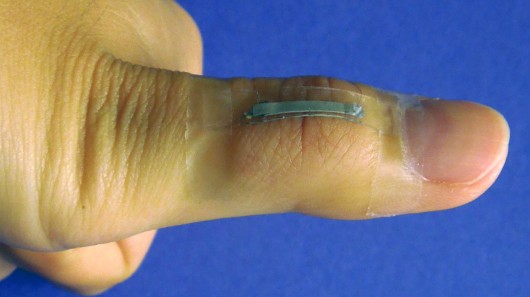
Wearable, multifunctional, silver nanowire sensor for prosthetics, robotics

http://pubs.rsc.org/en/Content/ArticleLanding/2014/NR/C3NR05496A#!divAbstract

North Carolina State University researchers have developed a thumb joint mounted, multifunctional sensor using silver nanowires that measures strain, pressure, human touch and bioelectronic signals.  With potential biomedical, military and athletic applications, the sensor can be used for prosthetics, robotic systems and flexible touch panels.

“The technology is based on either physical deformation or “fringing” electric field changes. The latter is very similar to the mechanism used in smartphone touch screens, but the sensors we’ve developed are stretchable and can be mounted on a variety of curvilinear surfaces such as human skin” according to NC State’s Shanshan Yao.

“These sensors could be used to help develop prosthetics that respond to a user’s movement and provide feedback when in use,” said Professor Yong Zhu. “They could also be used to create robotics that can ‘feel’ their environment, or the sensors could be incorporated into clothing to track motion or monitor an individual’s physical health.”

Categories
Diabetes mHealth Monitoring Sensors

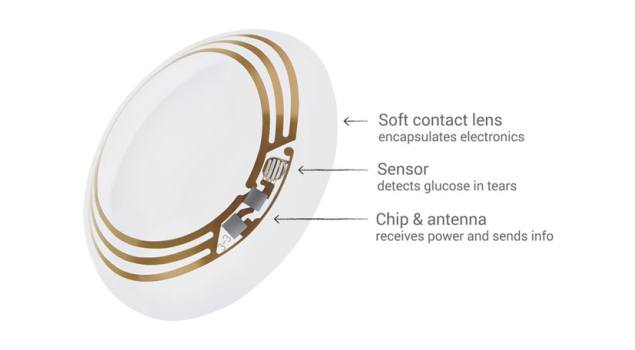
Smart contact lens prototype to monitor glucose

http://googleblog.blogspot.com/2014/01/introducing-our-smart-contact-lens.html

Google is testing a smart contact lens that’s built to measure glucose levels in tears.  It uses a tiny wireless chip and miniaturized glucose sensor embedded between two layers of soft contact lens material. The prototype can generate a reading once per second. They are investigating the potential of integrating tiny LED lights that could light up to indicate that glucose levels have crossed above or below thresholds.  Google says it is working with the FDA to turn the prototypes into products.

Categories
Eyes Sensors Wearables

Smart contact lens with potential to monitor intraocular pressure

http://www.nature.com/ncomms/2014/140107/ncomms3982/full/ncomms3982.html

Swiss Federal Institute of Technology scientists have developed a light, flexible, ultra-thin membrane with the potential to detect intraocular pressure in glaucoma.  Researchers claim that the technology “could offer significant advantages over existing solutions in terms of thickness, lightness, and transparency and, hence, comfort for the patient.”

The device consists of layered polymer films, one of which is a semiconductor. Gauge sensors monitor intraocular pressure in response to strain, which detects the high eye pressure typical of glaucoma.  In trials, the scientists transferred the material onto plastic contact lenses on an artificial eye.

The researchers must overcome technical obstacles before their solution is commercially viable. The method of attaching electronics to the contact lens must be optimized to include effects of the aqueous ocular environment.  Additionally, in the lab, the required energy is provided from an external source.  A different solution would be needed for a unit attached to a human eye.

Categories
Sensors Sleep

Nerve stimulation for sleep apnea

http://www.nejm.org/doi/full/10.1056/NEJMoa1308659

Current sleep apnea treatments are intrusive and uncomfortable. University of Pittsburgh Professor Patrick J. Strollo has developed a  “pulse generator” which, when surgically implanted, senses one’s effort to breath.  It then sends pulse stimulation to the hypoglossal nerve, controlling the neck muscles that keep the airway open, preventing collapse.

Standard treatment for sleep apnea is a device called a CPAP. It is a machine that applies air pressure through a mask, which, if worn while sleeping, keeps the airway open. Many people find the masks bulky and uncomfortable, choosing instead to leave their apnea untreated.

Categories
Babies Conference Sensors Sleep

Baby onesie tracks breathing, sleep, movement, temperature

http://mimobaby.com/

Sensor based baby monitoring is receiving a lot of exposure at CES.  One such monitor, by Mimo baby, includes three parts: the Kimono, the Turtle and the Lilypad station. The Kimono is a cotton onesie, with machine washable sensors, worn by a baby when sleeping. It houses the Turtle, which tracks a baby’s respiration, skin temperature, body position and activity levels. The Turtle conveys the information via Bluetooth to the base station, called Lilypad, in the baby’s sleep room. The Lilypad is connected to the home Wi-Fi network.  It processes the information and transmits it to a smartphone app.

Categories
Sensors

“Vapor nanobubble” laser scanner detects malaria through skin

http://www.pnas.org/content/early/2013/12/26/1316253111.abstract
Rice University researchers have developed noninvasive technology that accurately detects malaria through the skin in seconds with a laser scanner. The “vapor nanobubble” requires no dyes or diagnostic chemicals, and there is no need to draw blood.  In a recent study, the technology detected even a single malaria-infected cell among a million normal cells with zero false-positive readings.

The new diagnostic uses a low-powered laser that creates tiny vapor “nanobubbles” inside malaria-infected cells. The bursting bubbles have a unique acoustic signature that allows for an extremely sensitive diagnosis.

Categories
BCI Brain Sensors

Microscale torsional muscle system can simulate active neuromuscular system

http://newscenter.lbl.gov/news-releases/2013/12/19/a-micro-muscular-break-through/

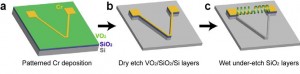
U.S. Department of Energy and Lawrence Berkeley National Laboratory researchers have developed a micro-sized robotic torsional muscle/motor made from vanadium dioxide. For its size, it is a thousand times more powerful than a human muscle, able to catapult objects 50 times heavier than itself over a distance five times its length within 60 milliseconds.

“Multiple micro-muscles can be assembled into a micro-robotic system that simulates an active neuromuscular system,” said Berkely professor Junqiao Wu.  “The naturally combined functions of proximity sensing and torsional motion allow the device to remotely detect a target and respond by reconfiguring itself to a different shape. This simulates living bodies where neurons sense and deliver stimuli to the muscles and the muscles provide motion.”

Categories
Assistive Technologies BCI Brain Sensors

Nerve impulse sensor exoskeleton assists paraplegics, Parkinson’s, stroke patients

http://www.dw.de/standing-again-with-nerve-controlled-robotics/a-17280419

Professor Thomas Schildhauer leads a team at Bergmannsheil University Clinic’s “Center for Neuro-Robotic Mobility Training”  that uses nerve impulse sensors to help patients walk again.  A robotic exoskeleton with sensors affixed to the hips and legs gives paraplegics, Parkinson’s and stroke patients a sense of stability during ambulatory exercises. The robot suit contains numerous sensors that recognize nerve impulses as they flash across the skin. Via a small motor, the suit converts those impulses into motion.

“The brain sends a signal out that typically arrives at the muscle via nerve systems,” said Schildhauer.  For patients capable of some movement, “Small impulses can still be discovered in the muscles. And they can be measured and recorded on the skin. That signal is then amplified in the robot and moves the motors of the exoskeleton.”

Such robot-supported training, Schildhauer says, “seems to build up and expand the remaining muscle functions, and the brain structures, too, that haven’t been used for a long time.” Movement patterns, he added, are then re-trained. “It seems to cause the patient to fall back into many of the old, usual cycles of movement, and results in them being able to walk again.”

Categories
Brain Sensors

Molecular sensor for early detection of Multiple Sclerosis

http://onlinelibrary.wiley.com/doi/10.1002/ana.24078/abstract

UCSF’s Gladstone Institute researchers have created a molecular sensor that can detect MS at its earliest stages — before the onset of physical signs. Professor Katerina Akassoglou’s study revealed in animal models that the heightened activity of a protein called thrombin in the brain could serve as an early indicator of MS. By developing a fluorescently labeled probe specifically designed to track thrombin, the team found that active thrombin could be detected at the earliest phases of MS, and that this active thrombin correlates with disease severity.

In laboratory experiments on mice modified to mimic the signs of MS, the team employed an Activatable Cell-Penetrating Peptide, a molecular probe that delivers fluorescent agents to a region of interest. For this study, they developed a thrombin-specific probe that could track thrombin activity in mice as the disease progressed. They then analyzed where, and at what stage of disease, thrombin activity was found.

“We detected heightened thrombin activity at specific disease ‘hot-spots,’ regions where neuronal damage developed over time,” said Gladstone scientist Dimitrios Davalos, “And when we compared these results to those of a separate, healthy control group of mice, we saw that thrombin activity in the control group was wholly absent.”

Categories
Cancer Sensors

Capsule endoscopy modification detects stomach cancer via “diagnostic pill”

http://www.inderscience.com/info/inarticle.php?artid=57925

Researchers at Chongqing University in China have developed an ingestible capsule capable of detecting chemical precursors of a gastric tumor. The findings might allow oncologists to catch the disease at a very early stage.  It is based on a modification of existing capsule endoscopy to detect occult bleeding  — tiny quantities of blood associated with the earliest stages of stomach cancer.

The diagnostic pill is encased in a non-toxic and acid-safe polycarbonate shell and carries its own power supply, transmitter, and a sensor with a detection limit of six micrograms per liter of fluid.