
Categories
Assistive Technologies BCI Sensors Wearables

Tongue based magnetic field controls wheelchair

http://stm.sciencemag.org/content/5/213/213ra166

Maysam Ghovanloo of Georgia Tech and Anne Laumann of Northwestern have developed a tongue piercing based magnet to operate a wheelchair.

The device is a small magnetic barbell which creates a magnetic field in the mouth. When users flick their tongues, it alters that field. The change is picked up by four small sensors on a headset with twin extensions curving around the cheeks, and relayed wirelessly to a smartphone, computer or iPod. The software translates the signals and sends them to a powered wheelchair or computer.

The system was tested on 11 tetraplegia patients from rehabilitation centers in Chicago and Atlanta and 23 able volunteers who already wore tongue jewelry.

After 30 minutes of training, everyone was able to move a computer cursor, clicking on targets on a laptop screen, playing video games and dialing phone numbers. Accuracy and speed improved with practice, even though subjects used the system only one day a week. After six weeks the tetraplegics were, on average, three times faster with the tongue system than with sip-and-puff, which six of the 11 had been using. It was equally accurate.

Using only tongue movements, the volunteers also navigated a powered wheelchair through a 50-meter-long course with 13 turns, 24 obstacles and occasional alarms signaling “Stop! Emergency!” Here, too, on average the 11 tetraplegics drove the course three times faster with the tongue system than with sip-and-puff, and just as accurately.

Categories
mHealth Monitoring Sensors Wearables

Sony’s “SmartWig” can monitor and transmit health data

US Patent Office

Sony has submitted a patent application for a health monitoring “SmartWig.”  It can include a GPS and camera placed near the forehead. Users can receive vibrating feedback on specific parts of their head.  A laser pointer and remote can be controlled by the head’s movement. An ultrasound transducer could transmit or receive ultrasound waves to detect surrounding objects, warning users if there are obstacles behind or above their heads.  A circuit board in the hair can talk to a second device wirelessly — such as a phone or pair of smartglasses.

Categories
Monitoring Seniors Sensors

NEC’s PaPeRo Petit robot uses third party apps to monitor seniors at home

http://jpn.nec.com/press/201311/20131111_01.html

NEC has introduced the PaPeRo Petit robot, which is about half the size of earlier PaPeRo senior companions, and a cloud computing system for services using the new robot.  PaPeRo Petit combines multiple sensors (cameras, ultrasonic range finders, temperature sensor, and microphones) to detect people and look in their direction even in complete darkness.  It can also link to online databases to better communicate with loved ones.  The robot can recognize faces and has between 80 to 90 percent success rate at speech recognition.

Categories
Brain Sensors

Smart foam measures football helmet impact

http://news.byu.edu/archive13-nov-helmetsmartfoam.aspx

Brigham Young University researchers have developed a “smart foam” helmet lining for immediate, real-time measurements of each hit that a football player endures. The measurements are communicated immediately to a hand-held device, telling coaches if a collision is capable of inducing a concussion, even if the player denies a problem.

“ExoNanoFoam” is a  nano-enabled foam that behaves as a piezoelectric in which pressure on the material produces an electrical voltage. A microcontroller sensor in the helmet reads the electrical voltage produced by the foam, and sends a signal to a tablet equipped with a program that interprets it and delivers real-time information on the seriousness of the hit sustained by the player.

As the foam is in contact with the player’s head, it provides a more accurate measurement of the forces on the player’s head than previously used accelerometers.  Accelemeters only measure the acceleration or deceleration of the player’s helmet.

Categories
Diabetes Monitoring Nanotubes Sensors

Implanted nanotube sensor monitors health for up to one year

http://web.mit.edu/newsoffice/2013/new-implantable-sensor-1103.html
MIT scientists are developing injectable and embeddable carbon nanotube sensors that can monitor blood sugar levels, inflammation, and other health issues.  The continuous monitor can stay in a person’s body for up to a year.

Researcher Nicole Iverson wrapped carbon nanotubes in DNA sensitive to nitric oxide and made two types of sensors.  One is injectable for short-term monitoring of problems such as a reaction during surgery.  The other is implanted for long-term monitoring of cancer, diabetes or immune reactions to artificial joints.

The next step will be to link the nanotube sensor to a medical device, such as an insulin pump. The sensor would be implanted under a person’s skin, detecting blood glucose levels. The nanotubes would fluoresce when exposed to certain levels of glucose, and the light could signal the pump to start working and release insulin.

Categories
Cancer Sensors

Breath sensor identifies lung cancer

Journal of Thoracic Oncology

Metabolic processes are different in those with and without lung cancer.   Cleveland Clinic researchers have developed a colorimetric sensor that analyzes breath to identify lung cancer and characterize cancer histology.  The sensor evaluates the activity of antioxidant pathways, the handling of energy stress, and the metabolism of specific volatile organic compounds.

The technology used included nanoporous matrix for chemically reactive colorants.  The study involved patients with biopsy-proven untreated lung cancer, patients with a high clinical suspicion for lung cancer, and control subjects.  Samples were obtained while subjects performed tidal breathing through a volatile organic compound filter. The end tidal carbon dioxide level triggered the collection of the alveolar portion of the breath. Data were log-transformed to provide color values. The entire dataset was then reduced using univariate logistic regression.  The sensor was optimized with samples from 288 subjects. Accuracy was then tested with samples from 236 patients.

Categories
Sensors

Light guiding hydrogel for cell based sensing

http://hms.harvard.edu/news/talking-light-10-22-13http://www.nature.com/nphoton//journal/vaop/ncurrent/abs/nphoton.2013.278.html

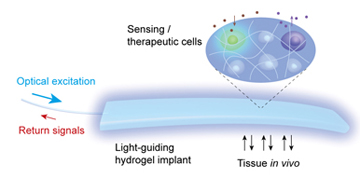
Harvard Medical School researchers have developed a way to deliver a light signal to specific tissues deep within the body.  Called a light-guiding hydrogel, the implant is constructed from a polymer-based scaffolding capable of supporting living cells. The hydrogel contains cells genetically engineered either to carry out a specific activity in response to light or to emit light in response to a particular metabolic signal. An optical fiber connects the implant to an external light source or light detector.

In one experiment, the scientists used programmed HeLa cells that were caused to emit a kind of protein when exposed to light. When that protein is produced in the body, the pancreas creates more insulin. A means of controlling diabetes was shown. In another experiment, the researchers filled the hydrogel with cells that light up when exposed to a certain toxin, then after implanting the hydrogel, injected mice with the toxin. Using the fiber cable in reverse, the researchers were able to see the cells in the hydrogel lighting up in response to the presence of the toxin

Categories
Parkinson's Sensors

Gait sensor for Parkinson’s patients could prevent falls

http://www.scientificamerican.com/article.cfm?id=could-a-simple-ankle-sensor-help-with-parkinsons-symptoms

University of Alabama professor Emil Jovanov is developing a sensory cue device to detect freezing of gait episodes that lead to falls and serious injuries.  It uses sensors embedded in a shoe or attached to the ankle. As soon as the system senses a gait freeze, it transmits an auditory cue (such as the word “walk”) to an earpiece, prompting the patient to keep moving.

Categories
fitness mHealth Monitoring Sensors Wearables

Printable, multi-touch sensors consumers can cut with scissors

http://embodied.mpi-inf.mpg.de/files/2012/11/ACuttableMultiTouchSensor.pdf

Max Planck Institute researchers and the MIT Media Lab have developed printable, multi-touch sensors that are printed with e-ink and can be cut with scissors.  A new circuit layout makes it robust against cuts, damage, and removed areas.  By customizing and pasting such a sensor, one can make every surface interactive, including the wristband of a watch, a fabric or an object.  This implies many digital health and fitness applications.

The scientists use “printed electronics” – electrical components and devices which are printed. The approach is similar to that of inkjet printers. Instead of printing with normal ink, electrically-functional electronic ink is printed on flexible, thin films called substrates.

In the circuit layout, the wires run horizontally, vertically, and parallel to each other. At the intersection of one parallel and one horizontal layer are the touch-sensitive electrodes. Via the wires they are connected to a controller. This type of layout requires only a minimal number of wires, but is not robust. Since each wire addresses several electrodes, a small cut has a huge effect: many electrodes become unusable and possibly large sensor areas do not work anymore. “It was not easy to find an alternative layout, robust enough for our approach” said lead developer Simon Olberding. They took their inspiration from nature, looking at the human nerve system and fungal root networks, and thus came up with two basic layouts. The “star topology” has the controller in the center. It is connected to every electrode separately. The “tree topology” also has the controller in its center connected to each electrode separately. But the wires are bundled similarly to a tree structure. They all run through a vertical line in the middle and then branch off to reach their electrodes.

The scientists found out that the star topology supports  basic forms like triangles, rectangles, or ovals best. It is suited for shapes commonly used for crafts, like stars, clouds, or hearts. In contrast, with the tree topology it is possible to cut out whole areas. The researchers were also able to combine both layouts in a space-saving way, so that the sensor supports all basic forms.
Categories
Assistive Technologies BCI Brain Sensors

Mind controlled bionic leg

http://www.nejm.org/doi/full/10.1056/NEJMoa1300126

A robotic control system for a prosthetic leg allowed a 31-year-old man to walk and climb stairs with a nearly normal gait. The system links nerves in the thigh — including some for missing muscles in the lower limb — to a processor that decodes the signals and guides the motion of the prosthesis, according to Levi Hargrove of the Rehabilitation Institute of Chicago.

The prosthetic limb includes thirteen mechanical sensors and can be used — like many commercially available prostheses — by changing its settings with a wireless key fob. Combining electromyographic signals from the residual limb and the sensor data eliminated the need to change settings with an external device and produced unique stride patterns for each type of ambulation, such as walking on a ramp and climbing stairs.  Adding the data from the nerves to the information from the sensors reduced the error rate — misclassification by the control system of the patient’s intended movement — from 12.9% to 1.8% of all motions.

Categories
Sensors

Miniature, lab-engineered “organs” create “body on a chip”

http://www.bbc.co.uk/news/technology-24125678

The US Department of Defense and Wake Forest University are developing miniature human organs with 3D printers to enable better drug testing.

The 2-inch “body on a chip” would be a testing ground for understanding how the human body might react to dangerous diseases, chemical warfare agents and new drugs intended to defend against biological or chemical attacks. This could speed drug development by replacing less ideal animal testing or testing done on human cells in petri dishes — and save time and money on drug candidates that fail in human clinical trials.

Tony Atala, director of the Wake Forest Institute for Regenerative Medicine, has pioneered 3D printing methods that aim to build human organs with layer upon layer of cells. Their bioprinting methods lay down the cell layers along with artificial scaffolding to keep an organ’s structure intact as it takes shape — a technique that has allowed the group to make tiny, less complex versions of full-size human organs.

The tiny organs intended for the “body on a chip” project don’t represent fully functional hearts, livers and kidneys. Instead, they represent small chunks of human tissue from such organs connected together by a system of fluid channels that circulate blood substitute to keep the cells alive — all placed on a 2-inch chip with sensors to monitor everything.

Having an artificial circulatory system means researchers can introduce biological or chemical agents into the “blood” to see how it affects the different organs. The system’s sensors would measure the temperature, oxygen levels, pH and other factors affecting the “body on a chip.”

Categories
mHealth Monitoring Seniors Sensors

Ambient Assisted Living system monitors senior health at home

http://www.theengineer.co.uk/medical-and-healthcare/news/wireless-system-provides-ambient-health-monitoring-of-elderly/1017120.article

One outcome of the EU’s support of Ambiant Assistant Living is the following multi-bio-marker home monitoring device which continuously monitors glucose, cholesterol and blood oxygen levels.  It is expected that several similar monitors will be introduced in the near future, enabling seniors to better manage various diseases at home.

Fraunhofer FIT has developed an AAL system using miniature sensors integrated into one platform.  A nano potentiostat measures biochemical information in a patient’s assay, including glucose, lactate and cholesterol levels. A fluorescence sensor is used to detect color-marked biomarkers. An SpO2 sensor monitors heart rate and arterial oxygen saturation. A smartphone app processes the data from the three sensors and transfers them to a server. For secure data communication, a Bluetooth connection with a specifically developed protocol is used.