
Categories
Heart Sensors Wearables

ECG wristband sensors use your heartbeat as your password

http://www.getnymi.com

The Nymi wristband confirms a user’s identity via electrocardiogram sensors that monitor the heartbeat and can authenticate a range of devices, from iPads to cars. Developers at Bionym, the Toronto-based company that makes the device, say the peeks and valleys of an individual’s heartbeat are harder to imitate than the external features of biometric systems, like fingerprints or facial recognition.  Bionym describes the process:

“When you clasp the Nymi around your wrist it powers on. By placing a finger on the topside sensor while your wrist is in contact with the bottom sensor, you complete an electrical circuit. After you feel a vibration and see the LEDs illuminate, your Nymi knows you are you and your devices will too. You will stay authenticated until your Nymi is taken off.”

Categories
Babies Monitoring Respiratory Sensors Sleep Wearables

Crowdfunded “smart sock” monitors baby’s breathing

http://www.owletcare.com

Owlet Baby Monitors has created a baby “smart sock” with sensors that transmit a child’s heart rate, oxygen levels, skin temperature, sleep quality, and sleep position (rollover alerts) to a parent’s smartphone.  The company has launched a crowdfunding campaign as it goes through the FDA approval process.

Categories
Apps mHealth Monitoring Sensors

Crowdfunded breast exam sensor and software

http://eclipsebreasthealth.com

Eclipse Breast Health Technologies has launched a crowdfunding campaign to test and eventually bring to market a wireless sensor meant to aid in the early detection of breast cancer and the tracking of patients being treated for the disease.  The campaign is meant to support the company as it goes through the FDA approval process.  With the simplicity of the home self-check, and  the potential vast amount of data that the company can gather on its servers, this is a potentially disruptive clinical tool.  Clearly those cases where the device did not detect cancer when it should have will make or break this product.

The system consists of a handheld imaging device paired with imaging software that tracks changes in breast density over time, and also incorporates an element of social networking. Eclipse says the device, which uses what the company calls “transphotonic” technology – combining low-energy photons and light sensors, without the need for radiation – is as much as five times as sensitive as the human hand.

The imaging device links wirelessly or by USB to a PC, smartphone or tablet, where a Web application creates a visual representation of the self-exam and helps quantify observations. Data is uploaded to patient accounts on a platform that calls Pink Cloud. From there, women can compare readings over time, share the information with their physicians or connect with others on Pink Cloud, which incorporates a social network of Eclipse users.

Categories
AI Apps Assistive Technologies Brain mHealth Monitoring Seniors Sensors

Personalized robot companion for seniors

http://cordis.europa.eu/fetch?CALLER=OFFR_TM_EN&ACTION=D&RCN=11525

A European consortium of research institutes, universities and technology companies has developed a highly customizable robot companion to help seniors to maintain their quality of life, stay healthy and avoid social exclusion.

The robot, a mobile wheeled semi-humanoid figure equipped with cameras, sensors, audio, and a touch screen interface, can remind users to take their medicine, suggest they have their favorite drink, or prompt them to go for a walk or visit friends if they haven’t been out for a while. As part of a larger smart-home environment that can include smart clothing to monitor vital signs, the system can monitor user’s health and safety, and alert emergency services if necessary.

Categories
Apps Data Heart mHealth Monitoring Sensors

Elfi-Tech – non-invasive sensor captures more meaningful health data

http://elfi-tech.com

Elfi-Tech of Israel, led by Dr. Ilya Fine,  has disrupted digital healthcare.  They are the only Israeli finalist in the Nokia XCHALLENGE competition, which “envisions a future of access to affordable, personalized healthcare through sophisticated sensing technologies”.  The company has developed a sensor that is more suitable as a continuous monitor with minimal discomfort. This is due to lower power consumption of the laser technology and less of a need to be very tightly secured to skin. Perhaps its most exciting feature is the non invasive measurement of many blood flow parameters, providing a more complete cardiac perspective at home.

Categories
Brain Sensors

Non-invasive intracranial pressure monitor receives NSF funding

http://www.3-e-d.com

The National Science Foundation is supporting Third Eye Diagnostics of Philadelphia as it develops a non-invasive, handheld intracranial pressure monitor to rapidly diagnose brain injury.

Cerepress simultaneously records images of the CRV and measures intraocular pressure while pressure in the eye is increased. A medical technician aligns the system by centering the field of view to patient’s pupil. The system then contacts the patient’s cornea and simultaneously collects images of the cornea and the retinal fundus. The contact force increases the IOP and momentarily compresses the CRV. When CRV compression is complete, the Cerepress records the eye pressure, which is equivalent to CRV pressure. CRV pressure is a known to be a good correlate to ICP.  Data shows that the combination of CRVP and the pulsatility index produces a correlation with better accuracy than using CRV pressure alone. To determine the pulsatility index, a medical technician uses an optimized Doppler ultrasound probe to obtain blood velocities in the ophthalmic artery.


Categories
Apps Data fitness mHealth Monitoring Sensors Sleep Wearables

Home medical device data uploaded to EHRs; patient participation encourages behavior modification

http://www.bostonglobe.com/lifestyle/health-wellness/2013/07/28/century-house-call/tdupWvOQI6b3dKdKcEgdGM/story.html
Boston’s Partners HealthCare has launched a system that allows patients to upload information from their medical devices directly to their electronic records in doctors’ offices.  Patients can regularly use glucometers, blood pressure cuffs, bathroom scales, and pulse oximeters at home, and send the data to their doctors.  Doctors are also becoming increasingly interested in eating habit, movement, and sleep data collected by patients using consumer health-tracking devices.

A recent study by the company showed a significant decrease in diastolic blood pressure among participants who both took their readings and uploaded them to a web interface where they could track and monitor their progress.

Categories
Machine Learning mHealth Monitoring Sensors

Tooth sensor monitors health

http://mll.csie.ntu.edu.tw/papers/TeethProbeISWC.pdf
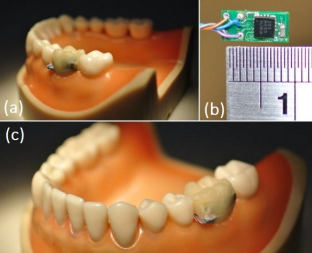
National Taiwan University researchers have created a tooth-based sensor, accelerometer, and associated machine learning software to detect and distinguish between chewing, smoking, coughing, or speaking.  The capability to monitor mouth motions may help physicians keep track of patient progress or allow a patient to better understand his/her health habits.  Working prototypes of the tooth sensor used wires to connect to a power source and a data-logging device.  Inventor Hao-hua Chu and colleagues envision the tooth sensor eventually being powered by a micro-battery and transmitting data wirelessly via Bluetooth to a smartphone. They also hope to embed the device inside artificial teeth that can be easily removed and customized for each individual.

It likely that the same technology could be used to monitor infection level in wound healing in the form of an adhesive sensor.

Categories
Apps Crowdfunding mHealth Monitoring Sensors

uChek crowdfunds smartphone urine analysis system

http://uchek.in

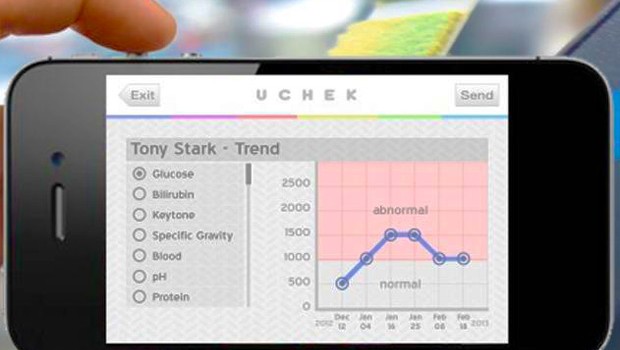
Biosense’s uChek is crowdfunding its urine analysis system.  It is a free app for iPhone users that can interpret color changes on urine analysis test strips with a smartphone camera. uChek can be used for semi-quantitative and qualitative detection of leukocytes, ketone, nitrite, urobilinogen, bilirubin, protein, specific gravity and pH. Test results may provide information regarding the status of carbohydrate metabolism, kidney and liver function, acidbase balance and bacteriuria.

Categories
Sensors

Non-invasive muscle oxygen saturation and pH monitor

http://www.reflectancemedical.com/Products.html

Reflectance Medical has received FDA clearance a non-invasive device that provides real-time measurement of hemoglobin oxygen saturation (SmO2) and pH (pHm) within muscle below the sensor.  Currently, acidosis is assessed with repeated blood sampling and laboratory analysis to determine pH. Mobile CareGuide 3100 is expected to reduce serial blood sampling and provide clinicians with real-time pHm measurements, to help promptly reverse acidosis

Categories
Sensors Wearables

Berkeley researchers develop touch responsive “e-skin”

http://newscenter.berkeley.edu/2013/07/21/first-interactive-e-skin-built-on-plastic/

Berkeley professor Ali Javey has developed a user-interactive sensor network on flexible plastic. The “e-skin” lights in response to touch, emitting a brighter light as pressure intensifies.  Javey’s lab is now engineering the sensor to also respond to temperature and light.

Categories
fitness Monitoring Sensors

Biosensor tattoo monitors physical exertion

http://www.jacobsschool.ucsd.edu/news/news_releases/release.sfe?id=1353

Temporary tattoos are emerging as a preferred way to monitor health.  Researchers at the University of California, San Diego have developed a sensor that monitors chemicals in the wearer’s sweat to gauge physical exertion. The temporary electrochemical tattoo relies on a carbon fiber backbone so that it bends with the skin during normal activity without loss of functionality, and a conductive polymer that is sensitive to pH-levels in sweat. The sensor is screen-printed onto the flexible adhesive. The tattoo is noninvasive and the results are immediate.