Categories
Apps Data Monitoring Wearables

Health tracking sensors embedded in commonly used items

http://teddytheguardian.com/fp-sections/about/

Health tracking technology is becoming increasingly accessible and aesthetically pleasing. Examples include Teddy the Guardian, a cute teddy bear used to monitor children’s health.  It measures a child’s heart rate, blood pressure, oxygen saturation, and body temperature, and sends the data using wireless technologies to a paqrent’s smartphone.  Miniature and advanced sensors will continue to enable product designers to discreetly incorporate vital sign sensing technology into commonly used objects.  We look forward to more developments in this fast-growing segment of the continuous monitoring industry.

Categories
Conference

Piezo-Phototronic LEDs may help robots feel

http://www.nature.com/nphoton/journal/vaop/ncurrent/full/nphoton.2013.191.html

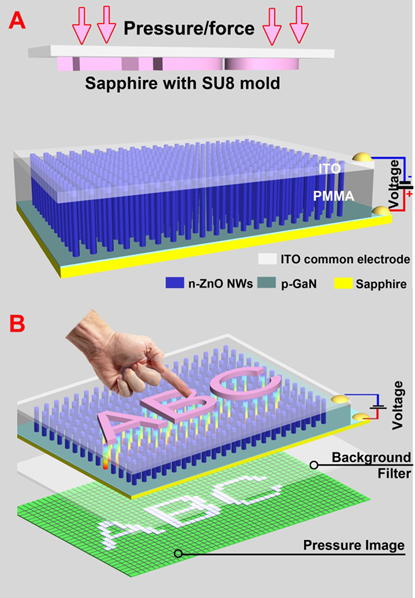
In a related development to Berkeley’s touch responsive e skin, Georgia Tech Professor Zhong Lin Wang  has proposed a new “piezo-phototronic” approach to the human-machine interface.  Zinc-oxide nanowires serve as tiny LEDs which have an emission intensity dependent on the local strain put on them.  The nanowire array could act as artificial skin for robots to give them human-like touch sensitivity.  Additional uses include inkless fingerprint scanners, biological imaging, or performance enhancement of micro-electro-mechanical systems.  ApplySci hopes that this technology will find its way into body tactile sensors in the near future.

Categories
Apps Conference Crowdfunding Data fitness Monitoring Wearables

Angel Health Monitor – Open platform, wearable vital sign sensors

http://www.angelsensor.com/index.html

The Angel Health Monitor is an open platform and SDK that senses motion and acceleration, skin temperature, blood oxygen saturation, and heart rate.  It was created by Eugene Jorov in Israel and will launch a crowdfunding campaign soon.  Developers will be able to use Angel to create apps for iPhone, Android, and other devices that support Bluetooth 4.0. Their SDK, drivers and app templates will be released as open source.

Categories
Brain Sensors

Non-invasive intracranial pressure monitor receives NSF funding

http://www.3-e-d.com

The National Science Foundation is supporting Third Eye Diagnostics of Philadelphia as it develops a non-invasive, handheld intracranial pressure monitor to rapidly diagnose brain injury.

Cerepress simultaneously records images of the CRV and measures intraocular pressure while pressure in the eye is increased. A medical technician aligns the system by centering the field of view to patient’s pupil. The system then contacts the patient’s cornea and simultaneously collects images of the cornea and the retinal fundus. The contact force increases the IOP and momentarily compresses the CRV. When CRV compression is complete, the Cerepress records the eye pressure, which is equivalent to CRV pressure. CRV pressure is a known to be a good correlate to ICP.  Data shows that the combination of CRVP and the pulsatility index produces a correlation with better accuracy than using CRV pressure alone. To determine the pulsatility index, a medical technician uses an optimized Doppler ultrasound probe to obtain blood velocities in the ophthalmic artery.


Categories
Conference

Brain-like computing from IBM

http://www-03.ibm.com/press/us/en/pressrelease/41710.wss

IBM is planning a a brain-inspired model for a new generation of highly-interconnected, asynchronous, parallel and large-scale computing systems based around the concept of cognitive computing.  It is an ecosystem designed for programming neurosynaptic chips that have an architecture inspired by the function, low power, and compact volume of the brain

Cognitive computing systems can be trained with artificial intelligence and machine-learning algorithms.  IBM Research says this sort of technology allows for the creation of “applications that mimic the brain’s abilities for perception, action, and cognition.”

IBM’s long-term goal is to build a chip system with ten billion neurons and a hundred trillion synapses, while consuming one kilowatt of power and occupying less than two liters of volume.

Categories
Brain Cancer

Real-time MRI guided gene therapy for brain cancer

http://health.ucsd.edu/news/releases/Pages/2013-08-06-MRI-guided-gene-therapy-for-brain-cancer.aspx

Neurosurgeons at the University of California San Diego School and Moores Cancer Center utilize MRI navigational technology to guide the delivery of investigational gene therapy Toca 511, or vocimagene amiretrorepvec, precisely into a brain malignancy in an attempt to make it more susceptible to chemotherapy.

Categories
Conference

Sensor based continuous monitoring helps doctors individualize treatment

http://www.theengineer.co.uk/medical-and-healthcare/in-depth/tailored-treatments-sensors-for-personalised-medicine/1016865.article

Doctors are still dependant on single point-in-time measurements of factors such as blood glucose and hormone levels, which do not show how these factors dip or rise into danger zones over the course of a day.   Similarly, monitoring heart rates over time in a hospital does not always show the physical responses caused by everyday stresses.

Sensors for continuous monitoring are being fine-tuned, giving doctors ongoing insight into a patient in order to track the spread of disease, monitor their exposure to environmental factors and assess their mental health and fertility, providing a complete picture of their health. This data can also be compared to the biomarkers within a person’s DNA that suggest how – or whether – their body will respond to particular compounds and metabolize certain drugs.
The UK’s Oxehealth system monitors respiratory rate, pulse rate and oxygen saturation by measuring light reflected from a person’s face using a webcam.  It uses novel algorithms that remove the effects of ambient light interference, allowing the technology to be used in everyday settings. Other algorithms are used to process the image recorded with the webcam and extract heart rate, respiratory rate and oxygen saturation.

Categories
Conference

Computer model reprograms cells

http://onlinelibrary.wiley.com/doi/10.1002/stem.1473/abstract

Professor Antonio del Sol of the Luxembourg Centre for Systems Biomedicine has developed a model that makes predictions from which differentiated cells, such as skin cells, can be very changed into completely different cell types, such as nerve cells.  Embryonic stem cells are not used.  Researcher Issac Crespo describes the process: “Our theoretical model first queries databases where vast amounts of information on gene actions and their effects are stored and then identifies the genes that maintain the stability of differentiated cells. Working from the appropriate records, the model suggests which genes in the starting cells need to be switched on and off again, and when, in order to change them into a different cell type.”

Categories
BCI Brain Wearables

Transcranial direct current stimulation headset receives FCC approval

http://www.extremetech.com/extreme/162581-foc-us-the-first-commercial-tdcs-headset-that-lets-you-safely-overclock-your-brain

The Foc.us headset is an early player in the wave of non-invasive devices that will enable improved brain function.  It passes direct current between the cathode and anode, which are placed over the prefrontal cortex, making neurons more excitable.  This helps them to fire more quickly, improving reaction time. When the currents are removed, neurons have additional plasticity.

Early studies have shown that tDCS, which can be used to stimulate regions of the brain other than the prefrontal cortex, such as the motor cortex, can provide therapeutic effects to Parkinson’s and stroke patients.  DARPA has used tDCS to improve the training of snipers, and it has also been used to improve gamer performance.

Categories
Apps Data fitness mHealth Monitoring Sensors Sleep Wearables

Home medical device data uploaded to EHRs; patient participation encourages behavior modification

http://www.bostonglobe.com/lifestyle/health-wellness/2013/07/28/century-house-call/tdupWvOQI6b3dKdKcEgdGM/story.html

Boston’s Partners HealthCare has launched a system that allows patients to upload information from their medical devices directly to their electronic records in doctors’ offices.  Patients can regularly use glucometers, blood pressure cuffs, bathroom scales, and pulse oximeters at home, and send the data to their doctors.  Doctors are also becoming increasingly interested in eating habit, movement, and sleep data collected by patients using consumer health-tracking devices.

A recent study by the company showed a significant decrease in diastolic blood pressure among participants who both took their readings and uploaded them to a web interface where they could track and monitor their progress.

Categories
Data Eyes mHealth Monitoring Wearables

Contact lens continuously monitors intra-ocular pressure

http://www.sensimed.ch/en/products/sensimed-triggerfishr.html

The Sensimed Triggerfish combines a non-invasive wireless soft contact lens sensor with an automated system for recording IOP related patterns for up to 24 hours. The ambulatory patient wears the device during normal activity, including sleeping.  At the end of the session, the data is transferred from the recorder to an ophthalmologist’s computer for analysis of the circadian IOP-related pattern.

Categories
Assistive Technologies Computer Vision Eyes

Tiny wearable computer uses audio feedback to assist the vision impaired

http://www.orcam.com

OrCam, led by Hebrew University Professor Amnon Shashua, one the most exciting computer vision entrepreneurs in Israel, has developed a device that uses audio feedback to relay visual information to visually impaired people.   The tiny wearable computer works with a 5-mega pixel camera attached to glasses.   A computer vision algorithm enables it to read text, and it can be taught to recognize faces and objects with the help of the user.