
Categories
Conference

“Artificial nose” speeds sepsis diagnosis

http://phys.org/news/2013-09-artificial-nose-device-diagnosis-sepsis.html

Researchers at the National University of Kaohsiung in Taiwan and the University of Illinois have developed an “artificial nose” capable of detecting the odor of germs that lead to blood poisoning.  Within 24 hours it determines whether a patient’s blood has bacteria that cause sepsis, a gain of up to two days over conventional methods.

The “nose” is a palm-sized plastic bottle filled with a liquid nutrient that helps bacteria to grow.  Attached to the inside of the bottle is a small array of chemical dots that change color in reaction to the odors released by the bacteria. The device can identify eight of the most common disease causing bacteria.

Other work in an “artificial nose” has yielded prototypes that can detect forms of cancer in a patient’s breath, and the presence of certain kinds of explosives.

Categories
BCI Brain Conference

Human-to-human brain interface – UW researcher controls colleague’s movement

http://www.washington.edu/news/2013/08/27/researcher-controls-colleagues-motions-in-1st-human-brain-to-brain-interface/

University of Washington researchers have performed what they believe is the first noninvasive human-to-human brain interface, with one researcher able to send a brain signal via the Internet to control the hand motions of a fellow researcher.

Using electrical brain recordings and a form of magnetic stimulation, Rajesh Rao sent a brain signal to Andrea Stocco on the other side of the UW campus, causing Stocco’s finger to move on a keyboard.

While researchers at Duke University have demonstrated brain-to-brain communication between two rats, and Harvard researchers have demonstrated it between a human and a rat, Rao and Stocco believe this is the first demonstration of human-to-human brain interfacing.

Magnetic stimulation as a direct brain communication channel is very intriguing.

Categories
Cancer Conference

Eliminating sugar slows cancer growth

http://www.scotsman.com/news/health/cutting-off-sugar-could-stop-cancer-growth-1-3024411
Old but important news: Eliminating sugar can slow cancer growth.

Researchers were aware that all cancer cells are attracted to sugar, grabbing it from the blood before using it to fuel their growth.  In breast cancer the process involves binding proteins called CtBPs together to form pairs known as dimers. These in turn help the cells to multiply and proliferate.  Dr Jeremy Blaydes of the University of Southampton found that chemicals called cyclic peptide inhibitors can block CtBPs and prevent the dimers forming.  The most successful of CtBP blocker, known as CP61, is now being developed as a potential new breast cancer drug.

This concept was put forth in the lecture given by Otto Warburg at his Nobel ceremony in 1931.  The short story: cancerous cells rely more on sugar for their energy consumption than normal cells.

In related news, a new technique for detecting cancer by imaging the consumption of sugar with MRI  has been unveiled by University College London scientists.

Categories
Conference

Piezo-Phototronic LEDs may help robots feel

http://www.nature.com/nphoton/journal/vaop/ncurrent/full/nphoton.2013.191.html

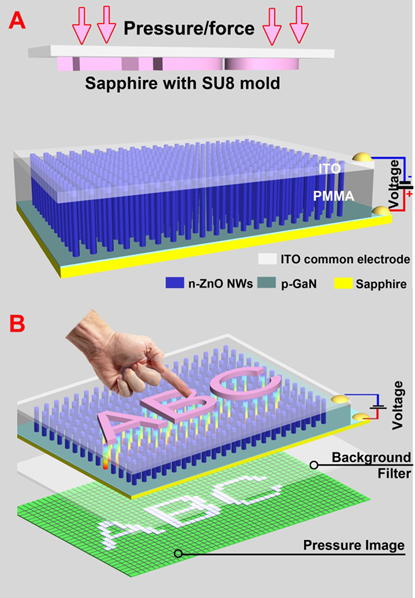
In a related development to Berkeley’s touch responsive e skin, Georgia Tech Professor Zhong Lin Wang  has proposed a new “piezo-phototronic” approach to the human-machine interface.  Zinc-oxide nanowires serve as tiny LEDs which have an emission intensity dependent on the local strain put on them.  The nanowire array could act as artificial skin for robots to give them human-like touch sensitivity.  Additional uses include inkless fingerprint scanners, biological imaging, or performance enhancement of micro-electro-mechanical systems.  ApplySci hopes that this technology will find its way into body tactile sensors in the near future.

Categories
Apps Conference Crowdfunding Data fitness Monitoring Wearables

Angel Health Monitor – Open platform, wearable vital sign sensors

http://www.angelsensor.com/index.html

The Angel Health Monitor is an open platform and SDK that senses motion and acceleration, skin temperature, blood oxygen saturation, and heart rate.  It was created by Eugene Jorov in Israel and will launch a crowdfunding campaign soon.  Developers will be able to use Angel to create apps for iPhone, Android, and other devices that support Bluetooth 4.0. Their SDK, drivers and app templates will be released as open source.

Categories
Conference

Brain-like computing from IBM

http://www-03.ibm.com/press/us/en/pressrelease/41710.wss

IBM is planning a a brain-inspired model for a new generation of highly-interconnected, asynchronous, parallel and large-scale computing systems based around the concept of cognitive computing.  It is an ecosystem designed for programming neurosynaptic chips that have an architecture inspired by the function, low power, and compact volume of the brain

Cognitive computing systems can be trained with artificial intelligence and machine-learning algorithms.  IBM Research says this sort of technology allows for the creation of “applications that mimic the brain’s abilities for perception, action, and cognition.”

IBM’s long-term goal is to build a chip system with ten billion neurons and a hundred trillion synapses, while consuming one kilowatt of power and occupying less than two liters of volume.

Categories
Conference

Sensor based continuous monitoring helps doctors individualize treatment

http://www.theengineer.co.uk/medical-and-healthcare/in-depth/tailored-treatments-sensors-for-personalised-medicine/1016865.article

Doctors are still dependant on single point-in-time measurements of factors such as blood glucose and hormone levels, which do not show how these factors dip or rise into danger zones over the course of a day.   Similarly, monitoring heart rates over time in a hospital does not always show the physical responses caused by everyday stresses.

Sensors for continuous monitoring are being fine-tuned, giving doctors ongoing insight into a patient in order to track the spread of disease, monitor their exposure to environmental factors and assess their mental health and fertility, providing a complete picture of their health. This data can also be compared to the biomarkers within a person’s DNA that suggest how – or whether – their body will respond to particular compounds and metabolize certain drugs.
The UK’s Oxehealth system monitors respiratory rate, pulse rate and oxygen saturation by measuring light reflected from a person’s face using a webcam.  It uses novel algorithms that remove the effects of ambient light interference, allowing the technology to be used in everyday settings. Other algorithms are used to process the image recorded with the webcam and extract heart rate, respiratory rate and oxygen saturation.
Categories
Conference

Computer model reprograms cells

http://onlinelibrary.wiley.com/doi/10.1002/stem.1473/abstract

Professor Antonio del Sol of the Luxembourg Centre for Systems Biomedicine has developed a model that makes predictions from which differentiated cells, such as skin cells, can be very changed into completely different cell types, such as nerve cells.  Embryonic stem cells are not used.  Researcher Issac Crespo describes the process: “Our theoretical model first queries databases where vast amounts of information on gene actions and their effects are stored and then identifies the genes that maintain the stability of differentiated cells. Working from the appropriate records, the model suggests which genes in the starting cells need to be switched on and off again, and when, in order to change them into a different cell type.”

Categories
Conference

Insulin pump detects overnight hypoglycemia, shuts off automatically

http://www.bloomberg.com/news/2013-06-22/medtronic-insulin-pump-cuts-deadly-night-blood-sugar-lows.html

Medtronic has designed an insulin pump that temporarily shuts off when blood sugar levels fall too low—a key advance in the effort to fully automate the delivery of insulin in diabetes patients.  Current technology allows people who use insulin pumps to wear a sensor that measures the amount of blood sugar in the body, which helps them program pumps to deliver the appropriate amount of insulin. Researchers have been trying to link the two technologies in order to automate insulin delivery, to create what has been referred to as an artificial pancreas.


Categories
Conference

Artificial spleen-on-a-chip to treat sepsis

http://wyss.harvard.edu/viewpressrelease/108/

Harvard researchers are developing a device that could be used to rapidly remove pathogens from the blood of patients with sepsis.  The dialysis-like machine acts as an artificial spleen, filtering the blood using injectable magnetic nanobeads engineered to stick to microorganisms and toxins.  After the beads are injected, blood is removed and run through a device that uses a magnetic-field gradient to extract the nanobead-bound germs. The blood is then returned to the body.  The team at the Wyss Institute for Biologically Inspired Engineering hopes that the device will be able to identify the specific microorganism causing the patient’s blood infection.  This could help physicians more quickly determine the most effective antibiotic treatment.

Categories
Conference Monitoring Sensors

Bio-integrated electronic tattoo measures vital signs and muscle movement

http://www.utexas.edu/know/2013/06/07/high-tech-tattoos-health-care-solutions/

Professor Nanshu Lu at The University of Texas is developing the next-generation of flexible/stretchable electronics, photonics and therapeutics.  Pioneered by John Rogers at the University of Illionois, flexible skin “tattoos” measure vital signs and muscle movement, transmitting data wirelessly and harvesting solar energy. Future versions may play critical roles inside the body in watching for signs of disease or damage, or treating problems automatically.

Professor Lu has designed a bio-integrated electronic tattoo. The ultrathin, ultrasoft stamp-sized patch clings to the human skin without adhesive, which would interrupt electrical connectivity.  Lu’s area of expertise — the interface of flexible electronics with biosystems — is one of three areas crucial to the future of bio-integrated electronics, the others being wireless data transmission and wireless power transmission.

Categories
Conference

Wireless, dissolvable circuits could kill bacteria

http://www.bbc.com/future/story/20130524-zapping-bacteria-the-wireless-way

Professor John Rogers of the University of Illinois has created bio-absorbable electronic circuits which could be implanted into wounds and powered wirelessly to destroy bacteria during healing before dissolving harmlessly into body fluids once their job is done.  Rogers and others have previously reported biodegradable flexible circuits and electronic devices that can be safely laid directly onto skin. But their success in making their circuits wireless could prove crucial to many potential applications, especially in medicine.